Transcribing some of my favourite short, self-contained chord sequences, spanning jazz, soul, disco, hip-hop, & more: great for quick-access vocabulary, jam session inspiration, creative harmonic study, etc

• Maiden Voyage (Herbie Hancock): Herbie’s all-time favourite •
• Impressions (John Coltrane): an ultra-concise modal jazz classic •
• Red Clay (Freddie Hubbard): curious ascending transpositions •
• Little Sunflower (Freddie Hubbard): another modal progression •
• You Gotta Have Freedom (Pharoah Sanders): just four minor chords •
• Cantaloupe Island (Herbie Hancock): a timeless jazz experiment •
• Teen Town (Weather Report): Jaco Pastorius’ 13th-chord dominance •
• 93 ’til Infinity (Souls of Mischief): hip-hop sampling via Billy Cobham •
• How Does It Feel? (D’Angelo): a truly sensual R’n’B progression •
• Lady (D’Angelo): a stripped-down linkup with Raphael Saadiq •
• Naima (John Coltrane): showcasing Trane’s slow and sparse side •
• Afro Blue (Mongo Santamaria): a much-covered latin jazz classic •
• Good Times (Chic/Nile Rodgers): disco’s most famous rhythm part •
• Breezin’ (George Benson): simple harmonies, odd fretboard shapes •
• Strange Meeting (Bill Frisell): clashing open-string dissonance •
• Electric Relaxation (ATCQ/Ronnie Foster): six luscious hip-hop chords •
• The Kicker (Joe Henderson): a quick-but-dense run of jazzy jumps •


A quick selection of my favourite ‘short loops’: i.e. concise, distinctive, self-contained chord sequences which come alive with just a handful of fretboard shapes. I hope the tabs and transcriptions below – haphazardly ordered by harmonic/technical complexity – will serve as varied jam inspiration, and also as a safeguard from mind-blanking in those moments when you’re suddenly put on the spot (‘play something for us’…). Also see my overlapping Golden-Age Hip-Hop transcriptions – and don’t hesitate to suggest more of these loops!
Support open-access, ad-free, anti-corporate musicology by joining my brand-new PATREON (launched 2024). And if you want to get deeper into playing this music, try out some online lessons!

• Maiden Voyage (Herbie Hancock) •

• NOTES: Playable with just two shapes, this beguilingly concise AABA sequence uses four straightforward chords to conjure an ambiguous mood – with three of them being vertical transpositions of the same ‘all-on-one-fret’ barre. Watch Herbie recount his struggles around choosing the final chord: and compare to his similarly sparse Cantaloupe Island, a direct precursor (as well as Red Clay by Freddie Hubbard, trumpeter on Maiden Voyage).
—Listen: Maiden Voyage (1965)—
“Music is powerful. I remember this guy came up to me and thanked me for writing Maiden Voyage. I said, ‘Why?, he said, ‘If it wasn’t for Maiden Voyage I wouldn’t have been born!’ [laughs]…” (Herbie Hancock)
• Impressions (John Coltrane) •

• NOTES: If you want to start playing along to Trane, start here: an exemplar set of modal AABA changes requiring just one chord shape – a barred Dm11, shifted a semitone higher for the bridge. Trane picked up the changes via his appearance on Miles Davis’ So What?, which sets the same progression much slower – with both these pieces drawing from Ahmad Jamal’s rework of Morton Gould’s Pavanne (also compare to Trane’s playing on Milestones: essentially the same idea in Gm, but with a double-length bridge of Am7).
—Listen: Impressions (1961)—
“First, Gould’s theme is identical to what Coltrane plays – not similar, but exactly the same. Second…the idea of repeating the theme at a higher pitch is retained. Third…there is an unissued version of Coltrane playing Impressions in 1961, where he plays not only the theme but also the repeating background riff [from] Gould’s original! What Coltrane did…was to take the second theme of Pavanne and apply it to the AABA form of a composition he knew well: So What? from Kind of Blue…” (Lewis Porter)
• Red Clay (Freddie Hubbard) •

• NOTES: Though instantly recognisable, the ‘head progression’ from Hubbard’s Red Clay only kicks in at around 1:04 of the track – and the solos which follow it are taken over a different progression (Cm7 | Bbm7 Eb7 | Abmaj7 | Dm7b5 G7b9, directly inspired by Bobby Hebb’s Sunny: in fact you can hear Hubbard quote Sunny‘s chorus hook at 3:07). The chords can be barred or individually fretted – try arpeggiating them to the rhythms of Ron Carter’s bassline!
—Listen: Red Clay (1970)—
“Creed [Taylor of CTI Records] said, ‘Man, write a hit’. I said, ‘Oh, sure, it’ll be gold’. Because commercialism never really fazed me…I always wanted to be a true jazz artist, but Creed said, ‘Write a hit’, so I wrote Red Clay. And all my friends who were jazz musicians said, ‘Man, you writing that square stuff!’. But that tune has earned me a living…It reminded me of my early childhood in Indianapolis; the guys used to sit on the porch, play their guitars, and tap their their foot. So I kind of adapted that ‘tanta-ta-tan-tum’…All over the world the first thing people say when they see me is ‘Red Clay’…” (Freddie Hubbard)
• Little Sunflower (Freddie Hubbard) •

• NOTES: Another minimalist beauty from trumpeter Freddie Hubbard, cycling between Dm7 and a chromatically adjacent pair of maj7 chords (n.b. my bar markings are not equivalent to the literal chord durations: e.g. the bridge is in fact 4 bars of Ebmaj7 followed by 4 bars of Dmaj7, which is then repeated in its entirety: play along with the track and you’ll pick it up quickly!)
—Listen: Little Sunflower (1967)—
“Everybody fell in love with it. To me, it was just a little thing I wrote for my son, but it touched a lot of people. People said, ‘Freddie, how could you write a soft, sensitive tune like that when you’re so crazy?’ I said, ‘I’m not crazy.’ But you almost have to be crazy to be a jazz musician.” (Freddie Hubbard)
• You Gotta Have Freedom (Pharoah Sanders) •

• NOTES: A fast loop of four minor 7th chords, jumping in 5ths and diatonic to Dmin until the final bar: where a Bm7 expands the tune’s harmonic possibilities, hinting at Dmaj and beyond. Unpick the groove by playing along to Pharaoh’s various takes – and sing the refrain too!
—Listen: You Gotta Have Freedom (1980)—
“I listen to things that maybe some guys don’t. I listen to the waves of the water, the train coming down, or an airplane taking off. I’ve always been like that: when I was small, I used to love hearing old car doors squeaking… Sometimes when I’m playing, I want to do something, but I feel like if I did, it wouldn’t sound right. So I’m always trying to make something that might sound bad sound beautiful.” (Pharoah Sanders)
• Cantaloupe Island (Herbie Hancock) •

• NOTES: Playable with only three chords in its most basic form, this modal standard presents wide-open space for further extensions and embellishments (see the bracketed voicings for starters, then use your ears!). Also compare to Herbie’s strange funk-blues rework from 1976, featuring Motown legend Wah Wah Watson on guitar: reset to Gm, with extra chords.
—Listen: Cantaloupe Island (1964)—
“With its infectious refrain, Cantaloupe Island quickly became a firm favorite of other jazz musicians. Hancock wrote a new and longer arrangement of the tune (which included a choir) for his former mentor Donald Byrd. South African flugelhorn specialist Hugh Masekela covered it a year later, and in 1969, French violinist Jean-Luc Ponty put a different spin on the tune…Hancock has himself revisited it several times: in 1974 as a 13-minute piece for electric piano and synth, and two years later with a full band. Even late in his career, the pianist included the song in his live repertoire, preferring the original 1964 arrangement…” (Charles Waring)
• Teen Town (Weather Report) •

• NOTES: Jaco uses four dominant 13th chords as a fast-shifting canvas for what may be the most famous fretless bass solo of all time (transcription here if you want to attempt it). While I’ve tabbed the latter two chords as root-5str shapes for variety’s sake, you can actually play the whole thing by just shifting the original C13 shape around: first to 13fr (F13), then 10fr (D13).
—Listen: Teen Town (1977)—
“[Interviewer: On Teen Town, you’re also playing drums?] I’m a drummer! That was my first instrument when I was a kid, and I switched to the bass because I broke my arm in an accident…‘Teen Town’ was a place I used to go to dance when I was 13, a church in Pompano Beach, Florida. I used to just wish I could be up there playing drums – that’s why I sorta had to play the drums on this tune – because the drums are talking with the bass…” (Jaco Pastorius)
• 93 ’til Infinity (Souls of Mischief) •

• NOTES: This classic hip-hop sequence was sampled (+3 semitones) from Billy Cobham’s Heather (1974) – I’ve done my best to capture the harmonic essence of the synth/bass figures in this arrangement. Focus on which finger frets the bass note for each chord shape – I use: ‘index, middle, index, thumb’ (and if you want an extra challenge, try plucking Abmaj13’s bracketed 1str note with your pinky to further enhance the voicing).
—Listen: 93 ’til Infinity (1993)—
“It was originally called ‘91 ‘til Infinity’, I made when we were still in high school…It was a slower, more somber beat. And I remember I wrote my rap and spit it to the dudes, and it was so emotional I might’ve shed a tear, ’cause like it was on some ‘Be together forever’-type shit. And the song never ended up getting done. But we rehashed the idea a year later. Our world was a lot different, and it was just like, ‘Oh remember that ‘91 ‘til Infinity’, let’s do a ’92 ‘til Infinity’…but this album ain’t going to come out ‘til ’93… I’d originally given the beat to Pep Love, because I just made beats and if somebody wanted them, I’d give it to them. But when the fellas heard it, they was like, ‘You can’t be giving away tight beats while we’re working on an album!’. Ultimately I had to take the beat back from Pep.” (A-Plus)
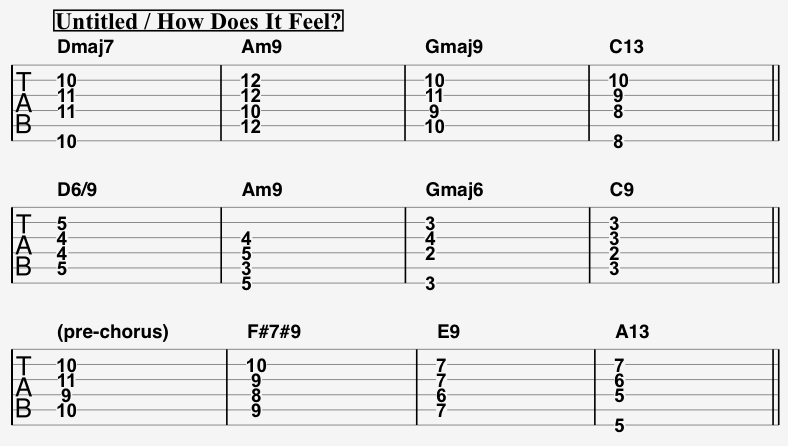
• Untitled: How Does it Feel? (D’Angelo) •

• NOTES: Take heed of the long pause in the first bar – and take advantage of the relatively straightforward physical shapes by singing the main melody over the top (also see a fuller transcription, including the brief pre-chorus insertion of F#7#9 / E9 / A13: and try adding guitar accompaniment to D’Angelo’s latter-day solo piano takes).
—Listen: How Does it Feel? (2000)—
“In 2000 he released the smoldering video for Untitled (How Does It Feel?), an instant sensation that made fans everywhere, especially women, lose their lustful minds. The video propelled him to superstardom, but it claimed its pound of flesh. D’Angelo struggled mightily with the way his body threatened to overshadow his music – and then, he all but disappeared…If given the chance, he tells me, he would absolutely shoot the video again. But he does admit to feeling angry: ‘A female fan threw money at me onstage, and that made me feel fucked-up, and I threw the money back at her…I’m not a stripper.’ He was beginning to sense a darkness beckoning…On the last day of the tour, Questlove says D’Angelo told him, ‘Yo man, I cannot wait until this fucking tour is over. I’m going to go in the woods, drink some hooch, grow a beard, and get fat.’ Questlove thought he was joking…And then it started to happen. That’s how much he wanted to distance himself.” (GQ)
• Lady (D’Angelo) •

• NOTES: While only three voicings are required, the second of them can be challenging, especially on guitars which limit access high-fret positions (n.b. if you shifted everything up a semitone – as D’Angelo sometimes does live – you could in principle play the voicings an octave lower with almost nothing but open strings). Also see Jeff Schneider’s more detailed harmonic analysis, and Thundercat’s breakdown of the bassline – as well as a DJ Premier remix.
—Listen: Lady (1995)—
“It was supposed to be for the [Tony! Toni! Toné!] record, but they didn’t like the initial idea. I played the guitar riff for D’Angelo, and he said ‘I like it’, and I said ‘Cool’. And so I was going to call somebody to [re-record] my guitar parts – and D’Angelo said ‘No, you should leave what you did’. And that’s the first time my guitar playing got on a record! How we came up with it, we were playing behind the beat…He would fall back, and start laughing, and then I’d fall back [further], and we’d be smiling and laughing…we just kept going. He’s a Dilla fan – I think we were just mocking Dilla…” (Raphael Saadiq)
• Naima (John Coltrane) •

• NOTES: From a no-frills arrangement I came up a while ago, transposed a semitone above the original in order to utilise the droning pedal-point possibilities of the open E strings (if you want to play along to Trane, here’s a +1 semitone audio file). Given the sparsity of the original, different harmonic interpretations are possible: although a handwritten transcription by Trane himself lists the whole sequence as a string of major 7ths (Dbmaj7 / Gbmaj7 / Amaj7 Gmaj7 / Abmaj7: n.b. raise all these by a semitone to play along in our key).
—Listen: Naima (1959)—
“The song is a dedication to Juanita ‘Naima’ Grubbs, Coltrane’s first wife. It was a frantic time in Coltrane’s life: he was living in Philadelphia, picking up gigs with local R&B bands and playing neighborhood bars…He was also drinking heavily and using heroin…In 1957, Coltrane reached a crossroads where he had to choose between the pleasure of his vices and the calling of his musical ambitions, since it had become evident that they could not coexist. At his mother’s house, he lay down in a bedroom, and instructed Naima to bring him only water while he went through the agony of kicking both heroin and alcohol…His resolve at the end of the experience was a dedication to clean and compassionate living…He felt so tremendously indebted to Naima for saving his life that his love for her was enshrined in this composition. In its wistful notes, you feel the tenderness of a warm embrace between two people who have been through hell together…” (XPN)
• Afro Blue (Mongo Santamaria) •

• NOTES: The essence of the original lies in its shuffling polyrhythmic groove, imported to Cuba from West Africa. While none of the shapes are harmonically complex or too challenging to play in their own right, they do change rapidly: if speed is an obstacle then leave out all the 4str notes, none of which are essential. Also jam to the myriad covers: e.g. John Coltrane (Fm), Nubiyan Twist (Cm), and Robert Glasper/Erykah Badu (Cm, with reshuffled chords).
—Listen: Afro Blue (1959)—
“Mongo Santamaria was born in the barrio Jesús María of Havana. His father was a construction worker, and his mother sold coffee and cigarettes to make a living. His grandfather came to Cuba from the Congo, probably as a slave…According to Santamaria, there were all kinds of music in his neighborhood, but most of it was from Africa. In the music that he heard and played, the drum was the key instrument. In his hands, it became a tool to play African music in a Cuban way…” (José E. Cruz)
• Good Times (Chic) •

• NOTES: Probably disco’s most famous guitar part, with a trio of E chords followed by a finger-twisting A13/E (also viewable as a 5th-less Em plus all three higher extensions: 9th, 11th, & 13th). Rhythm is definitely the main element: practice clapping along to the track to nail the timing, and keep the foot tapping throughout! Also see a tab of Bernard Edwards’ iconic bassline.
—Listen: Good Times (1979)—
“Good Times has inspired or been sampled in so many songs, but Nile Rodgers says the track got its inspiration from another iconic R&B band…Rodgers, who wrote the track with drummer Bernard Edwards, said the song’s bassline was inspired by Kool & the Gang’s Hollywood Swinging. Rodgers explained that his cousin was a member of Kool & the Gang, and his biggest aspiration at the time was to ‘be like my cousin and be in Kool & the Gang’…” (EurWeb)
• Breezin’ (George Benson) •

• NOTES: While there is nothing strange about the harmony here (all chords are diatonic to Dmaj), some of Benson’s fretboard shapes are surprisingly awkward: the opening Dmaj is voiced with a C shape, and the final transition to G/A requires an efficient reshuffle (it’s easier if you play the A bass note using open 5str, but fretting it on 6str maintains the moveability of the progression). Also check out a full transcription/tab.
—Listen: Breezin’ (1976)—
“‘The funny thing is, I didn’t think I should record it’, Benson says. ‘It had already been done [at least] two times before, and Bobby Womack’s recording was magnificent: great rhythm, beautiful bassline. I thought, ‘I can’t do anything better with it, leave it alone’. But [producer] Tommy LiPuma didn’t give up. Finally, I said, ‘I’ll consider it, but can you get Bobby Womack to come to the studio? Maybe he can give me a new idea’…As it happened, Womack knew what his song was missing – a hit-making lick. And he already knew what it should be: ‘Bobby came in and he went, ‘Da-da-da-da-da-da-da DUH-daaa!’ That’s the lick everybody knows. I said, ‘That’s the only thing you think I should do?’, and he said, ‘Sure. It’s the way I want to hear it’. So I went with that little change, and it made all the difference in the world. That was the line that took Breezin’ to the public.” (Guitar Player)
• Strange Meeting (Bill Frisell) •

• NOTES: A unique progression from the ever-unclassifiable Frisell, complicated by its perpetual open-string dissonances – to play them, keep the ring finger in place on 4str for the first two chords, and keep the little finger on 6str for the latter pair (n.b. although Frisell first recorded it in 1987, my favourite version is the duo with Julian Lage below: also compare to a 2001 take with Dave Holland & Elvin Jones).
—Listen: Strange Meeting (2021)—
“In so many ways, it feels the same now when I play as the very first time I picked up the instrument. There’s always this sound out there that’s just a little bit beyond my reach, and I’m trying to get there, and that just sort of keeps me going…It’s always been this real slow, gradual, day-by-day process. Even now, I don’t know if I do have a ‘sound’…I hear people say that they can recognize my sound, but it’s hard for me, looking from my side of it, to really know where I’m at…” (Bill Frisell)
• Electric Relaxation (ATCQ) •

• NOTES: This fascinating loop – unusual for hip-hop in being a 3-bar cycle – is sampled (-2 semitones) from funk-soul organist Ronnie Foster’s 1972 Mystic Brew. Some of the chord-pairs are awkward to play cleanly at full speed: to unlock them, focus first on which finger is used for the bass note of each shape (I prefer: ‘index, index | little, thumb | little, little’).
—Listen: Electric Relaxation (1993)—
“My grandmother gave [Q-Tip] a key, he used to just go in and do his thing – I came home from some type of trip and I walked in her kitchen, he’s in the basement and you could hear the music coming up…I didn’t even say hello to my grandmother, I was just like, ‘Hold on!’ and went downstairs: ‘Yo, what the hell is that?!’ He was like, ‘Yo, that shit is crazy, right?’, and it just became what it is now…On [Electric Relaxation], he wrote my lines and I wrote his…when we recorded, we traded.” (Phife Dawg)
• The Kicker (Joe Henderson) •

• NOTES: While stretching the definition of a ‘short’ progression, Henderson’s uptempo classic is nevertheless pleasingly concise – setting a wide variety of extensions into a fast, unchanging loop (I’ve transcribed with physical ease in mind: if it’s still too quick, cut off the roots). Somewhat like a ‘mutated blues’, with a Bb7 groove quickly swamped by a rolling cycle of jazzy resolutions.
—Listen: The Kicker (1968)—
“I try to create ideas the same as writers create images with words. I use the mechanics of writing in playing solos; quotations, commas, semicolons… Pepper Adams turned me on to a writer, Henry Robinson, who wrote a sentence that spanned three or four pages before the period came. It wasn’t stream-of-consciousness…He was stopping, pausing, with hyphens and brackets. He kept moving from left-to-right with this thought. I can remember trying to do that in Detroit – trying to play the longest meaningful phrase that I could possibly play before I took the obvious breath…” (Joe Henderson)
• Bonus: Aeolian loop #1 •

• NOTES: just a quick sequence I came up with while putting this together…
NEXT: Let me know which ‘short loops’ you like to play, which jazzy tunes have your favourite concise progressions, etc. And if you want to get deeper into this music, hit me up for Zoom lessons!




• ‘Guitaragas’ | My Music •
See more raga-guitar on my Instagram
George Howlett is a London-based musician and writer. I play guitar, tabla, sitar, & santoor, focusing on raga, jazz, and global improvisation. Above all I seek to enthuse fellow sonic searchers, connecting fresh vibrations to the human voices, cultures, and passions behind them.
• Join my PATREON! •
Recently I’ve worked long-term for Darbar, Guitar World, and Ragatip, and published research into tuning and Coltrane’s raga notes. I’ve written for Jazzwise, JazzFM, and The Wire, and also record, perform, and teach in local schools. Site menu above, follow below, & get in touch here!