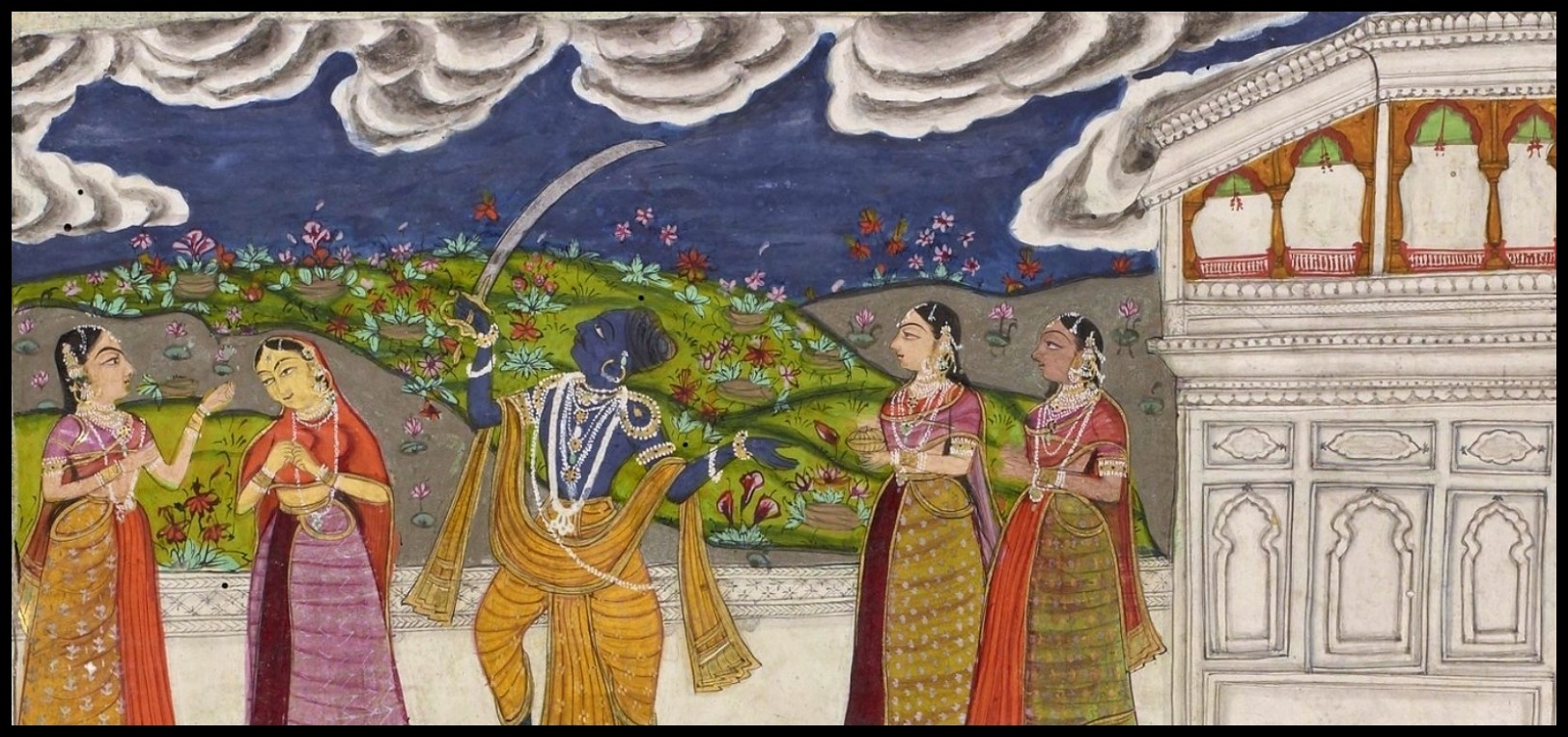

S-R-g-m-P-D-nN-S Derived from the Sanskrit for ‘banishing uncleanliness’, the Malhar family is inextricably linked to the rejuvenating effects of rain. The main raga of this lineage is named ‘Miyan ki Malhar’ for its fabled connections to Miyan Tansen, the great composer of Emperor Akbar’s 16th-century royal court, who is said to have sung it to […]

• Raag Miyan ki Malhar •

• Raag Megh (Malhar) •
S-R-m-P-n-S Among the oldest surviving members of the Malhar family, Megh (‘Cloud’) is said to have saved the life of Miyan Tansen himself. Legend holds that the great composer’s powerful rendition of the fire-bringing Deepak caused the oil lamps in Emperor Akbar’s 16th-century royal palace to ignite and burn uncontrollably – and, soon, all the […]

• Raag Shuddha Malhar •
S-R-m-P-D-S Perhaps the oldest surviving Malhar raga (‘shuddha’, as well as referring to ‘pure’ or ‘unaltered’ specific swaras, may also indicate a ‘primary’ or ‘original’ quality: as with the similarly-ancient Shuddha Basant), marked by “a ponderous gait and a meend-rich contour”. As per the accompanying notes to a K.G. Ginde lecture, Shuddha Malhar is distinguished […]

• Raag Jaldhar Kedar •
S-R-m-P-D-S Jaldhar Kedar applies the movement patterns of Kedar to the swara set of Durga, also drawing on the monsoon melodies of the Malhar family. Shuddha ma is emphasised as a nyas (e.g. SRSm; mRPm; DPm), and the Malharic Re–Pa sangati is also strong, while Durga’s mRP; mRDS is replaced by mRP; mRS; SRSm. Study […]

• Raag Bahar •
S-R-g-m-P-D-nN-S As per Tanarang, Bahar (‘Spring’) “brings out nature’s beautiful blessings…full of shringar and bhakti ras…khatkas and intricate taans are conducive to its dynamic, fleeting nature”. While rooted in the Kanada raganga, the raga features a Malharic twin-Ni, with the shuddha being more prominent. Bageshri hallmarks can also be evident in the weak aroha Re, and […]

• Raag Ramdasi Malhar •
S-R-gG-m-P-D-nN-S A diverse sankirna raga, fabled as a creation of Baba Ram Das – a 16th-century saint who is said to have opened Emperor Akbar’s eyes to the unity of the divine (“these jagirs [feudal land grants] are sources of evil passions, pride, and ego…it is by the name of God that all creatures, continents, worlds, […]

• Raag Gaud Malhar •
S-R-G-m-P-D-nN-S An ancient blend of Shuddha Malhar and the now-dormant Gaud, also seasoned with shades of Alhaiya Bilawal, which finds mention in medieval works such as Shrikantha’s Rasakaumudi treatise (published circa 1575). Parrikar highlights the “strong, glowing ma”, which serves to join a Gaud-like poorvang (SRGm, mGmPm) to uttarang phrases from Shuddha Malhar (mP(S)DS) and […]

• Raag Kamod •
S-R-G-mM-P-D-N-S An intricate raga which draws together elements from many others (Tanarang: “this dynamic melody is rather complex…one can see clear shadows of Malhar [SmRP], Hameer [GmDP], and Kalyan [SRS, SDP], together with glimpses of Kedar [MPDP] and Chayanat [PDPS, SRS]”). Distinguishing sequences include RRP, GmPGmRS, the taar Sa is accentuated with long P/S slides, […]

• Raag Surdasi Malhar •
S-R-m-P-D-nN-S A combination of melodies from the Malhar and Sarang ragangas, said to have been created by Saint Surdas: a blind 16th-century poet-musician renowned for his evocations of Krishna amidst themes of shringara and bhakti. The raga which bears his name is described by Tanarang as “uttarang-pradhan, with general movement around taar Sa…[lyrics] are dominated by […]

• Charju ki Malhar •
S-R-g-m-P-D-nN-S A diffuse branch of the Malhar lineage which exists in several modern forms. Pandit Jasraj, probably the raga’s most prominent interpreter, sings it as a Miyan ki Malhar variant with Desi-ang traits, including a distinctive treatment of shuddha Dha, which is emphasised in phrases such as mPDNS – echoed in Hemala Khare-Ranade’s recital preface (“Charju […]

• Raag Miyan ki Sarang •
S-R-m-P-D-nN-S A relatively straightforward mixture of Miyan ki Malhar and Brindabani Sarang, which omits Ga throughout in the fashion of the latter raga, while showcasing the former’s nDNS uttarang phrase (Jairazbhoy observes that “Dha is attached to ni, more or less as an ornament”). Refer to assorted vocal renditions by Apoorva Gokhale, K.G. Ginde, Shounak Abhisheki, […]

• Raag Meerabai Malhar •
S-R-gG-m-P-dD-nN-S A charming branch of the Malhar lineage, ragas under titles such as ‘Meera/Meerabai ki Malhar’ exist in diffuse modern forms, between them encompassing both forms of Ga, Dha, and Ni. While exact historical origins are uncertain, they take their name from Mira Bai, a famous 16th-century poet-musician revered for her fierce devotion to Lord […]

• Raag Jayant Malhar •
S-R-gG-m-P-D-nN-S An enchanting combination of Jaijaiwanti and Miyan ki Malhar, featuring correspondingly complex paths through the double Ga and Ni positions. Moumita Mitra’s explanation notes that some interpretations may alternate between the two parent ragas in a segmented, sequential manner, whereas others prefer to present their phrases in more intermingled fashion (e.g. RGm(G)P mGm\R; (m)R/P (m)gmR(SR)S: […]

• Raag Gaudgiri Malhar •
S-R-g-m-P-n-S An engrossing raga of uncertain origin, Gaudgiri Malhar is most prominently associated with Mewati pioneer Pandit Jasraj – although Gwalior stalwart Haribhau Ghangrekar and others were performing it even before this. Also sung by Jasraj’s brother Pratap Narayan and disciple Hemang Mehta, as well as Kirana vocalist Moumita Mitra – who describes it as a […]

• Raag Chanchalas Malhar •
S-R-g-m-P-nN-S Chanchalas Malhar (canchalas: ‘restless’, ‘flirting’, ‘fickle’) is an aprachalit stream of the monsoon family, seldom heard in the modern era. As per SIMA, the basic framework is derived from Megh, with other movements borrowed from Nayaki Kanada (e.g. mPnnP) – along with distinct srutis of komal ga and ni, both of which are raised […]

• Raag Dhuliya Malhar •
S-R-g-m-P-D-nN-S An underappreciated branch of the Malhar family tree, titled in various ways (‘Dhulia/Dhuliya’, ‘Dhundu/Dhoondo’, ‘Dhundya/Dhoondiya’: said to be a reference to its creator Pandit Dhundibaba Dikshit, although further details on this prove scant). Most sources describe the addition of Sarang flavours to the basic Malhar framework, although they disagree on precise details: Ocean of […]

• Raag Barwa •
S-R-g-m-P-D-nN-S An Agra gharana speciality, Barwa blends ideas from Kafi (mP, mgR; mPDNS), Sindhura (SRmP; Pg), Desi (RPRg), and Miyan ki Malhar (nDNS). The komal ga tends to be omitted in aroha, and ma is rendered deergha, while the Malharic Re–Pa pair is often given as the vadi-samvadi. Traditionally associated with the late morning hours, […]

• Raag Arun Malhar •
S-R-G-m-P-D-nN-S A rare and ancient Malhar variant, said to be marked out by a DDnP DGPm pakad. As per Rajan Parrikar, “although it finds a mention in Bhatkhande, no details are forthcoming – there are a couple of other works where the raga is treated, but only in the sketchiest of terms”. Described as a mix […]

• Raag Tilang Bahar •
S-R-gG-m-P-D-nN-S A sparsely-recorded form which uses all the swaras of both Tilang and Bahar, appraised by Tanarang as “a fine blend of the two melodies…both [ragas] provide sweet tonal embellishment” (who gives characteristic phrases of GmPm; GmRS; mDNS; DNSRS; SnPmG; mPm; DNSnP; GmRS). Kirana singer R.D. Jadhav’s performance (described on the cover as a “bright […]

• Raag Des Malhar •
S-R-G-m-P-D-nN-S A well-established fusion of the pastoral-themed Desh and the rain-bringing Malhar, spanning the full swara sets of both via characteristic movements such as RmP, PNSRmGR; mPnDP, PNS. Steadily popular with both instrumentalists (e.g. Ali Akbar Khan’s many renditions) and singers (e.g. the Bodas clan’s duets). Dinkar Kaikini’s daughter Aditi Upadhya recounts the tale behind the […]

• Raag Chaya Malhar •
S-R-G-m-P-D-N-S Profiled by Parrikar as “a compound melody formed by joining elements of Chaya to the Malhar raganga signature [mRm\RP]…The nyas on Pa is important, but an inapposite nyas on Re or undue brightening of ma may tilt the development towards Nat Malhar”. Listen to his Gwalior guru Ramrang’s rendition, seasoned with a particularly prominent […]

• Raag Tanseni Madhuvanti •
S-R-g-M-P-D-nN-S A captivating offshoot of Madhuvanti, named ‘Tanseni’ for its use of a Miyan ki Malhar-flavoured double-Ni sangati. Associated with the Rampur sarangi tradition, most prominently Hamid & Zahid Khan – as per the liner notes to Hamid’s ektal rendition: “it also resembles Multani…it is of Kafi parentage, with accents on Sa & Ma”. Thus […]

• Raag Bageshri Bahar •
S-R-g-m-P-D-nN-S A blend of the late-night Bageshri and the springtime Bahar, most prominently recorded by Bhimsen Joshi (below: from his 1997 Rarely-Heard Ragas album, also featuring Hindolita & Jaijaiwanti Nat: although the actual recording session appears to have taken place in 1980). Matches the swara set of ‘Kafi double-Ni’, and is thus prakriti with several […]

• Raag Shukla Bilawal •
S-R-G-m-P-D-nN-S A traditional Bilawal prakar, marked out by phrase patterns such as SGGm, GmPm and a general focus on shuddha ma, also integrating movements from the Malhar, Khamaj, and Kedar families. Jaipur-Atrauli vocalist Manjiri Asanare-Kelkar’s detailed demo breakdown (transcribed in full below) describes it as “a complex raga, with major phrases of Gaud Malhar and Bihagda […]

• Raag Tilak Malhar •
S-R-G-m-P-D-nN-S A presumed blend of Miyan ki Malhar and Tilak Kamod, mentioned in Geeta Banerjee’s Malhar Darshan but only recorded by a few artists. After struggling to ascertain the raga’s origins, I was pleased to receive a direct message from guitarist Akshat Sharma in early 2024, informing me that it was devised by his grandfather […]
