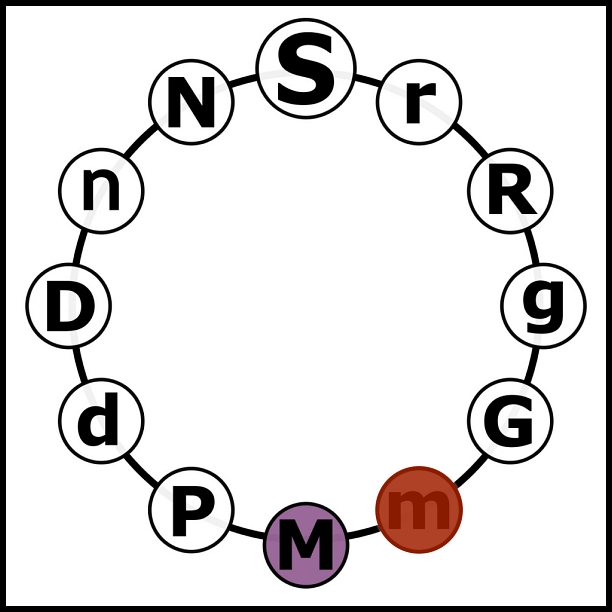

S-r-G-M-P-d-N-S Tankeshree is a seldom-performed Shree–ang raga, which lies closest to the predominant form of Triveni (the same scale minus Ma). Pa is strong and tivra Ma is weak – at least based on the evidence of Omkarnath Thakur’s soaring 1940 rendition (Malan Laaye Chun Chun Kaliyan), which regularly ascends in sparse SGP fashion (also […]

• Raag Tankeshree •

• Raag Rampriya •
S-r-G-M-P-D-n-S A mysterious sampurna form which follows the swara set of ‘Ahir Bhairav tivra Ma’, ‘Vachaspati komal re’, or ‘Puriya Kalyan komal ni’ (I’ve also seen the scale referred to as ‘Persian Vachaspati’ and ‘Ram Puriya Kalyan’). The ‘Rampriya’ moniker derives from a congruent Carnatic raga, although it is unclear whether this is a post-hoc […]

• Raag Gauri Basant •
S-r-G-M-P-d-N-S Introduced by prolific raga creator Kumar Gandharva via fusing Gauri with Basant’s tivra Ma incarnation. His original renditions also prominently showcase a Bhairav-ang G\r slide – but this fragment lacks its usual support from shuddha ma above, instead being followed in the bandish by Basant-like turns such as GPd; PMPG (…this shift is timed […]

• Raag Shankara Karan •
S-R-G-M-P-D-nN-S Associated with the crisp mornings of springtime, Shankara Karan is variously said to blend elements of Shankara, Shree, Hindol, and Yaman – although its swara set (‘Yaman double Ni’) is seldom-heard in the Hindustani ragascape (also hear the ultra-rare Guru Kalyan & Kala Kalyan). Recordings are rare, with the most prominent cut being a 1995 […]

• Raag Niranjani Todi •
S-r-g-mM-P-D-nN-S A seldom-heard raga said to have been invented by Kishori Amonkar, combining elements from Bairagi, Ahir Bhairav, and Bhinna Shadja. Despite these lofty origins, I can’t track down a single rendition by its apparent creator – although her disciple Raghunandan Panshikar has recorded it several times, focusing his interpretation on an Ahiri-prakriti core form […]

• Raag Malavi •
S-r-G-M-P-D-S An enchanting sandhiprakash raga, which has different melodic characteristics depending on the time of day. Jaipur-Atrauli vocalist Manjiri Asanare-Kelkar’s demo lesson describes its ‘morning form’ as “a complex raga combining Hindol and shuddha Dha Bibhas…you might also find a glimpse of Deshkar” – whereas she places the ‘evening form’ closer to Shree (“There are several […]

• Raag Hansa Narayani •
S-r-G-M-P-N-S Taking the shape of ‘Puriya Dhanashree minus dha’, Hansa Narayani presents uttarang shades of Hansadhwani (PNS): another swan-related raga with Carnatic roots (‘Hansa’ suggests a swan-riding image of Saraswati, the four-armed Hindu goddess of music and learning, and ‘Narayani’ refers to an incarnation of Lakshmi, goddess of wealth and fortune: collectively covering two-thirds of […]

• Raag Vijayanagari •
S-R-g-M-P-D-S A scale of Southern origin, seemingly imported North by Gwalior guru Balabhau Umdekar, which matches the swara set of ‘Madhuvanti minus Ni’ (although the Carnatic original is classed as a ‘janya‘ derivative of Hemavati). While I can’t trace any of Umdekar’s recordings, Malini Rajurkar has performed a pair of his bandish: Sajana Ghara Avo […]

• Raag Madhukant •
S-R-g-M-P-D-n-S An oddly-shaped and thinly-analysed sampurna raga, taking the shape of ‘Madhuvanti’s poorvang + Kafi’s uttarang’ (SRgM+PDnS: i.e. ‘Kafi tivra Ma’). Analysed by Jairazbhoy in 1971: “Ragas in which the Pa has a leading note [MP], while the Sa does not [nS]…Madhukauns and Madhukant are both modern ragas which appear to be evolving rapidly…Madhukant [is] […]

• Raag Namanarayani •
S-r-G-M-P-d-n-S Equivalent to ‘Basant Mukhari tivra Ma’, the SrGMPdnS swara-set – known in Carnatic music as Namanarayani, the 50th mela – has barely been played in the North. I searched hard during my quest to find matching ragas for the 32 ‘sampurna thaat’ scales (=all those with one variant each of ‘Sa, Re, Ga, Ma, […]

• Raag Rishabhapriya •
S-R-G-M-P-d-n-S Already a rare mode in Carnatic music (mela #62), Rishabhapriya has barely been touched by Hindustani musicians. Equivalent to ‘Charukeshi tivra Ma’ or ‘Vachaspati komal dha’, all poorvang swaras are set to their highest specific positions, and all uttarang swaras are at their lowest (SRGM+PdnS: like ‘Yaman’s poorvang + Bhairavi’s uttarang’). The rare Ma–ni sangati […]
