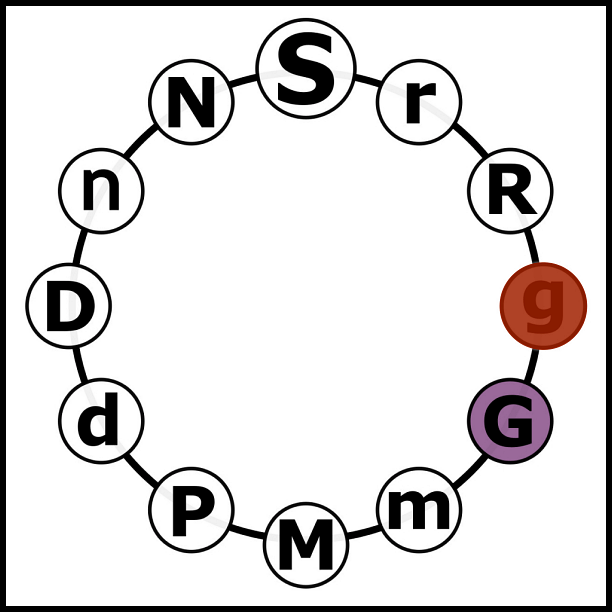

S-rR-G-P-D-S A charming audav raga with several disparate branches. In particular, the treatment of Re varies (some render it komal, and others shuddha, while Jaipur-Atrauli singers employ both forms) – with Dha, which must be taken vakra, also showing up in both its variants (albeit not within the same performance). Indeed, even renditions by the […]

• Raag Jait •

• Raag Hansa Narayani •
S-r-G-M-P-N-S Taking the shape of ‘Puriya Dhanashree minus dha’, Hansa Narayani presents uttarang shades of Hansadhwani (PNS): another swan-related raga with Carnatic roots (‘Hansa’ suggests a swan-riding image of Saraswati, the four-armed Hindu goddess of music and learning, and ‘Narayani’ refers to an incarnation of Lakshmi, goddess of wealth and fortune: collectively covering two-thirds of […]

• Raag Virat Bhairav •
S-r-G-m-P-dD-n-S A ‘double Dha Bhairav’ raga with a unique swara set, associated with Jaipur-Atrauli vocalists including Nivruttibuwa Sarnaik (who, according to gharana stablemate Gandhar Digrajkar, invented it). In addition to Bhairav’s classic G\rS swoop and general poorvang-focus, Parrikar notes “a rather busy uttarang: shuddha Dha is used sparingly, in special sancharis such as GmPDnDn and […]

• Raag Saraswati Kedar •
S-R-G-mM-P-D-nN-S A double-Ma, double-Ni raga created by Gwalior vocalist and educator Vishwanath Rao Ringe ‘Tanarang’ (also see Hemshri, Sundarkauns, and Jogeshwari Pancham). Characteristic phrases from Saraswati (RRMMP; MPDnDP; nDS) are intermingled with those of Kedar (MPDNS; PDPm; mGP; SRS; mmRS), with shuddha Ga only used in occasional avroh movements. Also see prakriti ragas including Nat […]

• Raag Kesari Kalyan •
S-R-G-P-D-N-S Kesari Kalyan is formed by removing Kalyan’s most characteristic swara – tivra Ma – leaving a curious shadav scale (prakriti with Shankara). Legendary Gwalior vocalist and educator Ramashreya Jha ‘Ramrang’ appears to have created the raga: hear his own rendition, and also listen to him discuss it in the context of “two key ideas […]

• Raag Hindolita •
S-G-mM-P-D-N-S A blend of Hindol and Lalit, seemingly introduced by Kirana master Bhimsen Joshi – who recorded it a handful of times over the years, including at the 1992 Sawai Gandharva Festival with Zakir Hussain, and for his 1997 Rarely-Heard Ragas album (also featuring Jaijaiwanti Nat and Bageshri Bahar). Given the sparsity of its recorded […]

• Raag Tilak Malhar •
S-R-G-m-P-D-nN-S A presumed blend of Miyan ki Malhar and Tilak Kamod, mentioned in Geeta Banerjee’s Malhar Darshan but only recorded by a few artists. After struggling to ascertain the raga’s origins, I was pleased to receive a direct message from guitarist Akshat Sharma in early 2024, informing me that it was devised by his grandfather […]

• Raag Tilak Bhairav •
S-rR-G-m-P-dD-N-S An ultra-rare raga associated with Imdadkhani composer Dhruva Tara Joshi, spanning the full swara sets of Bhairav and Tilak Kamod. Although initially a sitarist, Joshi’s sole traceable take of the raga is a vocal-only rendition from a lecture-demo (seemingly the result of an injury forcing him away from the strings) – which concisely interweaves […]

• Raag Bhankar •
S-r-G-mM-P-dD-N-S Bhankar is a complex morning form which introduces Lalit-flavoured phrases to the basic framework of Bhatiyar. Manjiri Asanare-Kelkar cites two main variants sung in her Jaipur-Atrauli gharana, one of which also features touches of Bhairav – with both versions sharing common phrases including Bhatiyar’s Sm mPG, MDS and Lalit’s NdMm, GmMmG. She also elucidates how […]

• Raag Bhankari •
S-r-G-mM-P-D-N-S A complex blend of several ragas, Bhankari was created by Gwalior guru Ramashreya Jha ‘Ramrang’. His student Rajan Parrikar describes it as a “tantalizing melody blending facets of Bhatiyar, Jait, Bibhas, and Deshkar, while retaining an aesthetic coherence in the end product”. Ramrang’s renditions also overlap significantly with some interpretations of Bhankar – an […]

• Raag Malayalam •
S-R-G-m-P-d-n-S A barely-documented morning raga created by Ali Akbar Khan sometime around the 1970s – named in honour of his mother (‘Malaya’) and father (‘Alam’: also the name of Khan’s son, born in 1982) [n.b. the Tamil-derived Dravidian language family of the same title is of a separate etymology, derived from ‘mala+alam’: ‘the land near the […]

• Raag Dakshinatya Basant •
S-r-G-m-P-D-N-S A springtime raga described by sarodiya Joydeep Mukherjee as “very rare…adapted from Carnatic music” (hear him play it on “a very rare instrument, the Radhika Mohanveena”, created by Radhika Mohan Maitra in 1948 – accompanied by Subhasish Sabyasachi, “the first ambidextrous percussionist of India“). The name translates as ‘Southern Basant’ (to distinguish it from the […]

• Raag Shivangi •
S-G-P-D-S A charming chatuswari, confined to the swaras SGPD throughout. Vocalist Shubhada Moghe, in the accompanying notes to her 2019 rendition, describes Shivangi as “a rare morning raga taught to me by my guru-ji Pt. Manikbua Thakurdas, whose lineage goes back seven generations…it is very close to Deshkar, but omits Re completely. The vadi-samvadi are […]

• Raag Sameshwari •
S-R-G-m-P-D-n-S An intriguing experiment in drawing direct inspiration from the distant past, Sameshwari is a creation of musicologist and vichtra veena maestro Lalmani Misra, inspired by his study of ancient Vedic chant practices. As explained by his daughter Ragini Trivedi, “Sameshwari is an attempt to preserve the notes used in Sāmgana [Vedic hymn singing]…Sāmik chanters […]

• Raag Loom •
S-R-G-m-P-D-N-S A rare but charming all-shuddha raga, said by some to be an older form of the Bilawal lineage. Most commonly associated with Ali Akbar Khan, who performed several variants over the course of his long career: including the ‘pure’ Loom, as well as Loom Nat and Loom Mand (all SRGmPDNS). During one concert, Khan recounted […]

• Raag Gaud •
S-R-G-m-P-D-N-S Now lying dormant, Gaud – assumed to have been named for its origins in the archaic Gaudadesha region – is best-known via its parental role in compounds such as Gaud Malhar, Gaud Sarang, and Gaud Bahar. In spite of its modern scarcity, the raga played a vital role in Hindustani history, turning up in numerous […]

• Raag Sonakshi •
S-r-G-mM-P-dD-N-S From my 2018 Darbar interview with Maihar bansuri maestro Rupak Kulkarni: “I created Sonakshi [‘Golden-Eyed‘] so I could experience a raga which was suitable for any time of day. I believe we have different mindsets depending on the hour: in the morning our mood is spiritual and fresh, and in the evening it is […]

• Raag Namanarayani •
S-r-G-M-P-d-n-S Equivalent to ‘Basant Mukhari tivra Ma’, the SrGMPdnS swara-set – known in Carnatic music as Namanarayani, the 50th mela – has barely been played in the North. I searched hard during my quest to find matching ragas for the 32 ‘sampurna thaat’ scales (=all those with one variant each of ‘Sa, Re, Ga, Ma, […]

• Raag Rishabhapriya •
S-R-G-M-P-d-n-S Already a rare mode in Carnatic music (mela #62), Rishabhapriya has barely been touched by Hindustani musicians. Equivalent to ‘Charukeshi tivra Ma’ or ‘Vachaspati komal dha’, all poorvang swaras are set to their highest specific positions, and all uttarang swaras are at their lowest (SRGM+PdnS: like ‘Yaman’s poorvang + Bhairavi’s uttarang’). The rare Ma–ni sangati […]

• Raag Asa •
S-R-G-m-P-D-N-S Asa (‘Hope’) is a historically influential raga which still enjoys widespread fame in Sikh musical traditions. Long popular in the Punjab, it is mentioned over a hundred times in the Guru Granth Sahib (1604), connected to the Kafi and Asavari lineages of that era. Most major Gurus have composed shabads in it – as […]
