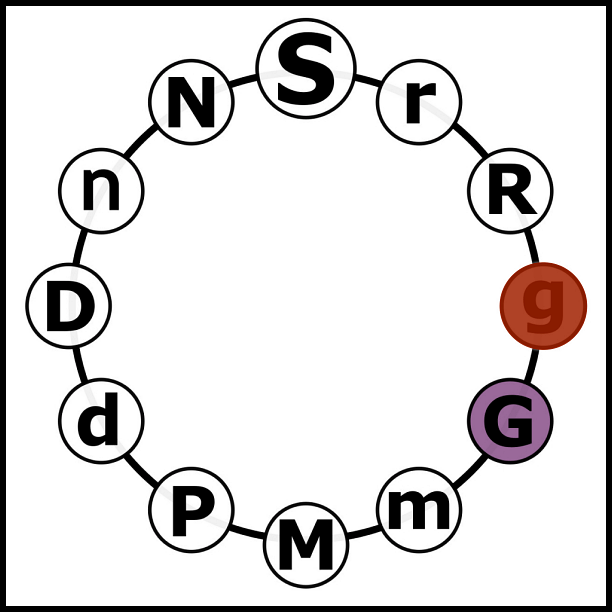

S-r-G-mM-P-dD-N-S A rare raga of the Jaipur-Atrauli gharana, described by Rajan Parrikar as “essentially Raag Poorvi adorned with bells and whistles” – in particular, the Ma-mixing catchphrases Sm, mGP and MMPPd, dNdP. Refer to the Rajshekhar Mansur bandish transcribed below, which showcases uttarang forays of MP, PdNdP and a prominent M\G glide. Also recorded by […]

• Raag Purba •

• Raag Swanandi •
S-R-G-m-P-D-N-S Fashioned by Agra vocalist Jagannathbuwa Purohit ‘Gunidas’ (also the creator of Jogkauns and Jaun Bhairav), fusing material from Bhatiyar, Bihag, and Bhinna Shadja into an engrossing new whole. Bhatiyar forms the main base, with its phrases being reworked to match the swaras of Bilawal thaat (e.g. PGRS; SD NDP, PDPm), with Bhinna Shadja contributing […]

• Raag Sazgiri •
S-r-G-mM-P-dD-N-S Often described as being among the most complex of Hindustani forms, Sazgiri is fabled as a creation of Amir Khusro (1253-1325): the legendary Sufi poet, singer, and mystic of the Delhi Sultanate (although direct historical evidence for his authorship of the raga is admittedly scant). Komal dha is restricted to Poorvi-ang phrases such as […]

• Raag Raj Kalyan •
S-R-G-M-D-N-S A ‘Kalyan no Pa’ melody devised by Gwalior vocal innovator Vasantrao Deshpande (although he may well have seen it more like a ‘Marwa shuddha Re’). Parrikar describes how “the relief-inducing nyas on Pa is missing, giving a ‘restive’ persona”, while Ocean of Ragas gives a pakad of GMD, DMGR, NRS. Generally treated as hexatonic […]

• Raag Rageshri •
S-R-G-m-D-n-S Working along the lines of a ‘shuddha Ga Bageshri with shades of the Khamaj-ang’, the early-night Rageshri enjoys popularity among vocalists and instrumentalists alike. Like Bageshri, Re is often weak in ascent, and the ma–Dha sangati is strong – while unlike Bageshri, Pa is varjit throughout (likely as a result of shuddha Ga destroying the […]

• Raag Monomanjari •
S-r-G-M-P-D-nN-S A scale with no apparent prakritis unveiled by sitar icon Nikhil Banerjee some time in the 1970s (in his own words: “I’m quite satisfied with one of my Sonodisc LPs, Raag Monomanjari: that’s my favourite so far…”). From Narendra Datar’s 1989 review of this record: “A jod raga…a remarkable combination of Kalavati and Marwa. […]

• Raag Meghranjani •
S-r-G-mM-N-S A truly odd scale form, Meghranjani can be interpreted as either ‘Bhairav minus Pa & dha‘ (SrGmNS) or ‘Lalit minus dha‘ (SrGmMNS) – producing a strange shape which omits two consecutive generic swaras (see other such ragas in my ‘consecutive varjits‘ category, including Adbhut Kalyan, Devranjani, & Malashree). Originally borrowed from the Carnatic Megharanjani, the […]

• Raag Madhuradhwani •
S-G-m-D-nN-S As per Parrikar, “Durga Khamaj-thaat is also known as ‘Madhuradhwani’. This is not a popular raga, its base eroded by the popularity of Rageshri…but is part of the Dagar family repertoire”. While some renditions will skip Ni in ascent, traditional Dhrupad presentations will render it shuddha in aroha and komal in avroh – along with […]

• Raag Lalita Sohini •
S-r-G-mM-D-N-S A blend of the early-morning Lalit and late-night Sohini, with the melodies of the latter dominating the aural impression, reportedly created by Agra vocalist Yunus Ahmed Khan in the mid-20th century. Raja notes that “while Sohini is a resident of the upper tetrachord, Lalit is a resident of the lower tetrachord. Thus, the resulting melodic entity […]

• Raag Kalashri •
S-R-G-m-P-D-n-S Introduced by Kirana legend Bhimsen Joshi, via combining Kalavati and Rageshri to span the full seven swaras of Khamaj thaat. Aarshin Karande notes that the raga’s origins lie in Gopalkrishna Bhobe’s 1969 sangeet natak [Marathi musical drama] ‘Dhanya Te Gayani Kala‘ (“Bhimsen-ji developed upon the melody, becoming Kalashri…He even named his home in Pune […]

• Raag Hem Bihag •
S-R-G-m-P-D-N-S Often cited as an invention of Ravi Shankar, Hem Bihag was in fact devised by his teacher Allauddin Khan – as noted by Shankar & Ali Akbar Khan when they chose it to open a tribute concert just a few weeks on from their guru’s 1972 death, at the reputed age of 110 (below: […]

• Raag Devgiri Bilawal •
S-R-G-m-P-D-nN-S A fusion of Bilawal, Kalyan, and Shuddha Kalyan, which either avoids the tivra Ma throughout or relegates it to an ornamental role. Balancing an uttarang-focus with a tendency for melodic development in mandra and madhya saptak, the raga (as per Thakurdas) prioritises Ga and Dha, also using Pa as a nyas – with komal […]

• Raag Des Malhar •
S-R-G-m-P-D-nN-S A well-established fusion of the pastoral-themed Desh and the rain-bringing Malhar, spanning the full swara sets of both via characteristic movements such as RmP, PNSRmGR; mPnDP, PNS. Steadily popular with both instrumentalists (e.g. Ali Akbar Khan’s many renditions) and singers (e.g. the Bodas clan’s duets). Dinkar Kaikini’s daughter Aditi Upadhya recounts the tale behind the […]

• Raag Chaya Malhar •
S-R-G-m-P-D-N-S Profiled by Parrikar as “a compound melody formed by joining elements of Chaya to the Malhar raganga signature [mRm\RP]…The nyas on Pa is important, but an inapposite nyas on Re or undue brightening of ma may tilt the development towards Nat Malhar”. Listen to his Gwalior guru Ramrang’s rendition, seasoned with a particularly prominent […]

• Raag Chandni Bihag •
S-G-mM-P-D-nN-S Chandni Bihag (‘Moonlit Bihag’) is a speciality of the Rampur khayal gharana which introduces the tense Ma–ni sangati to the basic framework of Bihag, further accentuated by a weak or absent Re – leaving two ‘4-row’ clusters (GmMP & DnNS), arranged symmetrically. Parrikar recounts the “enchanting tonal formulations” of his guru Ramrang’s rendition (passed down by […]

• Raag Bihagda •
S-R-G-m-P-D-nN-S A Khamaj-seasoned Bihag variant with possible connections to the Carnatic Behag, which appears in several overlapping variants. Raja notes that the raga’s main ‘double-Ni’ form (indistinguishable from some types of Khokar) is associated with Jaipur-Atrauli vocalists, who apply a pakad of Gm PDnDP, GmG PmPG, and limit Bihag’s tivra Ma to swift ornamental movements – while […]

• Raag Baradi •
S-r-G-M-P-D-N-S A long-lived and diffuse sonic lineage variously referred to as ‘Baradi’, ‘Barari’, ‘Varati’, and ‘Varali’, which appears in several overlapping modern forms, typically spanning the territory around Marwa thaat (Bhatkhande’s Sangeet Shastra Vol.3, published around a century ago, notes 13 distinct variants). Some artists omit tivra Ma, and others may add komal dha (‘Poorvi–ang’) – […]

• Raag Adbhut Kalyan •
S-R-G-D-N-S An uncommon Kalyan variety, named Adbhut (‘Wondrous’) for omitting two of Kalyan’s most vital swaras (Ma & Pa). Remains popular in the Dagarvani Dhrupad, but few others have risen to the centreless challenges of losing both mid-saptak swaras. Aminuddin Dagar reportedly considered the raga to be an offshoot of Khem Kalyan, while Uday Bhawalkar links […]

• Raag Pancham se Pilu •
S-R-G-mM-P-D-nN-S A murchana rotation of Pilu (literally: ‘Pilu from Pa’) – i.e. if you treat this raga’s Pa as the ‘new Sa’, Pilu is produced (albeit in its somewhat less common ‘komal dha-less‘ form). Pilu’s doubled gG–nN swaras, separated by a perfect 5th, are thus spun into nN–mM (i.e. the murchana’s principal effect is to […]

• Raag Sundarkali •
S-r-G-P-n-S A relatively straightforward audav raga, Sundarkali takes the swaras of ‘Ahir Bhairav no ma/dha’. Anjani Kumar Gupta’s concise bansuri rendition is the only full recording I could find (alap transcribed below), although Tanarang’s disciple Prakash Vishwanath Ringe has released a brief selection of khayal demos (and sax player Mister D Cell has used it to […]

• Raag Sohini Pancham •
S-r-G-mM-P-D-N-S A variant of Sohini, named for its insertion of shuddha ma and Pa via phrases from Pancham including MGMGrS; MPGmG; MDMmG [n.b. many other raga names involving ‘Pancham’ indicate the inclusion of the swara position rather than the raga, e.g. ‘Pancham Malkauns‘]. Refer to renditions by Madhup Mudgal and Nisha Nigalye-Parasnis (singing a Pranpriya […]

• Raag Maligoura •
S-r-G-M-P-dD-N-S A sandhiprakash raga which draws on Puriya, Gauri, Marwa, and Shree. Depending on rendition, Dha may be komal (Ali Akbar Khan), shuddha (Ramprapanna Bhattacharya), or double (Khadim Hussain Khan) – with considerable cross-gharana variance in characteristic phraseologies. Maihar sarodiya Sayak Barua states that “NDNrNP is the heart of the raga”, and, as per Manjiri […]

• Raag Chandni Kedar •
S-R-G-mM-P-D-nN-S A loosely-organised set of Kedar variations, Chandni Kedar (‘Moonlight Kedar’) is formed via minor modifications to its parent raga. As per Parrikar, who recommends a Kesarbai Kerkar mehfil rendition (Eri Ina Naina), “some suggest strengthening the komal ni and shuddha Ga in standard Kedar…others [suggest] Kedar with an added komal ni” – while Ocean […]

• Raag Bihagara •
S-R-G-m-P-D-nN-S A variant of Bihag popular in Kirtan and other Sikh devotional styles, used as the basis for compositions by great Gurus including Ram Das and Tegh Bahadur (some refer to the raga as ‘Punjabi Bihag’). As per Jawaddi Taksal, “Bihagara is very melodious, and brings out pangs of separation which can be removed by…becoming […]

• Raag Bhinna Shadja •
S-G-m-D-N-S Often characterised as the ‘older form’ of today’s Kaushik Dhwani, Bhinna Shadja’s lineage stretches back well over 1000 years. It appears in numerous ancient shastras: notably including Matangamuni’s Brihaddeshi (~8th-century), Abhinavagupta 11th-century writings (“Bhinnashadaja, Kaushiki, and Bhinnapanchama are favoured in Summer”), and Sarangdeva’s 13th-century Sangita Ratnakara – which describes its scale form in remarkably […]

• Raag Basanti Kanada •
S-r-G-mM-P-D-nN-S Perhaps the only Kanada raga to give prominence to tivra Ma (which appears in Basant-like poorvang motions such as GMDMG; MGrS), Basanti Kanada is a thinly-analysed form which summons idiosyncratic tensions via a precise mixing of seemingly incongruous elements (e.g. from the bandish below: DmG, GMdM\G, MGrS). Predominantly associated with vocalists of the Jaipur-Atrauli […]

• Raag Bangal Bhairav •
S-r-G-m-P-d-S A distinctive Bhairav raganga offshoot with uncertain origins, summarised in oddly poetic fashion by MeetKalakar: “Being Nishad-taboo, its caste is shadav. Dhaivat and Rishabh are used softly…which are respectively the plaintiffs”. Performed by only a handful of khayal vocalists (e.g. Abhirang, Purnima Sen, and Yunus Hussain Khan) – but remains a staple of the […]

• Raag Triveni •
S-r-G-P-d-N-S Taking a hexatonic ‘Shree/Bhairav no ma’ swara set, Triveni’s main incarnation (also known as ‘Tirban/Tirvan’) comprises two congruent swara-clusters – SrG & PdN (both semitonal jumps of ‘1-3’). Melodic motions mostly take after Shree and Bhairav, particularly via a strong re–Pa sangati and G\rS descents – both evident in Shounak Abhisheki’s jhaptal bandish (Kalindi […]

• Raag Tankeshree •
S-r-G-M-P-d-N-S Tankeshree is a seldom-performed Shree–ang raga, which lies closest to the predominant form of Triveni (the same scale minus Ma). Pa is strong and tivra Ma is weak – at least based on the evidence of Omkarnath Thakur’s soaring 1940 rendition (Malan Laaye Chun Chun Kaliyan), which regularly ascends in sparse SGP fashion (also […]

• Raag Savani •
S-R-G-m-P-D-N-S An evening raga, which, despite its regular titling of ‘Savani Kalyan’, usually lies closer to Bihag than the Kalyan family – chiefly via avoiding tivra Ma, and giving greater strength to the Sa–Pa sangati. In the raga’s main incarnation, Dha and Ni are often rendered durbal, and may be skipped via PSP turnarounds (although […]

• Raag Rampriya •
S-r-G-M-P-D-n-S A mysterious sampurna form which follows the swara set of ‘Ahir Bhairav tivra Ma’, ‘Vachaspati komal re’, or ‘Puriya Kalyan komal ni’ (I’ve also seen the scale referred to as ‘Persian Vachaspati’ and ‘Ram Puriya Kalyan’). The ‘Rampriya’ moniker derives from a congruent Carnatic raga, although it is unclear whether this is a post-hoc […]

• Raag Mangal Bhairav •
S-r-G-m-P-D-N-S A ‘shuddha Dha Bhairav’ offshoot, which thus allows for Durga-like uttarang movements such as mPDS. Ronu Majumdar also touches on Bhupali (e.g. SDS SDPDS: gat transcribed below), placing these passages in contrast to Bhairav’s signature GrS conclusion phrase. Subbha Rao’s Raga Nidhi Vol.3 notes that the raga’s movements remain anchored in the pentatonic swara […]

• Raag Malti Basant •
S-r-G-mM-D-N-S A rare springtime raga, summarised in Narayanrao Patwardhan’s 1964 Raga Vigyan as a fusion of Puriya, Basant, Sohini, & Hindol (see chalan phrases below) – although Deepak Raja recounts a conversation with Ulhas Kashalkar, who states that “there is no Hindol in it…the raga has shades of Puriya and Sohini as well as Basant…Mainly [sung] in […]

• Raag Kambhoji •
S-R-G-m-P-D-n-S Sometimes summarised as ‘Dhrupad Jhinjhoti’, Kambhoji also invites shades of Kalavati via omitting ma in upward motions (Parrikar: GPD; PD; GPDnD; nDS). The raga’s history stretches back to pre-Medieval times: listed as a derivative of Shree in Narada’s 8th-century Sangita Makaranda, and as a spouse of Nat-Narayani in Pundarika Vittala’s 16th-century works (n.b. some speculate […]

• Raag Gauri Basant •
S-r-G-M-P-d-N-S Introduced by prolific raga creator Kumar Gandharva via fusing Gauri with Basant’s tivra Ma incarnation. His original renditions also prominently showcase a Bhairav-ang G\r slide – but this fragment lacks its usual support from shuddha ma above, instead being followed in the bandish by Basant-like turns such as GPd; PMPG (…this shift is timed […]

• Raag Gaud Sarang •
S-R-G-mM-P-D-N-S Aside from its afternoon designation, Gaud Sarang typically carries few hints of the Sarang family – running more like a vakra Bihag variant seasoned by a GRmGPRS pakad amongst other melodic quirks (some refer to it as ‘Din ki Bihag’: ‘Daytime Bihag’). Shuddha ma is strong, but not used as a nyas, with its enclosing […]

• Raag Sakh •
S-R-G-m-P-D-n-S Despite their historic renown, the Sakh family is seldom-heard in the modern era. While nomenclature varies, the ‘main’ Sakh raga is generally held to be a Khamaj–prakriti form, with mood and movements proximate to Rageshri and Gaoti – evident in Patiala pair Amanat & Fateh Ali Khan’s soothing ma-focused rendition, built around characteristic phrases […]

• Raag Sorath •
S-R-G-m-P-D-nN-S A Khamaj-flavoured night raga which enjoys perennial popularity in Sikh traditions: as per Jawaddi Taksal, Sorath is “a simple and sweet raga: but it will be appealing only when the soul seeks the Lord’s name. By singing glorious praises, lifelessness does not come” – and, in the words of another Sikh writer: “Sorath conveys the […]

• Raag Shukla Bilawal •
S-R-G-m-P-D-nN-S A traditional Bilawal prakar, marked out by phrase patterns such as SGGm, GmPm and a general focus on shuddha ma, also integrating movements from the Malhar, Khamaj, and Kedar families. Jaipur-Atrauli vocalist Manjiri Asanare-Kelkar’s detailed demo breakdown (transcribed in full below) describes it as “a complex raga, with major phrases of Gaud Malhar and Bihagda […]

• Raag Shankara Karan •
S-R-G-M-P-D-nN-S Associated with the crisp mornings of springtime, Shankara Karan is variously said to blend elements of Shankara, Shree, Hindol, and Yaman – although its swara set (‘Yaman double Ni’) is seldom-heard in the Hindustani ragascape (also hear the ultra-rare Guru Kalyan & Kala Kalyan). Recordings are rare, with the most prominent cut being a 1995 […]

• Raag Sanjh Saravali •
S-R-G-mM-P-D-N-S Taking the general form of ‘Yaman Kalyan seasoned with Bihag’, Sanjh Saravali (‘Evening Melody’) was devised by Vilayat Khan in the late 1970s. Fellow Imdadkhani sitarist Deepak Raja, aided by input from Vilayat himself, describes the raga as “incorporating fleeting impressions of several Kalyan ragas, including Nand Kalyan and Chayanat…its melodic identity rests on […]

• Raag Purva •
S-r-G-M-P-D-N-S As per Deepak Raja’s insightful analysis, “Purva [bears] resemblance to Puriya in terms of swara material, phraseology, melodic centre of gravity, and aural impression” – also adding that, while sitarist Vilayat Khan considered the raga indistinguishable from Puriya Kalyan, it is in fact marked out by “differential weightages given to different segments of the […]

• Raag Pat Bihag •
S-R-G-mM-P-D-N-S A chalan bheda of Bihag, which varies according to gharana. Tivra Ma is generally restricted to ornamental use, while Jaipur-Atrauli singers may showcase a range of additional melodic quirks. In Parrikar’s summary, “most of its mannerisms are Bihag-like, the notable departure being its ‘glowing’ shuddha ma: deergha and mukta” – also see his rundown […]

• Raag Pancham se Gara •
S-R-G-mM-P-D-nN-S A rotation of Gara (literally: ‘Gara from Pa’) – i.e. if you treat the raga’s Pa as the ‘new Sa’, Gara’s scale is produced (SRGmMPDNS > SRgGmPDNS: although the raga’s creation in fact came via the reverse translation). Most closely associated with murchana master Ravi Shankar, who reworks Gara’s DnSNS uttarang catchphrase into GmPMP (see […]

• Raag Nat Kamod •
S-R-G-m-P-D-nN-S A Jaipur-Atrauli combination of Shuddha Nat and Kamod, which may also touch on the territory of Chayanat. Described by Deepak Raja as being “sustained by a single bandish – Nevar Baajo – [which] has virtually been synonymous with the raga for over half a century, and is perhaps the sole repository of its ‘raga-ness’ […]

• Raag Nat Bihag •
S-R-G-mM-P-D-nN-S A Bihag offshoot developed by the Agra gharana, distinguished by the integration of special phrases such as mnDP; PDNS; PDNDP alongside other flourishes from Shuddha Nat (e.g. SR, RG, Gm, mP). Tivra Ma is either avoided or limited to occasional ornamental status (M/P), with komal ni similarly restricted to use as a madhya-saptak kan in […]

• Raag Manjari Bihag •
S-R-G-m-P-D-N-S Produced via a chalan bheda of Bihag, Manjari Bihag also lies close to Pat Bihag, typically differing from both these forms via the exclusion of tivra Ma (compare to other members of the Bihag raganga). Most prominently recorded by Aslam Khan ‘Khusrang’: his 1989 album rendition (bandish: Sohat Kanha & Sughara Banara More Ghar […]

• Raag Malavi •
S-r-G-M-P-D-S An enchanting sandhiprakash raga, which has different melodic characteristics depending on the time of day. Jaipur-Atrauli vocalist Manjiri Asanare-Kelkar’s demo lesson describes its ‘morning form’ as “a complex raga combining Hindol and shuddha Dha Bibhas…you might also find a glimpse of Deshkar” – whereas she places the ‘evening form’ closer to Shree (“There are several […]

• Raag Lalit Pancham •
S-r-G-mM-P-D-N-S A title applied to various offshoots of Lalit which add some combination of Pa and shuddha Dha to the basic SrGmMdNS swara set, often removing komal dha in the process. Many such incarnations draw from Shuddha Basant (a raga which features Pa and, depending on variant, either form of Dha: Ulhas Kashalkar notes that […]

• Raag Khokar •
S-G-m-P-D-nN-S A captivating raga with disparate modern strands. In its predominant Jaipur-Atrauli incarnation, Khokar is, according to some, essentially identical to Bihagda, itself a fusion of Bihag and Khamaj (Deepak Raja: “A melodic analysis of the so-called Khokar confirms its identity with Bihagda…[any] distinction remains unsupported by either logic or evidence”). On the other hand, […]
