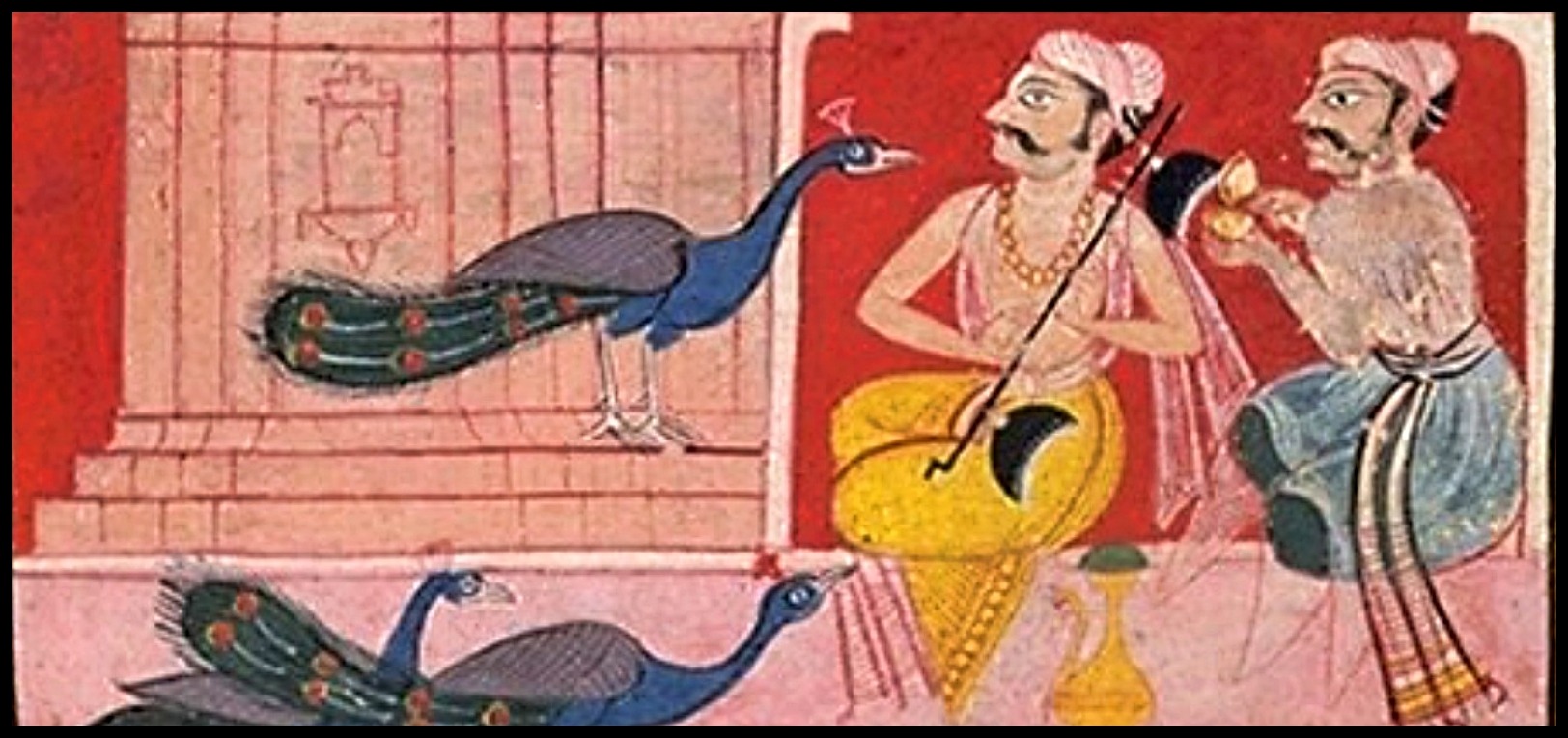

S-R-m-P-nN-S The Sarang raga lineage, mythically linked to 16th-century mystic-musician Swami Haridas, is also associated with snake-charming rituals of the past. Brindabani Sarang (named for Uttar Pradesh’s Vrindavan region), the principal raga of this group, is believed to have brought an incarnation of Lord Krishna to earth when Haridas sung it for the first time. […]

• Raag (Brindabani) Sarang •

• Raag Madhumad Sarang •
S-R-m-P-n-S Running along the lines of ‘Brindabani Sarang with komal ni only’, Madhumad Sarang is among the principal incarnations of its raganga (‘Madhumad’ derives from the Sanskrit ‘madhyamadi’: the Carnatic equivalent is similarly titled ‘Madhyamavati’). Ma and Pa are strong, and the PnS uttarang summons natural upward momentum via clusters such as PSn, PnS, PnSRm, […]

• Raag Madhusurja •
S-rR-mM-P-n-S A Kumar Gandharva creation, inspired by witnessing the plight of a goat as it was led past his house on the way to be sacrificed at a nearby Kali temple. To collate a few common tellings: “When the goat realises, it starts pleading to save its life. The vilambit bandish describes these prayers [‘bachaale […]

• Raag Shuddha Sarang •
S-R-mM-P-D-N-S A prominent early afternoon raga of the Sarang family, often said to evoke sringara. Ga is omitted, Dha is ornamental, and shuddha ma is introduced in avroh (always before Re, and sometimes adjacent to the tivra, e.g. MmR) – with Tanarang giving a pakad of NDSNRS (n.b. older variants of the raga also employed komal […]

• Raag Sarangkauns •
S-R-m-d-n-S A rare audav raga of bewitching beauty, taking the form of ‘Malkauns with shuddha Re instead of ga’. As the name implies, the adoption of Re allows for poorvang shades from Sarang (SRm, mR), set in contrast to distinctive Malkauns turnarounds in uttarang (Snd, dnS). Like both Malkauns and Madhumad Sarang, the scale shape […]

• Raag Surdasi Malhar •
S-R-m-P-D-nN-S A combination of melodies from the Malhar and Sarang ragangas, said to have been created by Saint Surdas: a blind 16th-century poet-musician renowned for his evocations of Krishna amidst themes of shringara and bhakti. The raga which bears his name is described by Tanarang as “uttarang-pradhan, with general movement around taar Sa…[lyrics] are dominated by […]

• Raag Miyan ki Sarang •
S-R-m-P-D-nN-S A relatively straightforward mixture of Miyan ki Malhar and Brindabani Sarang, which omits Ga throughout in the fashion of the latter raga, while showcasing the former’s nDNS uttarang phrase (Jairazbhoy observes that “Dha is attached to ni, more or less as an ornament”). Refer to assorted vocal renditions by Apoorva Gokhale, K.G. Ginde, Shounak Abhisheki, […]

• Raag Lakshmi Kalyan •
S-R-G-mM-P-D-N-S An enchanting but seldom-heard raga, taking the swara set of ‘Kalyan double-Ma’ (n.b. ‘Lakshmi’ refers to the Hindu goddess of power, prosperity, and fortune). Described by slide guitarist Deepak Kshirsagar as “a combination of Shuddha Sarang and Shyam Kalyan, [although] some combine Shuddha Sarang and Kamod..or use [the swaras of] Shyam Kalyan in the […]

• Raag Dhuliya Malhar •
S-R-g-m-P-D-nN-S An underappreciated branch of the Malhar family tree, titled in various ways (‘Dhulia/Dhuliya’, ‘Dhundu/Dhoondo’, ‘Dhundya/Dhoondiya’: said to be a reference to its creator Pandit Dhundibaba Dikshit, although further details on this prove scant). Most sources describe the addition of Sarang flavours to the basic Malhar framework, although they disagree on precise details: Ocean of […]

• Raag Lanka Dahan Sarang •
S-R-g-m-P-D-nN-S ‘Lanka Dahan’ refers to a famous tale from the Ramayana – as per Rajeev Taranath’s preface to a recital of the raga: “Ravana’s demonic horde set fire to Lord Hanuman’s tail; and the Monkey God sent the entire city of Lanka up in flames with it. But Rama’s consort Sita, an avatar of Lakshmi, […]

• Raag Rang Malhar •
S-R-mM-P-D-nN-S From my 2018 Darbar interview with Rupak Kulkarni: “Rang Malhar happened by chance. It was the rainy season, and I was playing in a monsoon festival. I was the last performer, and by the time my turn came then all types of Malhar family ragas had been played already. I thought I should come […]

• Raag Ambika Sarang •
S-R-mM-P-D-nN-S According to Rajan Parrikar, Ambika Sarang is associated with Agra vocalist Chidanand Nagarkar, with “elements of Shuddha Sarang and Kafi blended together in a delicious cocktail” (as per his great-nephew Prasad Upasani, “The story goes that while teaching Shuddha Sarang, one student kept singing komal ni by mistake. This phrase stuck in his head, and […]

• Raag Badhans Sarang •
S-R-m-P-D-nN-S A seldom-heard Sarang variant which appears in several different guises. All main forms include the swaras SRmPDnS, and most add shuddha Ni, while some also include shuddha Ga amidst other quirks. Thankfully, rare raga explorer Moumita Mitra recently conducted a survey of known renditions (read in full below), categorising them into three streams: ‘komal […]

• Raag Noor Sarang •
S-R-mM-P-D-N-S A rare raga of the Sarang family, around which there exists limited melodic consensus. As per Abhirang’s account, “when we only use tivra Ma in Shuddha Sarang, it is converted to Noor Sarang…in avroh, the Dha is kept ‘free’ [e.g. ornamented D(NP)]” – also noting its proximity to Jaymini Sarang (both Ni). Dhrupad interpretations […]

• Raag Saraswati Sarang •
S-R-mM-P-D-nN-S Despite the prachalit status of both its parents, the Saraswati + Sarang compound remains relatively rare. The best longform performance is that of vichitra veena maestro Gopal Krishnan (which revolves around an ear-catching nD MPDS pakad), who – as per a direct message from his grandson Akshat Sharma – created the raga (along with Tilak […]

• Raag Samant Sarang •
S-R-m-P-D-nN-S A Sarang family raga which, while infrequently performed, has found stable root in several vocal and instrumental gharanas. As per Parrikar, “shuddha Dha taken in vakra prayogas is the definitive theme, including tonal sentences of the type RmP; RmPDnDPmR; RmR; mDP. Some employ both Ni, others have use for only the komal…There is an occasional […]
