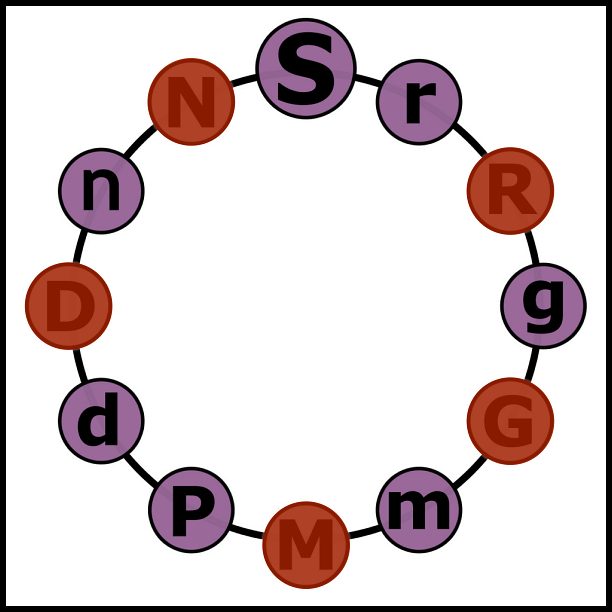

S-g-m-d-n-S Among the most revered ragas in the entire Hindustani pantheon, Malkauns (‘He who wears serpents as garlands’) combines structural simplicity with a nuanced mythological ethos. Said to have been composed by the goddess Parvati to soothe Lord Shiva’s murderous rage, in turn inspired by his wife Sati’s fiery death, its ‘all-komal‘ swara set is […]

• Raag Malkauns •

• Raag Bhairavi •
S-r-g-m-P-d-n-S Probably the most prominent raga in the entire Hindustani canon, the dawn Bhairavi (‘awe, terror’: named after the Fifth Avatar of Mahadevi, the Mother Goddess) is a concert-closing staple. Unique in its chromatic flexibilities, the raga’s ‘Mishra Bhairavi’ form can span the full swara spectrum, allowing for a multitude of moods in the hands […]

• Raag Bilaskhani Todi •
S-r-g-m-P-d-n-S A hallowed form, Bilaskhani Todi is fabled to have been created by Bilas Khan: son of Tansen, the legendary composer of Emperor Akbar’s 16th-century durbar. On trying to sing Todi at his father’s funeral wake, Bilas found himself so grief-stricken that he mixed up the swaras – however, his panic was allayed on witnessing […]

• Raag Bhupali Todi •
S-r-g-P-d-S A captivating audav raga said to symbolise spiritual purity, which essentially runs along the lines of ‘what if all Bhupali‘s chal swaras were set as komal rather than shuddha?’ (SRGPDS > SrgPdS). Most renditions are poorvang-dominant, drawing from the Todi-ang as well as reshaping phrases from Bhupali, Bilaskhani Todi, and other forms (given the uniqueness of […]

• Raag Dhani •
S-g-m-P-n-S Despite its ‘Minor Pentatonic’ scale form enjoying global popularity as the predominant mode of blues, rock, pop, and countless other guitar-driven genres, Dhani is comparatively rare as a raga in its own right – with its swara set mostly being heard as the ‘aroha of Bhimpalasi’ rather than in isolation (…it may be the […]

• Raag Bairagi Todi •
S-r-g-P-n-S Created by Ravi Shankar, Bairagi Todi replaces Bairagi’s shuddha ma with a Todi-intoned ati-komal ga, retaining the concise audav structure while presenting an odd mix of narrow and wide intervals. Sometimes matched with unusual talas (e.g. Shankar’s original is in ‘sade-gyarah’: a ‘fractional‘ 11.5 matra cycle divided ‘4-4-2-1.5‘), the raga is explorable in all saptak, […]

• Raag Bairagi •
S-r-m-P-n-S Bairagi (‘detachment’, ‘separation’) is a pentatonic form inducted into the ragascape by an early-career Ravi Shankar – as recounted in Oliver Craske’s superlative biography Indian Sun, p.106: “Shankar created Bairagi in 1949, [publishing] the raga, and a bandish in it, in Sangeet Magazine”. The ‘Megh komal re‘ swara set – which may well have […]

• Raag Gunkali •
S-r-m-P-d-S An enchanting morning raga, matching the swara set of ‘Bhupali komal re/dha’ (or ‘Shobhawari komal re’), described by Tanarang as “an epitome of bhakti and karuna…straightforward, and expandable in all three octaves”. While audav at its core, multivariate forms of the raga are in existence: some include shades of shuddha Ga in avroh (bringing hints […]

• Raag Bayati •
S-r̃-g-m-P-ᵭ-n-S A unique experiment by vocalist Dinkar Kaikini, based on adapting a Middle Eastern melodic form known as Maqam-al-Bayati – resulting in highly unusual sruti tunings for re and dha, which are set to ‘quarter-tonal’ shades roughly halfway between komal and shuddha (ga and ni also display some degree of flexibility, leaving only Sa, ma, & […]

• Raag Saheli Todi •
S-r-g-P-d-n-S An invention of vocalist Kumar Gandharva, lying between Bhupali Todi and Bilaskhani Todi via the addition of an avroh komal ni to the former (or the subtraction of ma from the latter). His original renditions linger patiently on the komal re (often intoned with a noticeably higher sruti than is usual for the Todi […]

• Raag Pancham Malkauns •
S-g-m-P-d-n-S A loose collection of melodic strands which fall under the general banner of ‘Malkauns with Pa in avroh’ (thus sharing conceptual overlap with Kaunsi Kanada and Sampurna Malkauns). Ascents typically stay true to the pentatonic structure of Malkauns, and the Pa is usually rendered in vakra avroh lines (e.g. ndmgmdP or gmdndmP). Beloved by […]

• Raag Gopika Basant •
S-g-m-P-d-n-S A hexatonic raga of bewitching beauty, Gopika Basant matches the swaras of ‘Asavari no Re’ (or ‘Malkauns add Pa’) – while also inviting shades of Bhairavi from ga upwards. The Sa–ma sangati is strong, and, as noted by Nazir Ali Jairazbhoy, descents can mirror the Malkauns-style scheme of “parallel conjunct tetrachords by oblique use […]

• Raag Gunakri •
S-r-m-P-d-S Taking the swaras of ‘Bhairav no Ga & Ni’, Gunakri – described by AUTRIM as “serious and peaceful” – brings out the character of its parent raganga via an oscillating komal re, and movements patterns including Sd, dP and SdSr, rS (although Jairazbhoy prefers to analyse it via the geometries of Basant Mukhari). Bose gives a […]

• Raag Darjeeling •
S-r-g-m-P-d-n-S Unveiled by sitarist Niladri Kumar in a 2014 Taj Mahal tea commercial, launching a new Darjeeling-themed range described in marketing materials as “definitely our most premium offering” (Niladri: “I have composed [it] in honour of the superlative flavour”). Status as a ‘real raga’ (rather than just a Mishra Bhairavi) is highly dubious – and […]
