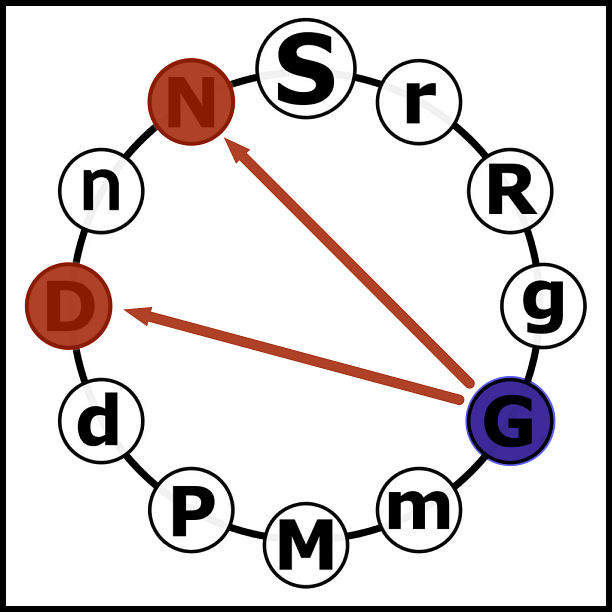

S-gG-m-P-n-S A lively late-evening raga, Jog translates as ‘State of Union’ (derived from the Sanskrit concept of ‘yogi’). Its oddly bluesy harmony presents an enchanting almost-familiarity to uninitiated listeners, mixing Major and Minor flavours via a characteristic ‘Gmg zigzag’ phrase in descent (which, via the wonders of convergent evolution, suggests the structure of a 7#9 […]

• Raag Jog •

• Raag Basant Mukhari •
S-r-G-m-P-d-n-S Effectively blending the poorvang of Bhairav with the uttarang of Bhairavi (SrGm; PdnS), Basant Mukhari’s complex history bears the imprints of multiple musical cultures. While its modern inception is traceable to S.N. Ratanjankar’s eclectic Carnatic borrowings of the 1950s (also see Charukeshi: the same scale with shuddha re instead), many also explicitly link it to […]

• Raag Charukeshi •
S-R-G-m-P-d-n-S Adopted from the Carnatic mela #26, Charukeshi (‘One with Beautiful Hair’) calls for wide-open melodic exploration, favouring long lines which wind around themselves while visiting the furthest reaches of all three octaves. Like many Southern scales, it may be used as a canvas for recolouring multiple ideas from adjacent ragas (see avirbhav–tirobhav), while itself […]

• Raag Malashree •
S-G-P-S Often said to comprise only three swaras (a SGP major triad), Malashree pushes the bounds of raga definition. Arguably, this challenge is its defining purpose, calling on performers to find expressive freedom within an ultra-limited framework. In practice, this often leads artists to push the raga’s own bounds instead, via including tivra Ma and shuddha […]

• Raag Imratkauns •
S-R-G-m-d-n-S Devised by Imdadkhani sitar and surbahar virtuoso Imrat Khan via blending the scales of Rageshri and Malkauns – producing a swara set matching ‘Charukeshi no Pa’. This mid-scale space presents a strong poorvang–uttarang separation, amidst the strange geometric regularity of the consecutive ‘2-2-2-2’ run (dnSRG: just a ma-to-Ma nudge from matching the whole-tone scale, […]

• Raag Amirkhani Kauns •
S-G-M-P-n-S A ‘pentatonic Vachaspati’ created (as the name implies) by Indore vocal master Amir Khan, which omits Re and Dha (thus, Amirkhani Kauns is to Vachaspati as Dhani is to Kafi). All swaras except Sa are imperfect – with the unusual Ma–ni sangati exerting inevitable gravity and drawing melodies away from clear resolution. Few of […]

• Raag Mohankauns •
S-gG-m-d-n-S As recounted in The Hindu, Mohankauns “was spontaneously created by Ravi Shankar in 1949. On hearing of Mohandas K. Gandhi’s death, Pandit-ji was asked by All India Radio to play a piece dedicated to the Mahatma. On the spot, he created a variation of…Malkauns”. As well as the occasional use of shuddha Re, his […]

• Raag Bibhas •
S-r-G-P-d-S The pentatonic Bibhas (or Vibhas) appears in at least three present-day forms: typically tilted towards either the Marwa, Bhairav, or Poorvi frameworks. The former takes a shuddha Dha, while the latter pair render it komal (thus drawing focus to Pa, which is often treated as a nyas). Prakriti with Reva in its komal dha […]

• Raag Gangeshwari •
S-G-m-P-d-n-S Like Parameshwari and Rangeshwari, Gangeshwari (‘Lordess of the Ganges River’) was created by Ravi Shankar in 1968, via murchana rotation of his newly-invented Kameshwari (itself dreamed up during a car ride through Bengal). Its unevenly-spaced shadav scale (prakriti with some forms of Sundarkauns) most closely resembles a ‘no Re’ version of either Charukeshi or Basant […]

• Raag Dev Gandhar •
S-R-gG-m-P-d-n-S A Gwalior gharana speciality described by Tanarang as “an old melodic form, not much in vogue…very sweet, its unique appeal stems from the application of both gandhars, elaborated similar to Jaunpuri”. Unlike Gandhari, Dev Gandhar allows for both Ga variants in aroha as well as avroh – with Parrikar providing a simple summary for […]

• Raag Faridi Todi •
S-r-gG-M-d-n-S A raga known, as of 2025, through a single rendition: Supriyo Maitro’s spellbinding vocal tribute to his Dagarvani forebear Zia Fariduddin Dagar, live from the 2018 Faridi Samorah Festival in Bhopal with Aditya Deep on pakhawaj (“in remembrance of [Zia’s] 86th birthday, the festival was a musical tribute to the Ustad by his disciples, […]

• Raag Madhurkauns •
S-gG-m-d-n-S A fascinating yet sparsely-recorded creation of Kirana vocalist Prabha Atre, matching the swaras of ‘Malkauns double-Ga’ (or ‘Nandkauns no Pa’). The addition of shuddha Ga maintains the original Ga–ni symmetry axis of Malkauns, while also giving more gravity to shuddha ma via upward resolutions of G/m – a feature which forms the basis of […]

• Raag Sehera •
S-R-G-M-d-n-S Among the strangest of raga scales, Sehera’s six swaras are all spaced out in two-semitone jumps (akin to the Western Whole-Tone scale and the Carnatic Gopriya). The resulting symmetries summon a curious, centreless mood (also famous as the ‘dream sequence‘ of countless soundtracks) – best explored by sarangiya Sultan Khan, who described Sehera as “the […]

• Raag Prabhakali •
S-r-G-m-P-d-n-S An Ali Akbar Khan invention, prakriti with the better-known Basant Mukhari. Information is scant – but, as per the liner notes to the raga’s 1964 LP release, “Prabhakali permits only five notes in aroha, dropping [Ga & Ni]. For avroh, it admits all the seven notes…[re & dha] are flats as in Bhairav, and […]

• Raag Zeelaf •
S-G-m-P-d-S A rare audav raga fabled to have been created by 13th-century qawwali pioneer Amir Khusrau, somewhat resembling ‘Bhairav minus re & Ni’. As per Rajan Parrikar, “this haunting pentatonic melody is composed of the following swaras: SGmPd. Jitendra Abhisheki gives a superb account with his own composition [transcribed below]: notice the strong ma and […]

• Raag Malayalam •
S-R-G-m-P-d-n-S A barely-documented morning raga created by Ali Akbar Khan sometime around the 1970s – named in honour of his mother (‘Malaya’) and father (‘Alam’: also the name of Khan’s son, born in 1982) [n.b. the Tamil-derived Dravidian language family of the same title is of a separate etymology, derived from ‘mala+alam’: ‘the land near the […]

• Raag Gunji Kanada •
S-R-gG-m-P-d-n-S A Gwalior gharana favourite which blends Malgunji and Kaunsi Kanada, principally via inserting the former’s catchphrase of RnSRG, Gm (also found in Dev Gandhar) into the broader framework of the latter – although some sources also cite vital influences from Adana and Bahar (e.g. mDnS). Modern renditions tend to take the komal dha, although a […]

• Raag Devgandhari Todi •
S-rR-gG-m-P-d-n-S A modification of Dev Gandhar, devised by Agra vocalist S.N. Ratanjankar via the addition of a Todi-like komal re – thus filling the entire Sa-to-ma swara space. Also recorded by his student K.G. Ginde, who extends this hemitonic run (and leans further into Todi’s geometries) by including touches of shuddha Ni, also reworking some […]

• Raag Reva •
S-r-G-P-d-S A rare pentatonic raga, Reva is often described as the ‘evening counterpart’ to Bibhas (or the ‘jawab to its sawal’), matching this samay designation by taking after the Poorvi–ang rather than Bibhas’ Bhairav-ang roots. Chiefly, its movements are distinguished from Bibhas via poorvang-focused sangatis including Gr; rS; SrrS, along with a greater exploration of […]

• Raag Nandkauns •
S-gG-m-P-d-n-S A poorvang–uttarang blend of Jog and Malkauns (despite the name, there are no traces of Nand). Shuddha ma, as the natural meeting point between both ragas, assumes the most prominence (sometimes hinting at a ma-murchana of SRgmPnNS) – along with frequent use of a highly expressive n\P glide. Remains rare on the concert platform, […]

• Raag Sundarkali •
S-r-G-P-n-S A relatively straightforward audav raga, Sundarkali takes the swaras of ‘Ahir Bhairav no ma/dha’ (n.b. the same name is also used separately as an alternate title for ‘Paraj Bhairav’). Anjani Kumar Gupta’s concise bansuri rendition is the only full recording I could find (alap transcribed below), although Tanarang’s disciple Prakash Vishwanath Ringe has released a […]

• Raag Bangal Bhairav •
S-r-G-m-P-d-S A distinctive Bhairav raganga offshoot with uncertain origins, summarised in oddly poetic fashion by MeetKalakar: “Being Nishad-taboo, its caste is shadav. Dhaivat and Rishabh are used softly…which are respectively the plaintiffs” (n.b. the ultra-rare Meghranjani is the only other ‘shadav Bhairav’ raga I can definitively trace). Performed by only a handful of khayal vocalists […]

• Raag Vardhini •
S-gG-m-P-d-n-S Adapted from Carnatic music’s mela #32 (‘Ragavardhini’: strictly speaking, the Northern form should perhaps be spelled this way too), Vardhini matches the swaras of Nandkauns or ‘Jogkauns komal ni’. Seemingly introduced to the Northern ragascape via the Dagarvani Dhrupad – as per information kindly supplied by Pelva Naik, “Vardhini came into the Dagar gharana, as far […]

• Raag Anup •
S-R-gG-m-P-n-S A recent creation of vocalist Sadhana Shiledar which serves to highlight the continuing phenomenon of ragas being inspired by regional folk melodies. As per her accompanying notes to a 2018 performance, “Anup is a dhun-ugam [folk-derived] raga, based on a folk tune from Dewas in the Malwa region of Madhya Pradesh”. Her full-length 2025 […]

• Raag Shiv Manjari •
S-R-G-m-d-n-S A captivating shadav raga created by my own sitar guru-ji Pandit Shivnath Mishra, resembling ‘Charukeshi no Pa’. The only known recording is a brief clip by his sarod student Pat Lambdin, filmed at a 2024 Vermont concert with Amit Kavthekar on fine tabla form (mukhda: dnSRG; GmGRS). [More info to follow…]. Compare to Imratkauns, […]

• Raag Rishabhapriya •
S-R-G-M-P-d-n-S Already a rare mode in Carnatic music (mela #62), Rishabhapriya has barely been touched by Hindustani musicians. Equivalent to ‘Charukeshi tivra Ma’ or ‘Vachaspati komal dha’, all poorvang swaras are set to their highest specific positions, and all uttarang swaras are at their lowest (SRGM+PdnS: like ‘Yaman’s poorvang + Bhairavi’s uttarang’). The rare Ma–ni sangati […]
