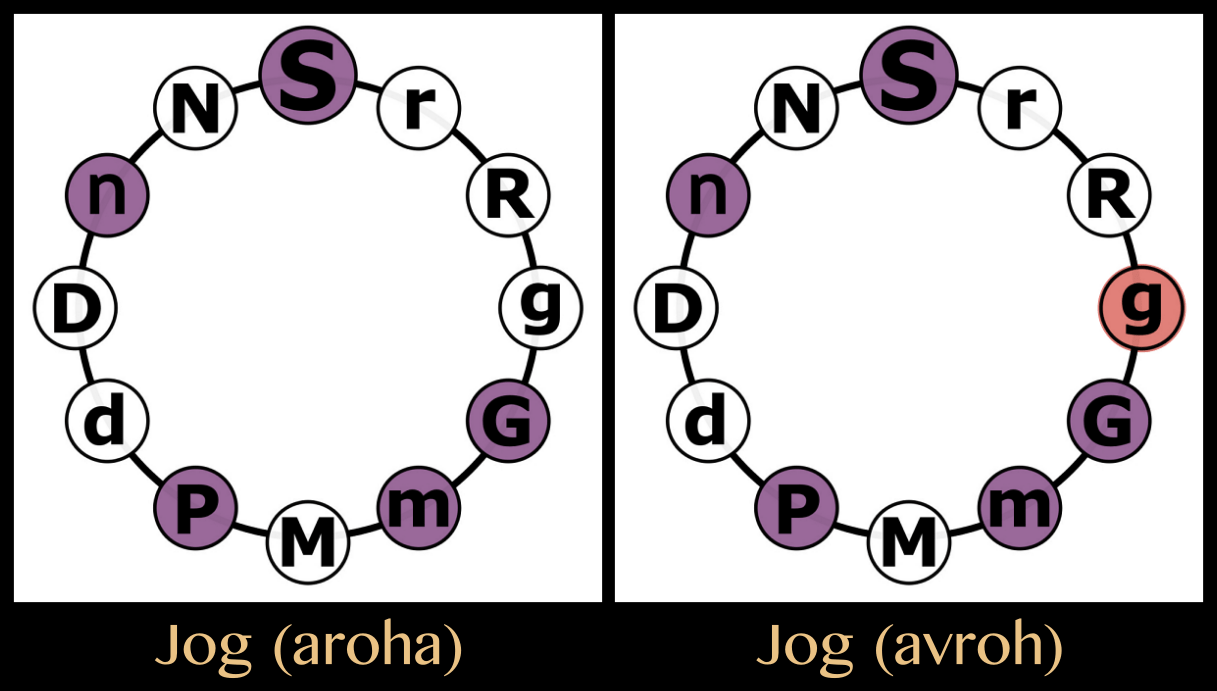

S-gG-m-P-n-S A lively late-evening raga, Jog translates as ‘State of Union’ (derived from the Sanskrit concept of ‘yogi’). Its oddly bluesy harmony presents an enchanting almost-familiarity to uninitiated listeners, mixing Major and Minor flavours via a characteristic ‘Gmg zigzag’ phrase in descent (which, via the wonders of convergent evolution, suggests the structure of a 7#9 […]

• Raag Jog •

• Raag Lalit •
S-r-G-mM-d-N-S Lalit (meaning ‘Lyrical’) is an oddly-shaped sunrise raga, resembling ‘Bhairav with Pa lowered a semitone’. Among the most influential forms in Hindustani history (see the Lalit raganga), its distinctive ‘double Ma, no Pa’ structure has a malleable ambiguity, capable of conjuring flavours ranging from ‘sadness and anguish’ to ‘the serene and devotional‘ (as per […]

• Raag (Brindabani) Sarang •
S-R-m-P-nN-S The Sarang raga lineage, mythically linked to 16th-century mystic-musician Swami Haridas, is also associated with snake-charming rituals of the past. Brindabani Sarang (named for Uttar Pradesh’s Vrindavan region), the principal raga of this group, is believed to have brought an incarnation of Lord Krishna to earth when Haridas sung it for the first time. […]

• Raag Jaijaiwanti •
S-R-gG-m-P-D-nN-S A much-beloved but highly intricate raga, featuring both variants of Ga and Ni – which shares significant overlap with Gara. Dhrupadyas hold NSDNR as the essential pakad (with some bemoaning the loss of the “slow glide from Ga to Re…as Jaijaiwanti’s distinguishing feature”) – while modern performers tend to ‘enclose’ the komal ga in […]

• Raag Gara •
S-R-gG-m-P-D-nN-S Gara is a disparate melodic lineage, derived from thumri compositions of centuries past: Manuel’s research describes it as “a loose, informal melodic entity until the 18th century, after which [its] grammar was organised by classically trained musicians…like Kafi, Pilu, Jungala, Barwa, and Zila”. Often close to Jaijaiwanti, the modern Gara may also draw from […]

• Raag Kedar •
S-R-mM-P-D-N-S An early night raga, Kedar is traditionally associated with heat (Tanarang: “there is much thermal energy in this melody…hence it is regarded as a ragini of Deepak“: Tansen’s legendary fire-bringing raga). Often seen as particularly subtle, complex, and hard-to-perform – partly due to its curiously wide aroha jump from Sa to Ma (depending on […]

• Raag Tilang •
S-G-m-P-nN-S A folk-derived Khamaj raga featuring distinctive double-Ni interplay, seemingly of ancient Southern origin (Bor: “Tilang probably originated in Telangana, and may have been introduced to the North by an unknown 15th-to-16th-century poet-composer“). Dha is varjit, and shuddha Re is typically omitted too (although some may occasionally include it swara in taar saptak). Parrikar suggests […]

• Raag Patmanjari •
(S-rR-gG-mM-P-dD-nN-S) Said by some to be more of a ‘performance concept’ than a single raga, ‘Patmanjari’ translates as ‘Bouquet of Five Ragas’. Debate persists over whether the form should be interpreted as an open challenge to blend five ragas of an artist’s own choosing, or whether it entails five specific ragas – and, if so, […]

• Raag Mohankauns •
S-gG-m-d-n-S As recounted in The Hindu, Mohankauns “was spontaneously created by Ravi Shankar in 1949. On hearing of Mohandas K. Gandhi’s death, Pandit-ji was asked by All India Radio to play a piece dedicated to the Mahatma. On the spot, he created a variation of…Malkauns”. As well as the occasional use of shuddha Re, his […]

• Raag Ramdasi Malhar •
S-R-gG-m-P-D-nN-S A diverse sankirna raga, fabled as a creation of Baba Ram Das – a 16th-century saint who is said to have opened Emperor Akbar’s eyes to the unity of the divine (“these jagirs [feudal land grants] are sources of evil passions, pride, and ego…it is by the name of God that all creatures, continents, worlds, […]

• Raag Khat •
S-rR-gG-m-P-dD-n-S Often described as one of the most complex Hindustani forms, Khat (Sanskrit: ‘six’) is based on the idea of combining six different ragas – although the precise six chosen may vary between performers. Subbha Rao’s Raga Nidhi volumes cites two main forms (“Suha, Kanada, Sarang, Desi, Gandhari, & Sughrai” and “Ramkali, Asavari, Todi, Gujiri, […]

• Raag Tulsikauns •
S-g-m-d-nN-S A creation of Maihar sitarist Kartik Kumar, matching the swara-set of ‘Malkauns double-Ni’ (or ‘Malkauns + Chandrakauns’). A consistently strong ma–murchana summons unmistakable flavours of the Western ‘Blues Scale’ (SgmMPnS), further accentuated by extended meend between the consecutive Ni positions (…I’ve used the exact same scale as a ‘modal sitar hack’ to play with […]

• Raag Alhaiya Bilawal •
S-R-G-m-P-D-nN-S Essentially summarisable as ‘Bilawal plus komal ni’, the ‘Alhaiya’ variant exemplifies the core traits of the Bilawal raganga. Most distinctively, Dha is treated as the vadi, but not as a nyas (Pa and Ga are used as stopping tones instead, often being reached via meend). Dha is also used to support komal ni via […]

• Raag Gaud Malhar •
S-R-G-m-P-D-nN-S An ancient blend of Shuddha Malhar and the now-dormant Gaud, also seasoned with shades of Alhaiya Bilawal, which finds mention in medieval works such as Shrikantha’s Rasakaumudi treatise (published circa 1575). Parrikar highlights the “strong, glowing ma”, which serves to join a Gaud-like poorvang (SRGm, mGmPm) to uttarang phrases from Shuddha Malhar (mP(S)DS) and […]

• Raag Ramkali •
S-r-G-mM-P-d-nN-S Resembling ‘Bhairav with touches of tivra Ma and komal ni in avroh’, Ramkali is an early morning raga, often associated with Sikh saintly traditions – with one author recounting that “the emotions in Ramkali are like those of a wise teacher disciplining their student, who is aware of the pain of learning” (although classical ragmala paintings commonly […]

• Raag Kamod •
S-R-G-mM-P-D-N-S An intricate raga which draws together elements from many others (Tanarang: “this dynamic melody is rather complex…one can see clear shadows of Malhar [SmRP], Hameer [GmDP], and Kalyan [SRS, SDP], together with glimpses of Kedar [MPDP] and Chayanat [PDPS, SRS]”). Distinguishing sequences include RRP, GmPGmRS, the taar Sa is accentuated with long P/S slides, […]

• Raag Vihang •
S-r-G-mM-P-D-N-S Vihang (Sanskrit for ‘Bird’) is a complex double-Ma form, most prevalent among Jaipur-Atrauli gharana vocalists. Manjiri Asanare-Kelkar’s detailed demo casts it as a ‘phrase-based’ raga, combining a Bihag core with melodies from Purva, Jait Kalyan, and Puriya, alongside connecting phrases such as MDMG, rS – also linking it Marwa and Puriya Kalyan. Tabla scholar Aneesh Pradhan […]

• Raag Champak •
S-R-G-m-P-D-nN-S A seldom-heard neighbour of Khambavati, distinguished (often very subtly) by stronger use of shuddha ma, and sometimes involving a Gm\S catchphrase. Both ni swaras are used, with the komal introduced via vakra avroh motions (e.g. SRn). Named after a huge evergreen tree species with fragrant yellow-orange flowers, used in perfumery and featured in myths […]

• Raag Kukubh Bilawal •
S-R-G-m-P-D-nN-S A Bilawal variant seasoned with poorvang shades of Jhinjhoti and Jaijaiwanti, which enjoys a notable presence in the Jaipur-Atrauli gharana. Shuddha Re typically takes centre stage, often ornamented from above as (G)R. Distinguishing phrases include SNS(G)R, GRGPmG, mGRGS(G)R, with most other movements falling into the framework of Alhaiya Bilawal (although the Agra interpretation tends […]

• Raag Lakshmi Todi •
S-rR-gG-m-P-dD-n-S A complex multi-melodic blend named after the Hindu goddess of power, beauty, prosperity, and good fortune (Lakshmi: ‘she who leads to the goal’) – which imports the movements of several other ragas into a general Todi framework. Abhirang’s breakdown discusses “shades of Jaunpuri (RmPSdP; nSRndP), Dev Gandhar (RnSRGm), Gaud (SRGmGm; mGRGm), Kafi (RmPDnS), Gandhari […]

• Raag Poorvi •
S-r-G-mM-P-d-N-S Poorvi is a long-lived sunset raga from East India, which some describe as evoking a ‘serious mood of mystical contemplation’. Mixing narrow and wide intervals (all swaras have at least one immediate neighbour), its complex twists and turns belie the base scale’s neat, palindromic nature – with Sa and Pa sometimes being omitted or rendered […]

• Raag Bhatiyari Bhairav •
S-r-G-m-P-D-N-S A hybrid of two morning ragas: Bhairav and Bhatiyar. While movements of the latter take centre-stage, its typical PGrS descending phrase is replaced by the Bhairav-ang GmG\rS signature: Ramrang offers indicative patterns including Sm; mPGm; GmPDNP; DmPGmP; DNr; NDP; GmPmrS; PGmrS, occasionally seasoned with tivra Ma via MDS [n.b. ‘Bhairav-Bhatiyar’, though built from the same […]

• Raag Deepak •
(S-R-G-m-P-D-nN-S) Strictly speaking, Deepak is a ‘lost raga’, chiefly known to us through its status as Tansen’s fabled fire-bringing melody – said to have sparked uncontrollable blazes when he sung it at Emperor Akbar’s 16th-century durbar (…and requiring a special rendition of Megh to extinguish it). The raga appears in numerous ragmala paintings, and has […]

• Raag Shivmat Bhairav •
S-r-gG-m-P-d-nN-S Shivmat Bhairav can be described as a blend of Bhairav, Bhairavi, and Todi, with the former being the most dominant over the sound (‘Bhairav double Ga/Ni’). Relatively rare in modern times, the raga brings out Bhairav via GmrS phrases and oscillations on the komal re – while also incorporating komal ga and ni in […]

• Raag Mand •
S-R-G-m-P-D-N-S Arising from the festive folk tunes of Rajasthan, Mand (not to be confused with Nand) is a multifaceted raga form, popular in light-classical settings. Generally based around a Bilawal swara set, some artists also add komal ga, komal dha, and tivra Ma among other mishra touches – setting them in heavily-ornamented vakra movements (e.g. […]

• Raag Surdasi Malhar •
S-R-m-P-D-nN-S A combination of melodies from the Malhar and Sarang ragangas, said to have been created by Saint Surdas: a blind 16th-century poet-musician renowned for his evocations of Krishna amidst themes of shringara and bhakti. The raga which bears his name is described by Tanarang as “uttarang-pradhan, with general movement around taar Sa…[lyrics] are dominated by […]

• Raag Enayetkhani Kanada •
S-R-gG-m-P-d-nN-S Invented by sitarist Vilayat Khan as a tribute to his father, legendary innovator Enayet Khan (although when the raga first surfaced, circa 1981, he was calling it ‘Vilayat Khani Kanada’ instead…). As per fellow Imdadkhani sitarist-scholar Deepak Raja’s excellent analysis, the raga runs along the lines of “Darbari with the addition of two ‘alien […]

• Raag Medhavi •
S-R-G-mM-P-D-nN-S Medhavi is generally cited as an invention of Ali Akbar Khan, who seems to be the sole source of recordings – however the liner notes to his most prominent rendition make no direct mention of this, instead describing it as “a compound melody of recent origin…its features [vary] according to traditional modes”, adding that […]

• Raag Lalita Gauri •
S-r-G-mM-P-dD-N-S Spanning a diverse range of ‘Lalit + Gauri‘ experiments, the name ‘Lalita Gauri’ essentially refers to the general concept of fusing these two ragas rather than a specific melodic form. The most prominent modern incarnation appears to have been created by Jaipur-Atrauli vocalist Kesarbai Kerkar (who often employed it as a concert centrepiece), although differing […]

• Raag Miyan ki Sarang •
S-R-m-P-D-nN-S A relatively straightforward mixture of Miyan ki Malhar and Brindabani Sarang, which omits Ga throughout in the fashion of the latter raga, while showcasing the former’s nDNS uttarang phrase (Jairazbhoy observes that “Dha is attached to ni, more or less as an ornament”). Refer to assorted vocal renditions by Apoorva Gokhale, K.G. Ginde, Shounak Abhisheki, […]

• Raag Sindhi Bhairavi •
S-rR-g-m-P-dD-n-S While often just lumped into the general ‘Mishra Bhairavi’ category, the ‘Sindhi Bhairavi’ lineage is a distinct melodic stream, although interpretations still vary significantly by artist and gharana. Typically, shuddha Re is given greater prominence, often employed in the fashion of the Asavari-ang, and performers may also give prominent roles to shuddha Dha, tivra […]

• Raag Chayanat •
S-R-G-mM-P-D-N-S A longstanding combination of Chaya and Nat, creating (as per Tanarang) an “attractive, sweet, and emotionally swaying” mood – the latter in particular summoned via ‘simple vakra’ phrases such as DNDP; RGRS. The Pa–Re sangati is vital, and shuddha ma is stronger than tivra Ma – with the raga inviting a range of expressive […]

• Raag Meerabai Malhar •
S-R-gG-m-P-dD-nN-S A charming branch of the Malhar lineage, ragas under titles such as ‘Meera/Meerabai ki Malhar’ exist in diffuse modern forms, between them encompassing both forms of Ga, Dha, and Ni. While exact historical origins are uncertain, they take their name from Mira Bai, a famous 16th-century poet-musician revered for her fierce devotion to Lord […]

• Raag Manj Khamaj •
S-R-G-mM-P-D-nN-S A ‘double-Ma, double-Ni’ offshoot of the Khamaj raganga, with origins in the Maihar lineage of Allauddin Khan (as per the liner notes to his grandson Dhyanesh’s rendition: “Originally a folk melody of Uttar Pradesh, which assumed its present shape under Allauddin Khan…rendered in a lighter vein, and full of erotic sentiments”). Famously showcased by […]

• Raag Lakshmi Kalyan •
S-R-G-mM-P-D-N-S An enchanting but seldom-heard raga, taking the swara set of ‘Kalyan double-Ma’ (n.b. ‘Lakshmi’ refers to the Hindu goddess of power, prosperity, and fortune). Described by slide guitarist Deepak Kshirsagar as “a combination of Shuddha Sarang and Shyam Kalyan, [although] some combine Shuddha Sarang and Kamod..or use [the swaras of] Shyam Kalyan in the […]

• Raag Jayant Malhar •
S-R-gG-m-P-D-nN-S An enchanting combination of Jaijaiwanti and Miyan ki Malhar, featuring correspondingly complex paths through the double Ga and Ni positions. Moumita Mitra’s explanation notes that some interpretations may alternate between the two parent ragas in a segmented, sequential manner, whereas others prefer to present their phrases in more intermingled fashion (e.g. RGm(G)P mGm\R; (m)R/P (m)gmR(SR)S: […]

• Raag Paraj Kalingada •
S-r-G-mM-P-d-N-S A seldom-performed jod raga matching the swaras of Poorvi, summarised by Aneesh Pradhan as “a combination of the [springtime] Paraj and Kalingada, [which is] popularly used in the thumri–dadra genres”. Paraj and Kalingada, already being closely-related forms, give rise to a subtle, samay-mixing blend – further seasoned by their respective proximities to Basant and Bhairav. […]

• Raag Gaudgiri Malhar •
S-R-g-m-P-n-S An engrossing raga of uncertain origin, Gaudgiri Malhar is most prominently associated with Mewati pioneer Pandit Jasraj – although Gwalior stalwart Haribhau Ghangrekar and others were performing it even before this. Also sung by Jasraj’s brother Pratap Narayan and disciple Hemang Mehta, as well as Kirana vocalist Moumita Mitra – who describes it as a […]

• Raag Trishnaa •
S-R-gG-P-dD-S A charming late-evening audav raga which features both forms of Ga and Dha, recently introduced by Dagarvani vocalist Ashish Dha. As per the summary he sent me, “Trishna – meaning ‘thirst’ in Hindi – creates a plaintive, slightly melancholic mood…Dha is shuddha in aroha, and komal in avroh. Komal ga is used in both […]

• Raag Madhyami •
S-R-gG-m-P-dD-n-S A complex, winding invention of sitar innovator Abdul Halim Jaffer Khan, which incorporates both forms of Ga and Dha into a Charukeshi-like framework. His most prominent rendition, released on a 1973 album with Samta Prasad on tabla, is a fascinating portrait of his ‘Jafferkhani baaj’ style – revolving, as the raga’s name suggests, around […]

• Raag Chanchalas Malhar •
S-R-g-m-P-nN-S Chanchalas Malhar (canchalas: ‘restless’, ‘flirting’, ‘fickle’) is an aprachalit stream of the monsoon family, seldom heard in the modern era. As per SIMA, the basic framework is derived from Megh, with other movements borrowed from Nayaki Kanada (e.g. mPnnP) – along with distinct srutis of komal ga and ni, both of which are raised […]

• Raag Chaya •
S-R-G-mM-P-D-nN-S Despite its long history, Chaya (also called Shuddha Chaya) is now largely overshadowed by its compounds, chiefly including Chayanat. According to sarodiya Rahul Bhattacharya, the raga is “in many aspects a more restrained version of Chayanat”, chiefly distinguished by its poorvang-dominance and weaker treatment of komal ni – although Deepak Raja notes that “even […]

• Raag Rati Bhairav •
S-r-G-m-P-dD-nN-S An idiosyncratic ‘double-Dha’ invention of vocalist Kumar Gandharva (also the creator of Bhavmat Bhairav, Bihad Bhairav, Saheli Todi, Lagan Gandhar, & Madhusurja), which blends Bhairav with Ahir Bhairav. As per Milap Rane, “Rati Bhairav is a jod raga, [with] Ahir Bhairav overshadowing Bhairav…This raga symbolises the union of Shiva [Bhairav] and Shakti [Ahir Bhairav]. […]

• Raag Maluha (Kalyan) •
S-R-G-m-P-D-N-S Maluha (‘Tearful’) is compound raga which draws on forms including Kamod and Shyam Kalyan. Tivra Ma and komal ni are mostly restricted to ornamental use (e.g. GP(MDPM)P), and the avroh may feature touches of Khem Kalyan and other proximate forms. The liner notes to a 1966 Nikhil Banerjee album describe Maluha Kalyan as “an […]

• Raag Zila Kafi •
S-R-gG-m-P-D-nN-S A springtime raga described by Satyaki Dutta as “a flow of a thousand feelings…the advent of new beginnings, painted with gleaming colours and shimmering joy”. Its Zila component (archaic spelling: ‘Jilha’) places significant emphasis on the double-Ga, while the rest of the raga tends to fit into the thumri-allied Mishra Kafi framework. Virtually all […]

• Raag Shivanjali •
S-gG-m-P-d-nN-S Despite captivating millions of listeners, Shivanjali is only known to the world through a single performance. Conceived by bansuri master Hariprasad Chaurasia as a tribute to his close friend and collaborator Shivkumar Sharma, its lone unveiling came at a whole-night Stuttgart concert in 1995, with Shiv-ji present in the audience (‘Shiv-anjali’: ‘Reverences to Shivkumar’). […]

• Raag Amrut Ranjani •
S-gG-m-dD-n-S An ingenious evening raga created by the late (and vastly underappreciated) santoor maestro Ulhas Bapat, based around mirroring Jog‘s GmgS catchphrase in the uttarang as Dndm: thus hinting at a ma-murchana (i.e. ‘double-Ga is to Sa as double-Dha is to ma‘). This allows Amrut Ranjani (meaning ‘Nectar of Delight’) to sample flavours of Bageshri (DnS), Rageshri […]

• Raag Jog Tilang •
S-gG-m-P-nN-S Seldom heard today, the SgGmPnNS scale form once served as a vital historical bridge between Tilang and Jog: the latter, having evolved from the former around a century ago, originally retained Tilang’s double-Ni along with its own distinctive double-Ga. While most artists soon dropped Jog’s shuddha Ni, the older version is still occasionally performed […]

• Raag Basant Bahar •
S-rR-gG-mM-P-dD-nN-S A complex jod raga which, due to its parentage, has the rare distinction of using all 12 swara positions in its core form (Basant: SrGMPdNS + Bahar: SRgmPDnNS). While there are other ragas which do allow the use of all swaras, they tend to be either combinational experiments (e.g. Patmanjari, a blend of five […]

• Raag Madhurkauns •
S-gG-m-d-n-S A fascinating creation of Kirana vocalist Prabha Atre, matching the swaras of ‘Malkauns double-Ga’ (or ‘Nandkauns no Pa’). The addition of shuddha Ga maintains the original Ga–ni symmetry axis of Malkauns, while also giving more gravity to shuddha ma via upward resolutions of G/m – a feature which forms the basis of most of her […]
