F-A-C-E-G-B

• OVERVIEW •
A ‘stack of thirds’, alternating between major and minor (i.e. semitone gaps of ‘4, 3, 4, 3, 4’). Proposed by Greek mathematician Dr. Costas Kyritsis as an ideal landscape for simplifying the shapes of all common diatonic chords – a logical point, given that much of Western harmony is built from ‘towers of thirds’ (n.b. also see its ‘flipped’ counterpart: the ‘min-maj’ zigzag – as well as Sevish’s fantastic website covering the ‘Neutral Thirds Tuning’ variation, which introduces quarter-tones to the mix).
Outlines a maj9(#11) arpeggio from low to high, with each string having its own unique tone. This odd-jumping regularity is surprisingly easy to settle into – in fact, the narrowed range is probably its most constraining element (18 semitones: 6 fewer than Standard). Top tip: try playing melodies using nothing but natural harmonics, which scatter in mellifluous fashion – e.g. the positions above <5fr>, <7fr>, and <12fr>.
Pattern: 4>3>4>3>4
Harmony: Fmaj9(#11) | 1-3-5-7-2-#4

• TUNING TONES •

Multi-step meend in Raag Bageshri: some riyaz improv in one of my all-time favourite ragas
Sep 30
E8 Boogie (Squarepusher): @sqpusher did I get them right? Tried to work out guitar voicings for this curious chord sequence in E8 Boogie (…originally at the request of a student!)
Sep 27
Raag Jaiwanti Todi (SrgmPDnS): An Ahiri-prakriti raga introduced by Maharaja Jaiwant Singh Waghela (1904-1980): the hereditary ruler of Sanand who gained wide renown as a spiritual teacher, vocal educator, and generous patron of the nascent Mewati gharana (also the creator of Gyankali and other ragas). Sung here by his student Pandit Jasraj – a bandish I’ve always loved, especially the ferocious taan and colourful harmonium accompaniment…
Sep 22
Raag Prabhateshwari (SrgmPDnS): A mysterious raga created by Hariprasad Chaurasia, played here by his nephew Rakesh – resembling a blend of the morning Ahir Bhairav and the late night Bageshri. I was inspired to learn the raga when researching Maa Annapurna Devi’s time teaching Hariprasad (many thanks to my crack team of experts including Rupak Kulkarni, Alam Khan, George Ruckert, Suresh Vyas, Anindya Banerjee, and Gopi Shanker, who all gave valuable assistance in illuminating the raga’s origins)
Sep 15

—Home | Menu | About—
• Support ad-free, AI-free musicology by joining my PATREON. And to intensify your six-string imagination, try some online lessons: get in touch to book a free taster session!
#raga #jazzguitar #indianmusic #icm #londonmusic

Original: Squarepusher/Tom Jenkinson (from 1997’s Hard Normal Daddy)
#jungle #jazzguitar #warprecords #idm #dnb @warprecords

—Original: Pandit Jasraj (khayal); Appa Jalgaonkar (harmonium); Nizamuddin Khan? (tabla)
#raga #khayal #indianmusic #worldmusic #icm

—Original: Rakesh Chaurasia (bansuri), live at Darbar 2008 @chaurasia_rakesh @darbarfestival
#raga #darbarfestival #indianmusic #bansuri #worldmusic


• SOUNDS •
I first encountered this ‘alternating thirds’ tuning concept via the blog of Dr. Costas Kyritsis, an Associate Mathematics Professor at the University of Ioannina in Greece. In a lengthy 2016 post entitled Melodic-optimal and chord-optimal tunings: Alternative tunings and comparison with violin, mandolin, and other instruments, he analyses questions around which tunings are best suited to different types of guitar playing – concluding that:
“When chord-playing is the main target, and not so much solo playing, [try] alternating alternating minor and major 3rds [4>3>4>3>4 or 3>4>3>4>3]…This may be called the ‘Harmonic Tuning’…as it is based on the harmonic 2-octave 7-note scale” [i.e. all its tones come from the 2-octave natural minor scale]. While he states that the min-maj layout [3>4>3…] is “the most natural” variant, the majority of his arguments for the tuning concept apply virtually just as well to this one – the maj-min. His reasoning – as far as I can decipher it – runs as follows:
- Triads: The tuning provides a highly regular canvas for reaching all major and minor chords in all octaves. The same basic ‘line’ shape can even be used for both – just hop it up or down a string to switch between maj and min (e.g. x-x-7-7-7-x is major, so x-7-7-7-x-x & x-x-x-7-7-7 are minor).
- 7ths: The geometry of jazzier voicings is also simplified (and who doesn’t want that?) – with handy major 7ths [8-8-8-8-x-x], minor 7ths [x-8-8-8-8-x], dominant 7ths [x-8-9-8-8-x], diminished 7ths [x-8-8-7-7-x], and augmented 7ths [8-8-9-9-x-x]. Impressively, all diatonic 7th chords are playable in uninverted form right up to the 3rd octave, even in low fret positions (impossible in Standard without some crafty inversions).
- Modulations: Due to the tuning’s multiple symmetries, “the relations of relative chords [e.g. Gmaj & Emin] and also chords in the wheel of 4ths [e.g. Gmaj7 > Cmaj7 > Fmin6 > Bbmin7] is immediate to grasp”. This also eases the general jenga-block panic of moving melodic phrases across strings on a Standard-tuned guitar – instead offering simple diatonic scale modulations via such things as “very symmetric zig-zag patterns“.

What can you make of the zags & zigs?
Kyritsis adds that this ‘alternating intervals‘ concept has historical precedent too: “One similar example is the keyboards [and key buttons] of some accordions, concertinas, or bandoneons: where 4 notes increase in pitch by one semitone, [on] a ‘skew line’…”.
He also expanded on his thinking in a 2018 Music.StackExchange thread (albeit focused more on the min-maj variant): “It can be proven mathematically that the…tuning [with] the largest number of [uninverted triads]…[is] the alternating minor 3rd-major 3rd: exactly as music theory gives that major and minor triad chords are created…Sometimes it is used in therapeutic harps…[It] is also very instructive [for learning] harmony – as it is represented directly [and] geometrically…[However] it is not designed for…strumming on all 6 strings: its simple magic occurs only when we play 3 or 4 [string] chords”.
I commend the breadth and odd analytic clarity of Dr. Kyritsis’ investigations (…and honestly, I’m always just happy to stumble across another hardcore tuning nerd). Inevitably, it’s hard to know what to make of all this frantic abstract reasoning without diving in to see how it fits on the fretboard – however I can’t track down any examples of recorded music in this tuning (although Kyritsis mentions using its min-maj flip to “record improvisations, before I pass [them] to the [EADGBE] guitar”).
Thus, it provides you with a vast expanse of largely uncharted guitaristic territory – so go try it out! Does it really simplify chordal movements as advertised? And if it does, what compromises are made elsewhere? (Long live these gonzo avenues of DIY musicology!)
UPDATE (July 2025): Reader Jesse Miguel generously sent in some reflections on his use of the tuning: “I attempted to play some Standard-tuned songs in FACEGB…including Plush by Stone Temple Pilots. Results are that some major chords (like Cmaj and Fmaj) are much easier to play, while others (like Gmaj) are somewhat harder…while Dmaj is more or less the same. The intro is difficult to play unless one sticks to the treble strings…”.
- …send me your experiments!
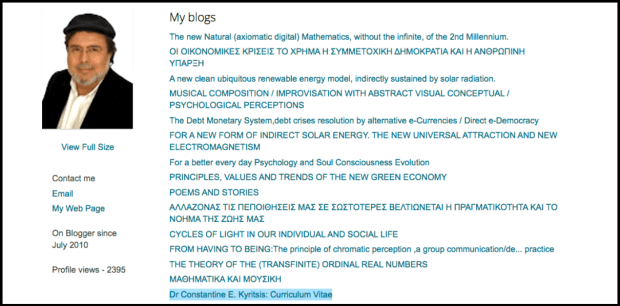
More musings from Dr. Costas Kyritsis
Further insights: Many thanks to reader Caleb Ramsby (a true Maj. 7th tuning aficionado) for sending in some fantastically detailed notes on this form of Zigzag Thirds: “I’ve been playing around with it on my acoustic for a bit – bumped up a full step to G-B-D-F#-A-C#: which, compared to Standard, makes 6str tenser by 3 semitones, and 1str slacker by 3 semitones. I strung with Martin’s Silk & Steels, which seem to hold higher pitches with less tension than typical acoustic strings…”
“The tuning is definitely a rather odd arrangement, for both the head and hands. As Kyritsis says, it definitely provides easy access to a massive array of chords – but, for me, the finger positions are a bit too bunched up, and, due to them all being close voicings on adjacent strings, don’t feel so enticing from a playing or improv perspective. However, it’s a nice one for composing chordal pieces, since they’re all laid out so easily…”
“But, for it to really work, you need a custom set of strings, and probably a modified nut to fit them, as well as bridge/intonation adjustments too (I’m pretty certain that’s why you hadn’t found any audio of people playing with that tuning!). So, for it to be optimally usable, it requires a lot of things to be done. However, G-B-D-F#-A-C# can certainly work to give a feel for it, if you’re willing to torture your sixth string for a bit...” [I, for one, have definitely put my 6str through much worse!].

Like everything on my site, the World of Tuning will always remain 100% open-access and ad-free: however, anti-corporate musicology doesn’t pay the bills! I put as much into these projects as time and finances allow – so, if you like them, you can:
• Support the site! •
…and hasten the project’s expansion…
—Documenting more altered tunings—
—Further harmonic & melodic analysis—
—Engaging with peg-twisting guitarists—
—Ensuring that high-quality guitar knowledge will remain open to all, at no cost: free from commercial motive!—

Insights to share? Get in touch!
• NUMBERS •
| 6str | 5str | 4str | 3str | 2str | 1str | |
| Note | F | A | C | E | G | B |
| Alteration | +1 | 0 | -2 | -3 | -4 | -5 |
| Tension (%) | +12 | 0 | -21 | -29 | -37 | -44 |
| Freq. (Hz) | 87 | 110 | 131 | 165 | 196 | 247 |
| Pattern (>) | 4 | 3 | 4 | 3 | 4 | – |
| Semitones | 0 | 4 | 7 | 11 | 14 | 18 |
| Intervals | 1 | 3 | 5 | 7 | 2 | #4 |
- See my Tunings Megatable for further such nerdery: more numbers, intervallic relations, comparative methods, etc. And to any genuine vibratory scientists reading: please critique my DIY analysis!

• RELATED •
—Associated tunings: proximities of shape, concept, context, etc…
- Zigzag Thirds (Min): reversing the order of the thirds
- All Major Thirds: going up in a straight line this time
- Schizophrenia: another extremely narrow setup

• MORE INFO •
—Further learnings: sources, readings, lessons, other onward links…
- The imaginarium of Dr. Kyritsis: I highly recommend browsing his other music writings too – a vast collection of dense, fiendishly detailed, topic-hopping tracts which combine abstract musical geometry with ancient rhythmic poetry and much, much more. This madcap corner of the online musicology world has certainly provided me with fruitful sparks in my overall tuning quest – and while I’m not quite sure the blog’s title of ‘Simpler Guitar Learning‘ is necessarily the most accurate, I certainly hail the Doc’s mission (“This blog is for making…guitar learning, song composition, and improvisation easier – based on more abstract mathematics of the music…rhythm, and the guitar…It is a new awareness and method, to link mental perception-images, the creation of feelings, and finger actions. The true goal of composition and improvisation is the existential process of creating and listening…We concentrate most of all on the feeling of the sound and new math-musical concepts”)
- ‘Neutral’ thirds: what would it sound like if the two constituent intervals of this tuning – the equally-tempered major and minor 3rds – declared a truce, and joined forces? Well, I guess they coexist harmonically as part of the ‘Hendrix‘ chord (a dom.7#9 voiced as 1-3-b7-#9) – and melodically in the Hindustani Raag Jog (1-3-4-5-b7-8 <> 8-b7-5-4-3-4-b3-1 = SGmPnS <> SnPmGmgS in Indian sargam). Although the ultimate compromise would surely be a ‘neutral third‘: the microtone lying halfway between them (i.e. 350 cents above the root) – which, in looser form, has been a mainstay of blues vocalism from its earliest Delta days (“Cluster analysis was performed…The ‘neutral‘ third was confirmed to occur [and] a similar blending of the perfect 4th and tritone was demonstrated…”). UPDATE (2026): See microtonal pioneer Sevish’s fantastic website covering the ‘Neutral Thirds Tuning’!
Header image: assorted topics on Dr. Kyritsis’ website


George Howlett is a London-based musician, writer, and teacher (guitars, sitar, tabla, & santoor). Above all I seek to enthuse fellow sonic searchers, interconnecting fresh vibrations with the voices, cultures, and passions behind them. See Home & Writings, and hit me up for Online Lessons!