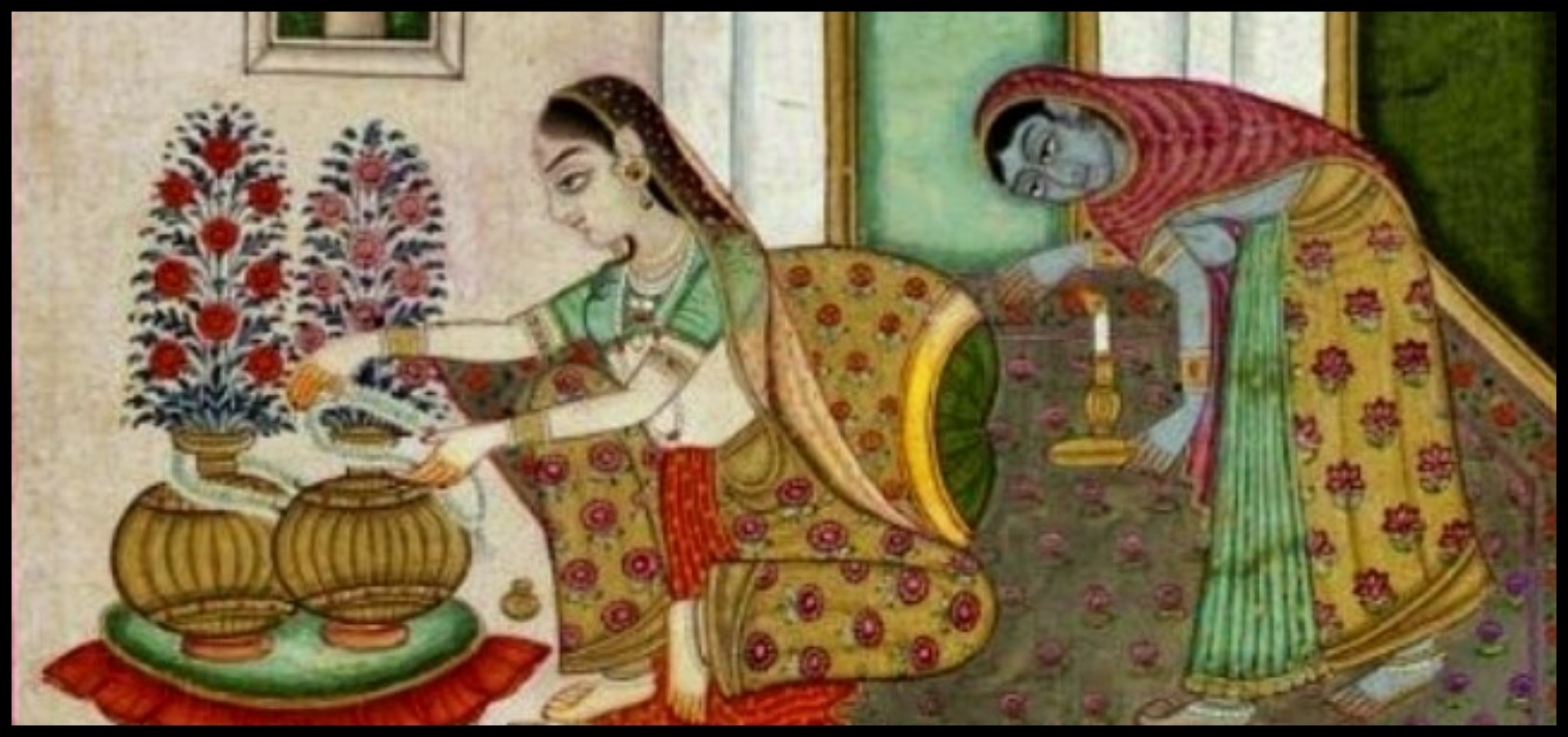

S-R-G-M-P-D-N-S Among the first-learned and most-performed ragas, Yaman’s influence on modern Hindustani music is impossible to overstate. Linked to the early night hours (‘when lanterns are lit’), the disbalancing effects of tivra Ma – the only non-shuddha swara on offer – allow for a kaleidoscopic emotional range, with Sa and Pa often being skipped in […]

• Raag Yaman •

• Raag Bhupali •
S-R-G-P-D-S Hailed for its structural simplicity, Bhupali is often the first raga taught to Hindustani students. While its basic ‘Major Pentatonic‘ scale form is shared by countless global cultures, the North Indian incarnation (named for Madhya Pradesh’s Bhopal region) presents its own quirks – invoking tranquillity and home-bound reassurance with interlinked sliding motions and emphatic […]

• Raag Shuddha Kalyan •
S-R-G-M-P-D-N-S A popular early night raga, Shuddha Kalyan ascends with the same 5 swaras as Bhupali (SRGPDS), and descends with the full 7 of Yaman (SNDPMGRS), leading some to title it ‘Bhoop-Kalyan’. Phrases tend to end on the poorvang-slanted Sa, Re, Ga, or Pa, and both the ‘avroh-only’ swaras (Ni & Ma) must be treated subtly throughout […]

• Raag Maru •
S-R-G-M-D-N-S Rare to the point of near-extinction in its own right, the historic Maru is now best known as an ingredient of the highly popular Maru Bihag. In the words of scholar-singer Arun Dravid: “It is not well known, even in the music world, that Maru Bihag is a mixed raga…very few people know that […]

• Raag Puriya Kalyan •
S-r-G-M-P-D-N-S Effectively combining the poorvang of Puriya Dhanashree with the uttarang of Yaman (SrGM+PDNS), Puriya Kalyan covers the seven swaras of Marwa thaat. Pa is prominent in descent, but may be skipped in Kalyanic ascending passages such as MDNS – and Sa is often omitted in both upward and downward motions, with mandra saptak Ni […]

• Raag Kedar •
S-R-mM-P-D-N-S An early night raga, Kedar is traditionally associated with heat (Tanarang: “there is much thermal energy in this melody…hence it is regarded as a ragini of Deepak“: Tansen’s legendary fire-bringing raga). Often seen as particularly subtle, complex, and hard-to-perform – partly due to its curiously wide aroha jump from Sa to Ma (depending on […]

• Raag Malashree •
S-G-P-S Often said to comprise only three swaras (a SGP major triad), Malashree pushes the bounds of raga definition. Arguably, this challenge is its defining purpose, calling on performers to find expressive freedom within an ultra-limited framework (as per Dagarvani beenkar Bahauddin Dagar, “We do not believe in ‘small’ vs. ‘big’ ragas: Malashree for example […]

• Raag Shyam Kalyan •
S-R-G-mM-P-D-N-S Shyam Kalyan (‘Evening Kalyan‘) is a prachalit Kalyan variant. Ga is used sparingly in ascent, and typically skipped in phrases which run through the scale sequentially, and shuddha ma is taken in descent only – while Re is emphasised throughout, and Pa is available as a resting note. As per Tanarang‘s summary, the raga is “a very […]

• Raag Jait Kalyan •
S-R-G-P-D-S A Bhupali–prakriti raga which blends Jait with the Kalyan-ang, retaining the former’s strong Pa–Sa sangati amidst descending lines from the latter such as DP(G)RS. Re may be played weakly in aroha, rendering some upward-moving sections of the raga surtar, while glides of (D)G and (P)G are frequent. Seemingly introduced to the ragascape by Jaipur-Atrauli […]

• Raag Kamod •
S-R-G-mM-P-D-N-S An intricate raga which draws together elements from many others (Tanarang: “this dynamic melody is rather complex…one can see clear shadows of Malhar [SmRP], Hameer [GmDP], and Kalyan [SRS, SDP], together with glimpses of Kedar [MPDP] and Chayanat [PDPS, SRS]”). Distinguishing sequences include RRP, GmPGmRS, the taar Sa is accentuated with long P/S slides, […]

• Raag Deepavali •
S-R-G-mM-D-N-S A tantalising invention of bansuri pioneer Pannalal Ghosh, with a scale resembling ‘Bihag no Pa’ (or even ‘Bilawal komal Pa’/’Major Scale b5‘). As with Pannababu’s other creations, debate persists as to exactly how he conceptualised the raga – his own renditions span a multitude of ideas, and, at the time of his sudden passing aged […]

• Raag Yaman Kalyan •
S-R-G-mM-P-D-N-S While the terms ‘Yaman’ and ‘Kalyan’ are often used interchangeably, the name ‘Yaman Kalyan’ refers to a distinct double-Ma variant of the parent raga, which sees shuddha ma inserted in descending phrases such as PMG, GmG. Vilayat Khan outlined his view of the raga’s characteristic twin-Ma interaction in the opening remarks to a sublime sitar–shehnai […]

• Raag Nand •
S-R-G-mM-P-D-N-S Associated with Lord Krishna, Nand (also known as ‘Anandi’ or ‘Anandi Kalyan‘) rose to prominence around the turn of the 20th century – initially gaining renown through a pair of bandishes by Mehboob Khan ‘Daraspiya’ (Dhundu Bare Saiyan) and Vilayat Hussain Khan ‘Pranpiya’ (Ajahun Na Aye). Aarshin Karande describes the raga as being “regarded […]

• Raag Shree Kalyan •
S-r-G-M-P-D-N-S Congruent with the seven swaras of Puriya Kalyan (and Marwa thaat), Shree Kalyan is an enchanting product of Kumar Gandharva’s prolific imagination (also see Madhusurja, Lagan Gandhar, Saheli Todi, Rati Bhairav, Bihad Bhairav, and Bhavmat Bhairav). The movements of his main rendition (Dekho Re Rut Phoolan Lagi) place Shree’s tritonal re–Pa sangati on stark […]

• Raag Medhavi •
S-R-G-mM-P-D-nN-S Medhavi is generally cited as an invention of Ali Akbar Khan, who seems to be the sole source of recordings – however the liner notes to his most prominent rendition make no direct mention of this, instead describing it as “a compound melody of recent origin…its features [vary] according to traditional modes”, adding that […]

• Raag Latangi •
S-R-G-M-P-d-N-S A unique sampurna scale borrowed from the 63rd Carnatic mela, which takes the form of ‘Kalyan komal dha’ (or ‘Yaman’s poorvang + Bhairav’s uttarang’: SRGM+PdNS). Subbha Rao’s Raga Nidhi Vol.3, written in the early 1960s, mentions that “Latangi is not found in Hindustani music” (p.90) – and it remains unclear who first imported the […]

• Raag Chayanat •
S-R-G-mM-P-D-N-S A longstanding combination of Chaya and Nat, creating (as per Tanarang) an “attractive, sweet, and emotionally swaying” mood – the latter in particular summoned via ‘simple vakra’ phrases such as DNDP; RGRS. The Pa–Re sangati is vital, and shuddha ma is stronger than tivra Ma – with the raga inviting a range of expressive […]

• Raag Lakshmi Kalyan •
S-R-G-mM-P-D-N-S An enchanting but seldom-heard raga, taking the swara set of ‘Kalyan double-Ma’ (n.b. ‘Lakshmi’ refers to the Hindu goddess of power, prosperity, and fortune). Described by slide guitarist Deepak Kshirsagar as “a combination of Shuddha Sarang and Shyam Kalyan, [although] some combine Shuddha Sarang and Kamod..or use [the swaras of] Shyam Kalyan in the […]

• Raag Maluha (Kalyan) •
S-R-G-m-P-D-N-S Maluha (‘Tearful’) is compound raga which draws on forms including Kamod and Shyam Kalyan. Tivra Ma and komal ni are mostly restricted to ornamental use (e.g. GP(MDPM)P), and the avroh may feature touches of Khem Kalyan and other proximate forms. The liner notes to a 1966 Nikhil Banerjee album describe Maluha Kalyan as “an […]

• Raag Anjani Kalyan •
S-R-g-M-P-D-N-S A creation of Gwalior vocalist and educator Ramashreya Jha ‘Ramrang’ – named in honour of Anjana, a mythic Vanara princess fabled in Hindu lore as Lord Hanuman‘s mother. As per his student Rajan Parrikar, “the basic idea involves rendering the aroha of Madhuvanti sampurna, by taking in both [shuddha] Re and Dha. The aroha […]

• Raag DoGa Kalyan •
S-gG-M-P-D-N-S A Ravi Shankar creation taking the form of ‘Kalyan with komal ga instead of Re’ (‘DoGa’: ‘Double-Gandhar’) – which, despite never having been released in classical form, may have left its mark on modern music as a possible source for The Beatles’ Blue Jay Way, composed by Shankar’s sitar student George Harrison in 1967. At […]

• Raag Hameer •
S-R-G-mM-P-D-N-S A winding raga of complex historical lineage, Hameer (‘Royal, Regal’) enjoys a steady presence on the modern concert circuit. Re is weak in aroha, and Tanarang links the shuddha Dha vadi to “the enthusiasm and courage of warriors”, giving a pakad of GMND; DDP and uttarang-focused phrases such as Gm(N)DNS; PDPPS; MPDNS. Touches of […]

• Raag Khem Kalyan •
S-R-G-mM-P-D-N-S A rare-but-charming raga of the Agra gharana, Khem Kalyan is a Kalyan variant with Hansadhwani-like touches. In his essay The Precious Kalyan, Imdadkhani sitarist-scholar Deepak Raja recounts his quest to decode and reconstruct its workings from old recordings, having failed to find a guru who knew it: “This was no ordinary raga…not even just […]

• Raag Raj Kalyan •
S-R-G-M-D-N-S A ‘Kalyan no Pa’ melody devised by Gwalior vocal innovator Vasantrao Deshpande (although he may well have seen it more like a ‘Marwa shuddha Re’). Parrikar describes how “the relief-inducing nyas on Pa is missing, giving a ‘restive’ persona”, while Ocean of Ragas gives a pakad of GmD, DmGR, NRS. Generally treated as hexatonic […]

• Raag Adbhut Kalyan •
S-R-G-D-N-S An uncommon Kalyan variety, named Adbhut (‘Wondrous’) for omitting two of Kalyan’s most vital swaras (Ma & Pa). Remains popular in the Dagarvani Dhrupad, but few others have risen to the centreless challenges of losing both mid-saptak swaras. Aminuddin Dagar reportedly considered the raga to be an offshoot of Khem Kalyan, while Uday Bhawalkar links […]

• Raag Savani •
S-R-G-m-P-D-N-S An evening raga, which, despite its regular titling of ‘Savani Kalyan’, usually lies closer to Bihag than the Kalyan family – chiefly via avoiding tivra Ma, and giving greater strength to the Sa–Pa sangati. In the raga’s main incarnation, Dha and Ni are often rendered durbal, and may be skipped via PSP turnarounds (although […]

• Raag Rampriya •
S-r-G-M-P-D-n-S A mysterious sampurna form which follows the swara set of ‘Ahir Bhairav tivra Ma’, ‘Vachaspati komal re’, or ‘Puriya Kalyan komal ni’ (I’ve also seen the scale referred to as ‘Persian Vachaspati’ and ‘Ram Puriya Kalyan’). The ‘Rampriya’ moniker derives from a congruent Carnatic raga, although it is unclear whether this is a post-hoc […]

• Raag Sanjh Saravali •
S-R-G-mM-P-D-N-S Taking the general form of ‘Yaman Kalyan seasoned with Bihag’, Sanjh Saravali (‘Evening Melody’) was devised by Vilayat Khan in the late 1970s. Fellow Imdadkhani sitarist Deepak Raja, aided by input from Vilayat himself, describes the raga as “incorporating fleeting impressions of several Kalyan ragas, including Nand Kalyan and Chayanat…its melodic identity rests on […]

• Raag Purva •
S-r-G-M-P-D-N-S As per Deepak Raja’s insightful analysis, “Purva [bears] resemblance to Puriya in terms of swara material, phraseology, melodic centre of gravity, and aural impression” – also adding that, while sitarist Vilayat Khan considered the raga indistinguishable from Puriya Kalyan, it is in fact marked out by “differential weightages given to different segments of the […]

• Raag Kesari Kalyan •
S-R-G-P-D-N-S Kesari Kalyan is formed by removing Kalyan’s most characteristic swara – tivra Ma – leaving a curious shadav scale (prakriti with Shankara). Legendary Gwalior vocalist and educator Ramashreya Jha ‘Ramrang’ appears to have created the raga: hear his own rendition, and also listen to him discuss it in the context of “two key ideas […]
