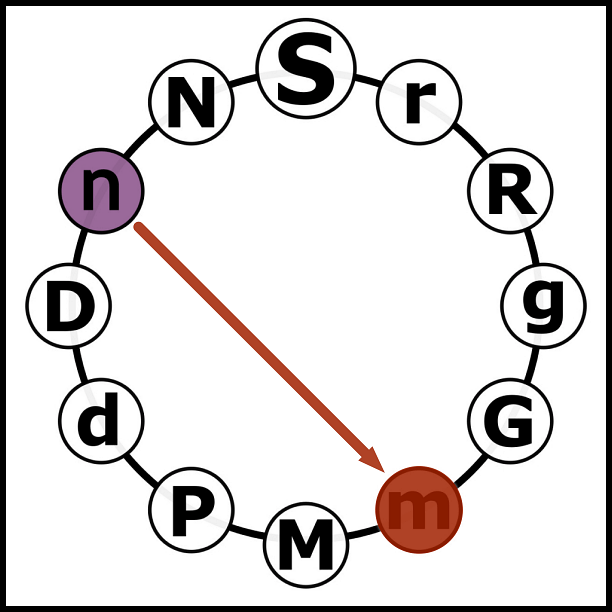

S-G-P-D-n-S A playful pentatonic form, neatly structured as a stack of ‘regularly narrowing’ intervals (4>3>2>1 semitones). The wide, sparse poorvang (SG) and clustered uttarang (PDnS) combine to bring a reassuring momentum, with increasing melodic urgency as you go higher (a ‘triple jump then a sprint’). Most Kalavati performances tend towards energy and rhythmic charge (Rahul […]

• Raag Kalavati •

• Raag Vachaspati •
S-R-G-M-P-D-n-S Vachaspati (‘Lord of Speech’) is a recent import from the South, adapted from Carnatic music’s 64th mela scale around the mid-20th century by artists including Ravi Shankar and Ali Akbar Khan. Consequently, its Northern form is still in a state of flux, with few firm melodic conventions aside from staying within the scale’s bounds – […]

• Raag Bairagi Todi •
S-r-g-P-n-S Created by Ravi Shankar, Bairagi Todi replaces Bairagi’s shuddha ma with a Todi-intoned ati-komal ga, retaining the concise audav structure while presenting an odd mix of narrow and wide intervals. Sometimes matched with unusual talas (e.g. Shankar’s original is in ‘sade-gyarah’: a ‘fractional‘ 11.5 matra cycle divided ‘4-4-2-1.5‘), the raga is explorable in all saptak, […]

• Raag Bahar •
S-R-g-m-P-D-nN-S As per Tanarang, Bahar (‘Spring’) “brings out nature’s beautiful blessings…full of shringar and bhakti ras…khatkas and intricate taans are conducive to its dynamic, fleeting nature”. While rooted in the Kanada raganga, the raga features a Malharic twin-Ni, with the shuddha being more prominent. Bageshri hallmarks can also be evident in the weak aroha Re, and […]

• Raag Saraswati •
S-R-M-P-D-n-S Derived as a ‘janya’ offshoot of the Carnatic Vachaspati (mela #64), Saraswati is named after the four-armed Hindu goddess of music, art, and learning – also venerated in Thailand as ‘Surasawadee’, Myanmar as ‘Thurathadi’, China as ‘Biancaitian’, and Tibet as ‘Yang-Chen-Ma’ (the word derives from ‘saras+wati’: ‘she who possesses flowing water’, associated with Harappan-era worship of […]

• Raag Madhukauns •
S-g-M-P-n-S A curious ‘Dhani tivra Ma’ scale introduced by vocalist Amir Khan via a ‘ma-murchana’ of Chandrakauns (listen to his sargam-demo of the process below) – full of inescapable tension, with 3 of the 5 swaras being imperfect, and the disbalancing Ma–ni sangati on stark display. Sometimes considered identical to Khan’s Chandramadhu, created as part […]

• Raag Amirkhani Kauns •
S-G-M-P-n-S A ‘pentatonic Vachaspati’ created (as the name implies) by Indore vocal master Amir Khan, which omits Re and Dha (thus, Amirkhani Kauns is to Vachaspati as Dhani is to Kafi). All swaras except Sa are imperfect – with the unusual Ma–ni sangati exerting inevitable gravity and drawing melodies away from clear resolution. Few of […]

• Raag Hemavati •
S-R-g-M-P-D-n-S Adopted from Carnatic mela #58, Hemavati matches the swaras of ‘Kafi tivra Ma‘, ‘Madhuvanti komal ni’, or ‘Vachaspati komal ga’. Prominently associated with Hariprasad Chaurasia, although it is unclear who may have first borrowed the scale from the South: Abdul Halim Jaffer Khan also recorded it, as has Amjad Ali Khan, with broad melodic variance […]

• Raag Sehera •
S-R-G-M-d-n-S Among the strangest of raga scales, Sehera’s six swaras are all spaced out in two-semitone jumps (akin to the Western Whole-Tone Scale and the Carnatic Gopriya). The resulting symmetries summon a curious, centreless mood (also famous as the ‘dream sequence‘ of countless soundtracks) – best explored by its creator sarangiya Sultan Khan, who described Sehera as […]

• Raag Shanmukhpriya •
S-R-g-M-P-d-n-S A strange scale imported from the Carnatic mela #56, equivalent to ‘Darbari tivra Ma’ (or ‘Hemavati komal dha’). Despite its Southern popularity, it is still little-known in the North, with only a few Hindustani artists having explored it in any depth. Among these, Rampur-Sahaswan singer Hafeez Ahmed Khan provides direct insight into its workings […]

• Raag Shankh Dhwani •
S-R-G-P-n-S A pleasing pentatonic form, Shankh Dhwani (‘Sound of the Conch’) takes its name from a truly ancient instrument. While we will never know precisely when our proto-human ancestors first blew into a resonant gastropod shell, artefacts turn up in the archaeological record as early as 18,000 years ago – with their ritual significance discussed […]

• Raag Tivrakauns •
S-g-M-d-n-S A novel experiment by rare raga connoisseur Abhirang, formed by changing Malkauns’ shuddha ma vadi to its tivra variant. This shift renders both Sa and Ma ‘detached’ (i.e. with no swaras either 7 semitones above or below them: a property shared by only Harikauns and Sehera), meaning that conclusive resolutions towards the raga’s two […]

• Raag Komal Ramkali •
S-r-g-M-P-d-n-S A strange sampurna scale, equivalent in shape to ‘Todi komal Ni’ or ‘Bhairavi tivra Ma’ (or ‘Todi’s poorvang + Bhairavi’s uttarang’: SrgM+PdnS) – indeed, the scale matches a historic form of Todi itself (Bor: “Todi Varali…first mentioned by Ahobala c.1665, with the scale SrgMPdnS”). Aside from Sa and Pa, Komal Ramkali has no shuddha […]

• Raag Jansammohini •
S-R-G-P-D-n-S Broadly running along the lines of ‘Kalavati plus shuddha Re’ (especially in avroh), Jansammohini is a captivating Southern import. As per santooriya Tarun Bhattacharya, “This [scale] was originally called ‘Siva Kalyan’, but the raga went out of circulation. Having heard the Carnatic Jansammohini, my guruji Ravi Shankar brought it back [under] the Carnatic name. […]

• Raag Harikauns •
S-g-M-D-n-S Among the strangest of pentatonic scales, Harikauns resembles ‘Hemavati no Re/Pa’ or ‘Madhukauns with Dha-for-Pa’ (or ‘Malkauns with the middle two swaras raised’) – forming a ‘diminished square’ of 3-semitone jumps (SgMD) plus a (symmetry-destroying) komal ni. Aside from a natural uttarang focus, the raga allows for near-complete freedom of motion – but presents inherent […]

• Raag Rasikpriya •
S-gG-M-P-nN-S A direct borrowing of the Carnatic mela #72: which, as the final position on the wheel, has all its swaras set to their highest allowable positions. In Hindustani music, the equivalent principle would produce Yaman (SRGMPDNS), but the South Indian system allows three variants for each of Re, Ga, Dha, & Ni, with the highest Re/Dha […]

• Raag Malay Marutam •
S-r-G-P-D-n-S ‘Malay Marutam’ translates as ‘Fragrant Hill-Breeze’. Maihar bansuriya Rupak Kulkarni explained to me in a 2018 interview how the raga “is from Carnatic music, which does not give so much attention to the times of day. We have decided to designate it as a morning raga, mainly due to the nature and essence of […]

• Raag Kameshwari •
S-R-M-P-D-n-S Dreamed up by Ravi Shankar during a March 1968 car journey through Chengali, Bengal. As explained by his widow Sukanya: “While riding in the car, he conceived the nucleus of a melodic form that he later developed and called Kameshwari [‘Lordess of Love’]. By using the old murchana and swara bheda system, he discovered […]

• Raag Devshri •
S-R-M-P-n-S An intriguing audav raga resembling ‘Megh tivra Ma’ (or ‘Vachaspati no Ga/Dha’). Its unique swara set – which features the unusual ‘tivra Ma, komal ni‘ sangati – is principally distinguished by a disbalance in how Sa and Pa are ‘surrounded’ by the swaras above and below (nSR: ‘2-2’, MPn: ‘1-3’) – offering curious contrast with the symmetry […]

• Raag Chandni Todi •
S-r-g-M-P-D-n-S Equivalent to ‘Todi’s poorvang + Kafi’s uttarang‘ (or ‘Ahiri tivra Ma’), the SrgM+PDnS scale has barely been explored in Hindustani music – in fact, I couldn’t trace a single recording of it until late 2025, when vocalist Ashish Dha sent me his experiment in a new raga titled Chandni Todi (‘Moonlit Todi’). He describes […]

• Raag Saheli Todi •
S-r-g-P-d-n-S An invention of vocalist Kumar Gandharva, lying between Bhupali Todi and Bilaskhani Todi via the addition of an avroh komal ni to the former (or the subtraction of ma from the latter). His original renditions linger patiently on the komal re (often intoned with a noticeably higher sruti than is usual for the Todi […]

• Raag Monomanjari •
S-r-G-M-P-D-nN-S A scale with no apparent prakritis unveiled by sitar icon Nikhil Banerjee some time in the 1970s (in his own words: “I’m quite satisfied with one of my Sonodisc LPs, Raag Monomanjari: that’s my favourite so far…”). From Narendra Datar’s 1989 review of this record: “A jod raga…a remarkable combination of Kalavati and Marwa. […]

• Raag Chandramadhu •
S-g-M-P-n-S An angular pentatonic form conjured up by vocalist Amir Khan only a short time before his untimely death in a 1974 car accident – indeed, it is unclear if he ever formally named his new creation (I’ve seen it referred to as ‘Bhushwati’ and ‘Amarpriya’, and at least two releases just list it as […]

• Raag Faridi Todi •
S-r-gG-M-d-n-S A Todi variant known, as of 2025, through a single rendition: Supriyo Maitro’s spellbinding vocal tribute to his Dagarvani forebear Zia Fariduddin Dagar, live from the 2018 Faridi Samorah Festival in Bhopal with Aditya Deep on pakhawaj (“in remembrance of [Zia’s] 86th birthday, the festival was a musical tribute to the Ustad by his […]

• Raag Salagavarali •
S-r-g-P-D-n-S A rare ‘Ahiri no ma’ scale, combining a Bhupali Todi-like poorvang with an Ahir Bhairavic uttarang (Srg+PDnS) As per Parrikar: “S.N. Ratanjankar conceived of this raga…ma is eliminated to yield the following contour: SrgPDnDS; SnDPgPrgrS. Brilliantly exploited by Jitendra Abhisheki in a celebrated natyageeta. Watch out for the injection of a vivadi dosha via […]

• Raag Milan Gandhar •
S-gG-P-D-n-S An enchanting yet ultra-rare raga created by pioneering Punjabi vocalist Salamat Ali Khan, running along the lines of ‘Kalavati with komal ga in avroh’ (often as PDPgS or SngS), bringing shades of Kafi. A 1965 Salamat & Nazakat performance in Kabul (bandish: Piya More Angan Aaye & Tana Dhere Na Dhim), emphatically places the […]

• Raag Tanseni Madhuvanti •
S-R-g-M-P-D-nN-S A captivating offshoot of Madhuvanti, named ‘Tanseni’ for its use of a Miyan ki Malhar-flavoured double-Ni sangati. Associated with the Rampur sarangi tradition, most prominently Hamid & Zahid Khan – as per the liner notes to Hamid’s ektal rendition: “it also resembles Multani…it is of Kafi parentage, with accents on Sa & Ma”. Thus […]

• Raag Sundarkali •
S-r-G-P-n-S A relatively straightforward audav raga, Sundarkali takes the swaras of ‘Ahir Bhairav no ma/dha’. Anjani Kumar Gupta’s concise bansuri rendition is the only full recording I could find (alap transcribed below), although Tanarang’s disciple Prakash Vishwanath Ringe has released a brief selection of khayal demos (and sax player Mister D Cell has used it to […]

• Raag Mangal Gujari •
S-r-g-M-d-n-S A strange shadav scale matching the swara set of ‘Gujiri Todi komal ni’ or ‘Meladalan minus shuddha ma’. Its structure presents a unique combination of geometric quirks: Sa is ‘detached’ (=Pa and ma are both varjit), and all other swara positions are vikrit (rgdn: komal, M: tivra) – leaving the ultra-rare ‘tivra Ma, no […]

• Raag Rampriya •
S-r-G-M-P-D-n-S A mysterious sampurna form which follows the swara set of ‘Ahir Bhairav tivra Ma’, ‘Vachaspati komal re’, or ‘Puriya Kalyan komal ni’ (I’ve also seen the scale referred to as ‘Persian Vachaspati’ and ‘Ram Puriya Kalyan’). The ‘Rampriya’ moniker derives from a congruent Carnatic raga, although it is unclear whether this is a post-hoc […]

• Raag Lilavati •
S-g-P-D-n-S Confusion persists around which melodic forms assume the name ‘Lilavati’, with several incongruous examples in sporadic modern circulation – as per Biswarup Ghosh Dastidar, “Lilavati/Leelavati can be sung in Kafi thaat [SRgPdS], Khamaj thaat [SgPDnS] and Bhairav thaat [SrGmPnS]”. Abhirang sets his to the tones to the second of these (as a ‘komal ga Kalavati’), […]

• Raag Shankara Karan •
S-R-G-M-P-D-nN-S Associated with the crisp mornings of springtime, Shankara Karan is variously said to blend elements of Shankara, Shree, Hindol, and Yaman – although its swara set (‘Yaman double Ni’) is seldom-heard in the Hindustani ragascape (also hear the ultra-rare Guru Kalyan & Kala Kalyan). Recordings are rare, with the most prominent cut being a 1995 […]

• Raag Saurashtra Bhairav •
S-r-G-m-P-dD-N-S A unique ‘double-Dha’ blend of the morning Bhairav with the night-time Bhinna Shadja, Saurashtra Bhairav’s movements vary across gharana boundaries. Abhirang, interpreting a pair of Ramrang compositions (Barani Na Jaye Chabi & Aba Main Kase Jaya Kahu), cites the importance of Bhinna Shadja’s mDNSNDm catchphrase – although most other movements fall in line with those of […]

• Raag Manavi •
S-R-g-P-D-n-S A shadav scale resembling ‘Kafi no ma’ (or ‘Shivranjani plus ni’), said to have been adapted from a congruent Carnatic form (Madhyamavarali). Most prominently performed by Patiala star Parveen Sultana: her enchanting 1982 album rendition places a swooping Pa–ga sangati centre-stage (e.g. P\gP; P(g)PgR), often traversing wide interval jumps such as gPgD; nDgPgRS (bandish: […]

• Raag Madhukant •
S-R-g-M-P-D-n-S An oddly-shaped and thinly-analysed sampurna raga, taking the shape of ‘Madhuvanti’s poorvang + Kafi’s uttarang’ (SRgM+PDnS: i.e. ‘Kafi tivra Ma’). Analysed by Jairazbhoy in 1971: “Ragas in which the Pa has a leading note [MP], while the Sa does not [nS]…Madhukauns and Madhukant are both modern ragas which appear to be evolving rapidly…Madhukant [is] […]

• Raag Namanarayani •
S-r-G-M-P-d-n-S Equivalent to ‘Basant Mukhari tivra Ma’, the SrGMPdnS swara-set – known in Carnatic music as Namanarayani, the 50th mela – has barely been played in the North. I searched hard during my quest to find matching ragas for the 32 ‘sampurna thaat’ scales (=all those with one variant each of ‘Sa, Re, Ga, Ma, […]

• Raag Rishabhapriya •
S-R-G-M-P-d-n-S Already a rare mode in Carnatic music (mela #62), Rishabhapriya has barely been touched by Hindustani musicians. Equivalent to ‘Charukeshi tivra Ma’ or ‘Vachaspati komal dha’, all poorvang swaras are set to their highest specific positions, and all uttarang swaras are at their lowest (SRGM+PdnS: like ‘Yaman’s poorvang + Bhairavi’s uttarang’). The rare Ma–ni sangati […]
