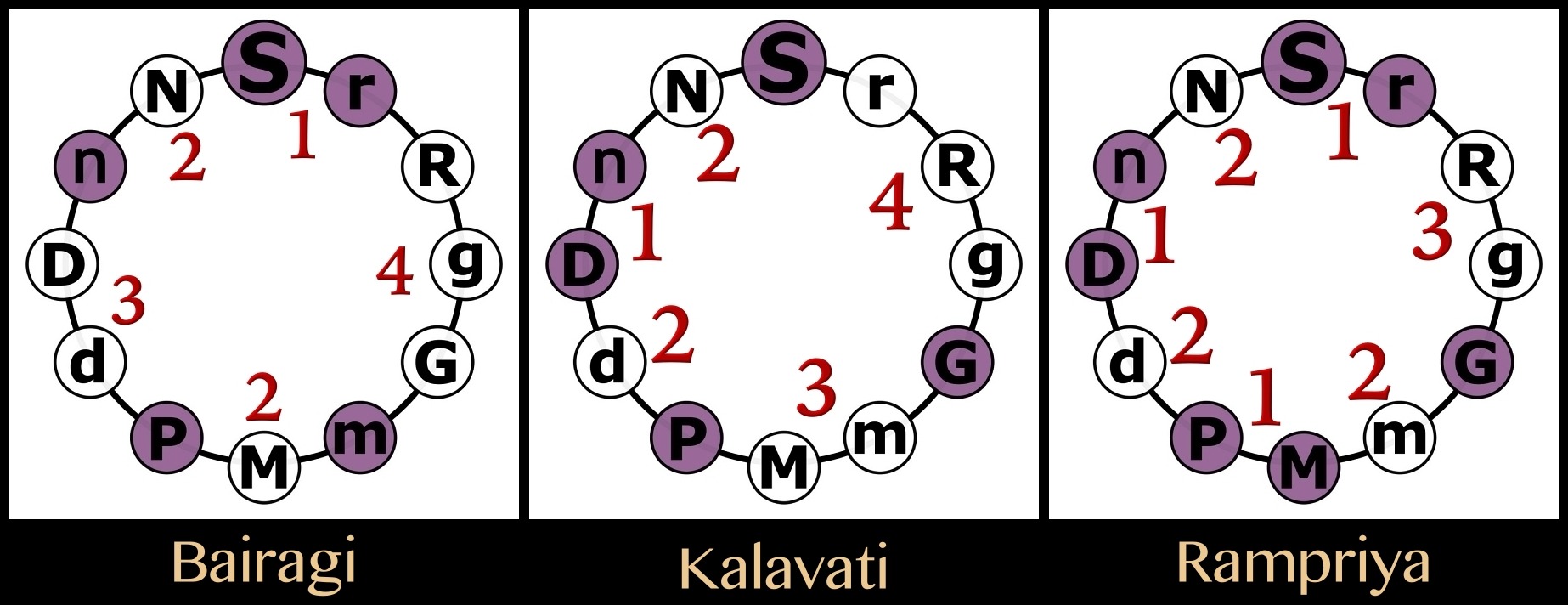

S-G-P-D-n-S A playful pentatonic form, neatly structured as a stack of ‘regularly narrowing’ intervals (4>3>2>1 semitones). The wide, sparse poorvang (SG) and clustered uttarang (PDnS) combine to bring a reassuring momentum, with increasing melodic urgency as you go higher (a ‘triple jump then a sprint’). Most Kalavati performances tend towards energy and rhythmic charge (Rahul […]

• Raag Kalavati •

• Raag Shivranjani •
S-R-g-P-D-S A spellbinding raga resembling ‘Bhupali komal ga’ (or ‘Kafi no ma/ni’), Shivranjani’s melodies, described by Kalakar as “plaintive and haunting”, are said to appease the destructive rage of Lord Shiva (a similar mythology to that of Malkauns). Tanarang suggests illustrative combinations of SRgPD; PDPgR; gRgSRDS, although interpretations vary greatly within the scale’s pentatonic bounds […]

• Raag Bhupali Todi •
S-r-g-P-d-S A captivating audav raga said to symbolise spiritual purity, which essentially runs along the lines of ‘what if all Bhupali‘s chal swaras (Re, Ga, Dha) were komal rather than shuddha?’ (SRGPDS > SrgPdS). Most renditions are poorvang-dominant, drawing from the Todi-ang as well as reshaping phrases from Bhupali, Bilaskhani Todi, and other forms (given the uniqueness […]

• Raag Bairagi Todi •
S-r-g-P-n-S Created by Ravi Shankar, Bairagi Todi replaces Bairagi’s shuddha ma with a Todi-intoned ati-komal ga, retaining the concise audav structure while presenting an odd mix of narrow and wide intervals. Sometimes matched with unusual talas (e.g. Shankar’s original is in ‘sade-gyarah’: a ‘fractional‘ 11.5 matra cycle divided ‘4-4-2-1.5‘), the raga is explorable in all saptak, […]

• Raag Bairagi •
S-r-m-P-n-S A distinctive pentatonic form inducted into the ragascape by an early-career Ravi Shankar. As recounted in Oliver Craske’s superlative biography Indian Sun (p.106), “Shankar created Bairagi in 1949, [publishing] the raga and a bandish…in Sangeet Magazine”. The ‘Megh komal re‘ swara set – which may well have appeared in other guises throughout history – […]

• Raag Hindol •
S-G-M-D-N-S A captivating, challenging audav raga with all swaras appearing in their highest specific positions (i.e. no komals, and Ma, if present, is tivra: also see Bhupali, Hansadhwani, & Adbhut Kalyan). The name translates as ‘swinging’: indicative of the raga’s melodic character, which is built around ‘swaying’ motions between a SGD trio of nyas, with […]

• Raag Gunkali •
S-r-m-P-d-S An enchanting morning raga, matching the swara set of ‘Bhupali komal re/dha’ (or ‘Shobhawari komal re’), described by Tanarang as “an epitome of bhakti and karuna…straightforward, and expandable in all three octaves”. While audav at its core, multivariate forms of the raga are in existence: some include shades of shuddha Ga in avroh (bringing hints […]

• Raag Malashree •
S-G-P-S Often said to comprise only three swaras (a SGP major triad), Malashree pushes the bounds of raga definition. Arguably, this challenge is its defining purpose, calling on performers to find expressive freedom within an ultra-limited framework (as per Dagarvani beenkar Bahauddin Dagar, “We do not believe in ‘small’ vs. ‘big’ ragas: Malashree for example […]

• Raag Firozkhani Todi •
S-r-g-M-d-S A fascinating audav raga formed by removing the Ni from Gujiri Todi – leaving an angular pentatonic shape which, aside from Sa, contains no shuddha swaras (n.b. the same scale is known as ‘Audav Todi’ and ‘Chaya Todi’ too: although the latter title is also separately applied to other fusions of Chaya and Todi). […]

• Raag Amirkhani Kauns •
S-G-M-P-n-S A ‘pentatonic Vachaspati’ created (as the name implies) by Indore vocal master Amir Khan, which omits Re and Dha (thus, Amirkhani Kauns is to Vachaspati as Dhani is to Kafi). All swaras except Sa are imperfect – with the unusual Ma–ni sangati exerting inevitable gravity and drawing melodies away from clear resolution. Few of […]

• Raag Amritvarshini •
S-G-M-P-N-S A rare audav raga corresponding to the swaras of ‘Yaman no Re/Dha’, imported from a well-established Carnatic form. The name translates as ‘one who showers the elixir of immortality’, hinting at its rich mythological history – in South India, the raga has long been associated with the monsoon (compare to the Northern Malhar ragas, […]

• Raag Kaushik Dhwani •
S-G-m-D-N-S A modern-era descendent of the ancient Bhinna Shadja, essentially indistinguishable from its parent. Ma is a strong vadi, and a S\D glide is common in descending motions – but aside from this, artists are essentially free to roam at will within the scale, with all swaras employable as nyas across all three saptak (Tanarang: […]

• Raag Sundarkauns •
S-g-m-D-n-S There are at least two ragas in modern circulation which go by the title ‘Sundarkauns’, which appear to share no connection other than their name. One version, taking the swaras SgmDnS (‘Malkauns shuddha Dha’), is described by Tanarang as having been unjustly sidelined by previous generations, who have tended to misinterpret it as a ‘Bageshri-ang Chandrakauns’ […]

• Raag Chandni Todi •
S-r-g-M-P-D-n-S Equivalent to ‘Todi’s poorvang + Kafi’s uttarang‘ (or ‘Ahiri tivra Ma’), the SrgM+PDnS scale has barely been explored in Hindustani music – in fact, I couldn’t trace a single recording of it until late 2025, when vocalist Ashish Dha sent me his experiment in a new raga titled Chandni Todi (‘Moonlit Todi’). He describes […]

• Raag Shobhawari •
S-R-m-P-d-S A rare ‘audav Asavari’ raga, matching the swaras of ‘komal Dha Durga’ (or ‘shuddha Re Gunakri‘). While relatively free of specific melodic constraints, the dha assumes natural prominence due to its disbalancing effects: it is involved in the only hemitonic pairing (Pd) and also the widest adjacent jump (dS), while serving as the only […]

• Raag Shivawanti •
S-R-g-M-P-D-S A sparsely-documented modern creation of sitar and surbahar legend Imrat Khan – kindly brought to my attention by his student Chris Stephens via the Chandrakantha forum: “In regard to the ‘idiosyncratic’ Etawah ragas, here’s a video of [Khan] playing Shivawanti, which he described as a combination of Shivranjani and Madhuvanti. I captured this in […]

• Raag Rasaranjani •
S-R-m-D-N-S A rare, oddly-shaped audav raga formed by omitting Ga and Pa from Bilawal thaat – essentially, ‘removing the major triad from the major scale’ (it can also be seen as ‘Bhavani plus Ni’, Rajeshwari Re-for-ga’, or ‘Durga Ni-for-Pa’). Vocalist Sakuntala Narasimhan, introducing a drut khayal, cites Rasaranjani as an innovation of her Rampur gharana […]

• Raag Devranjani •
S-m-P-d-N-S Stretched by the emptiness of a vast Sa–ma poorvang jump, Devranjani is formed by removing the re and Ga from Bhairav. Abhirang offers up both ‘shuddha Ni’ and ‘double Ni’ variants, with the former appearing to be predominant – while Bhatkhande’s early 20th-century works discuss the unavoidable strength of the ascending phrase Sm, mP […]

• Raag Bhavani •
S-R-m-D-S Distinguished by permitting only four swaras (and sometimes titled ‘Chatuswari’: ‘four-toned’), Bhavani’s symmetrical shape is akin to ‘Durga no Pa’ – seemingly reflected in its title, with ‘Bhavani‘ referring to a fierce, nurturing form of Maa Durga who dispenses cosmic justice by killing malevolent Asuras. Its intriguing surtar sparsity necessitates a multipolar approach to […]

• Raag Abhogi •
S-R-g-m-D-S A rare instance of an ‘audav Kanada’ raga, Abhogi’s swara-set resembles ‘Bageshri‘s aroha without ni’ – presenting a clustered poorvang and sparse uttarang (SRgm; DS). As per Tanarang, the raga’s capacity for Darbaric concluding motions (mgmRS) summons “a deep atmosphere” – with the vacant upper scale presenting performers with a curious creative challenge. Abhogi is […]

• Raag Salagavarali •
S-r-g-P-D-n-S A rare ‘Ahiri no ma’ scale, combining a Bhupali Todi-like poorvang with an Ahir Bhairavic uttarang (Srg+PDnS) As per Parrikar: “S.N. Ratanjankar conceived of this raga…ma is eliminated to yield the following contour: SrgPDnDS; SnDPgPrgrS. Brilliantly exploited by Jitendra Abhisheki in a celebrated natyageeta. Watch out for the injection of a vivadi dosha via […]

• Raag Milan Gandhar •
S-gG-P-D-n-S An enchanting yet ultra-rare raga created by pioneering Punjabi vocalist Salamat Ali Khan, running along the lines of ‘Kalavati with komal ga in avroh’ (often as PDPgS or SngS), bringing shades of Kafi. A 1965 Salamat & Nazakat performance in Kabul (bandish: Piya More Angan Aaye & Tana Dhere Na Dhim), emphatically places the […]

• Raag Rajeshwari •
S-g-m-D-N-S Taking the swaras of ‘Chandrakauns shuddha Dha’, Rajeshwari’s five tones bring an idiosyncratic spin to the Kaunsi-ang, coloured with diffuse tensions. All poorvang swaras are set to their lowest specific position (Sgm), and all uttarang swaras are set to their highest (DNS), with the relief-bringing Re–Pa axis banished throughout. The resulting scale presents significant challenges […]

• Raag Gunakri •
S-r-m-P-d-S Taking the swaras of ‘Bhairav no Ga & Ni’, Gunakri – described by AUTRIM as “serious and peaceful” – brings out the character of its parent raganga via an oscillating komal re, and movements patterns including Sd, dP and SdSr, rS (although Jairazbhoy prefers to analyse it via the geometries of Basant Mukhari). Bose gives a […]

• Raag Bhinna Shadja •
S-G-m-D-N-S Often characterised as the ‘older form’ of today’s Kaushik Dhwani, Bhinna Shadja’s lineage stretches back well over 1000 years. It appears in numerous ancient shastras: notably including Matangamuni’s Brihaddeshi (~8th-century), Abhinavagupta 11th-century writings (“Bhinnashadaja, Kaushiki, and Bhinnapanchama are favoured in Summer”), and Sarangdeva’s 13th-century Sangita Ratnakara – which describes its scale form in remarkably […]

• Raag Bangal Bhairav •
S-r-G-m-P-d-S A distinctive Bhairav raganga offshoot with uncertain origins, summarised in oddly poetic fashion by MeetKalakar: “Being Nishad-taboo, its caste is shadav. Dhaivat and Rishabh are used softly…which are respectively the plaintiffs”. Performed by only a handful of khayal vocalists (e.g. Abhirang, Purnima Sen, and Yunus Hussain Khan) – but remains a staple of the […]

• Raag Rampriya •
S-r-G-M-P-D-n-S A mysterious sampurna form which follows the swara set of ‘Ahir Bhairav tivra Ma’, ‘Vachaspati komal re’, or ‘Puriya Kalyan komal ni’ (I’ve also seen the scale referred to as ‘Persian Vachaspati’ and ‘Ram Puriya Kalyan’). The ‘Rampriya’ moniker derives from a congruent Carnatic raga, although it is unclear whether this is a post-hoc […]

• Raag Lilavati •
S-g-P-D-n-S Confusion persists around which melodic forms assume the name ‘Lilavati’, with several incongruous examples in sporadic modern circulation – as per Biswarup Ghosh Dastidar, “Lilavati/Leelavati can be sung in [Asavari] thaat [SRgPdS], Khamaj thaat [SgPDnS] and Bhairav thaat [SrGmPnS]”. Abhirang sets his to the tones to the second of these (as a ‘komal ga Kalavati’), […]

• Raag Malavi •
S-r-G-M-P-D-S An enchanting sandhiprakash raga, which has different melodic characteristics depending on the time of day. Jaipur-Atrauli vocalist Manjiri Asanare-Kelkar’s demo lesson describes its ‘morning form’ as “a complex raga combining Hindol and shuddha Dha Bibhas…you might also find a glimpse of Deshkar” – whereas she places the ‘evening form’ closer to Shree (“There are several […]

• Raag Vijayanagari •
S-R-g-M-P-D-S A scale of Southern origin, seemingly imported North by Gwalior guru Balabhau Umdekar, which matches the swara set of ‘Madhuvanti minus Ni’ (although the Carnatic original is classed as a ‘janya‘ derivative of Hemavati). While I can’t trace any of Umdekar’s recordings, Malini Rajurkar has performed a pair of his bandish: Sajana Ghara Avo […]

• Raag Shivangi •
S-G-P-D-S A charming chatuswari, confined to the swaras SGPD throughout. Vocalist Shubhada Moghe, in the accompanying notes to her 2019 rendition, describes Shivangi as “a rare morning raga taught to me by my guru-ji Pt. Manikbua Thakurdas, whose lineage goes back seven generations…it is very close to Deshkar, but omits Re completely. The vadi-samvadi are […]

• Raag Japaniya •
S-R-g-P-d-S The SRgPdS swara set – equivalent to ‘Shivranjani komal dha’ or ‘Bhupali Todi shuddha Re’ – exists in several distinct Hindustani guises. Patiala vocalists title it ‘Lilavati’, however this name is also applied to a separate ‘Kalavati komal ga’ raga by others. The same scale also appears under the intriguing title of ‘Japaneeya / […]

• Raag Audav Meladalan •
S-g-mM-n-S For the 366th page in the project, I offer something a little different. Instead of documenting an already-existing raga, I humbly present a fresh scale form, intended as a challenge for intrepid artists who wish to break new melodic ground. The SgmMnS sequence – as far as I can tell, untouched in Hindustani raga […]
