
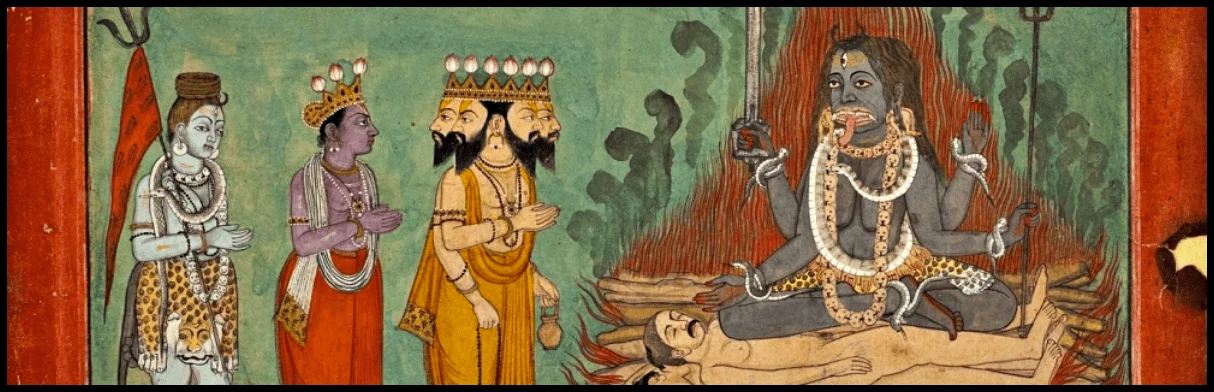
S-g-m-d-n-S Among the most revered ragas in the entire Hindustani pantheon, Malkauns (‘He who wears serpents as garlands’) combines structural simplicity with a nuanced mythological ethos. Said to have been composed by the goddess Parvati to soothe Lord Shiva’s murderous rage, in turn inspired by his wife Sati’s fiery death, its ‘all-komal‘ swara set is […]

• Raag Malkauns •

• Raag Yaman •
S-R-G-M-P-D-N-S Among the first-learned and most-performed ragas, Yaman’s influence on modern Hindustani music is impossible to overstate. Linked to the early night hours (‘when lanterns are lit’), the disbalancing effects of tivra Ma – the only non-shuddha swara on offer – allow for a kaleidoscopic emotional range, with Sa and Pa often being skipped in […]

• Raag Darbari •
S-R-g-m-P-d-n-S Darbari has been described as “the Emperor of Ragas, and the Raga of Emperors”. Its majestic tones famously echoed across the marble floors of Mughal palaces in centuries past, bringing solemn relief to kings, warlords, and diplomats alike. Consequently, modern renditions tend to retain a grave, reverential patience, pairing pakad of (n)dnP & (m)gmR amidst […]

• Raag Miyan ki Malhar •
S-R-g-m-P-D-nN-S Derived from the Sanskrit for ‘banishing uncleanliness’, the Malhar family is inextricably linked to the rejuvenating effects of rain. The main raga of this lineage is named ‘Miyan ki Malhar’ for its connections to Miyan Tansen, the great composer of Emperor Akbar’s 16th-century royal court, who is said to have sung it to summon […]

• Raag Bageshri •
S-R-g-m-P-D-n-S An ancient raga of the late night, Bageshri is associated with ‘vipralambha’ – the profound shades of longing felt by a separated lover. These sentiments are reflected in its multipolar phraseology: artists may resolve towards shuddha ma for a more open, expansive sound (DnSgm), or towards Sa for a clustered, inward-turning feel (mgRS: sometimes […]

• Raag Chandranandan •
S-R-gG-m-P-d-nN-S Chandranandan (‘Moonstruck’) is a modern classic, created by Ali Akbar Khan in a spare studio moment via spontaneously blending concepts from the Kaunsi family (“Three minutes and it was finished…They asked me for the name, but I never thought of the name, I never thought about the notes. I just thought of my father and […]

• Raag Kalavati •
S-G-P-D-n-S A playful pentatonic form, neatly structured as a stack of ‘regularly narrowing’ intervals (4>3>2>1 semitones). The wide, sparse poorvang (SG) and clustered uttarang (PDnS) combine to bring reassuring momentum, with increasing melodic urgency as you rise higher (a ‘triple jump then a sprint’) – also being a rare example of a ‘jagged‘ scale, i.e. […]

• Raag Desh •
S-R-G-m-P-D-nN-S Intimately connected to Indian national identity, Desh gives melodic direction to the famous patriotic anthem Vande Mataram, as well as soundtracking dozens of Rabindrasangeet. Associated with the second quarter of night, renditions tend towards the sweet and amorous, with Deepak Raja noting clear divergence between ‘classicist’ and ‘romanticist’ treatments (the former is confined to […]

• Raag Chandrakauns •
S-g-m-d-N-S Chandrakauns is a spacious raga of relatively modern origin, only becoming distinct from divergent strains of ‘shuddha Ni Malkauns’ by around the mid-20th century. This Ni-for-ni replacement removes much of Malkauns’ symmetry and intervallic balance, with the chromatic leading-tone resolution (Ni>Sa) bringing more prominence to both swaras (see melodic summary). Given these sharper tensions, it […]

• Raag Jaijaiwanti •
S-R-gG-m-P-D-nN-S A much-beloved and highly intricate raga featuring both variants of Ga and Ni – which shares significant overlap with Gara. Dhrupadyas hold NSDnR as the essential pakad, with some bemoaning the loss of the “slow glide from Ga to Re as Jaijaiwanti’s distinguishing feature” – while most performers tend to ‘enclose’ komal ga in […]

• Raag Basant •
S-r-G-M-P-d-N-S Basant (meaning ‘Springtime’) is a historic and highly influential form, with a lineage stretching back to at least the 8th century. The raga’s modern incarnation matches the swaras of Poorvi thaat, with shades of shuddha ma also permitted in many interpretations (e.g. SmmG; mdrS). Phraseological allies include Puriya (GMdNM; mdGmG) and Shree (e.g. NrS; […]

• Raag Megh (Malhar) •
S-R-m-P-n-S Among the oldest surviving members of the Malhar family, Megh (‘Cloud’) is said to have saved the life of Miyan Tansen himself. Legend holds that the great composer’s powerful rendition of the fire-bringing Deepak caused the oil lamps in Emperor Akbar’s 16th-century royal palace to ignite and burn uncontrollably – and, soon, all the […]

• Raag Shivranjani •
S-R-g-P-D-S A spellbinding raga resembling ‘Bhupali komal ga’ (or ‘Kafi no ma/ni’), Shivranjani’s melodies, described by Kalakar as “plaintive and haunting”, are said to appease the destructive rage of Lord Shiva (a similar mythology to that of Malkauns). Tanarang suggests illustrative combinations of SRgPD; PDPgR; gRgSRDS, although interpretations vary greatly within the scale’s pentatonic bounds […]

• Raag Maru Bihag •
S-R-G-mM-P-D-N-S Despite its A-list status (Deepak Raja’s Ragascape research estimates it as the 13th most-performed raga of the modern era), Maru Bihag is a relatively recent invention, at least in its own right – Parrikar notes that “Manikbua Thakurdas speaks of an older Raag Maru [SRGMDNS] as its progenitor…but the Maru Bihag in currency [today] […]

• Raag Kaunsi Kanada •
S-R-g-m-P-d-n-S Kaunsi Kanada is often oversimplified as a blend of two ragas: ‘Malkauns (or Pancham Malkauns) on the way up, and Darbari on the way down’. But, as ever, the whole is far more than the sum of these parts, with multiple facets of both these ragas interacting with ideas from across the Kanada spectrum. […]

• Raag Nat (Shuddha) •
S-R-G-m-P-D-N-S Described by Parrikar as “singular for its unabashed promiscuity”, Nat is perennially popular as a jod ingredient (see Nat Bihag, Nat Bhairav, Nat Kamod, Chayanat, and Jaijaiwanti Nat). The raga has likely origins in the age before Hindustani and Carnatic music’s bifurcation (while seemingly being unrelated to the Southern ‘Nata’), although renditions of its […]

• Raag Gara •
S-R-gG-m-P-D-nN-S Gara is a disparate melodic lineage, derived from thumri compositions of centuries past: Manuel’s research describes it as “a loose, informal melodic entity until the 18th century, after which [its] grammar was organised by classically trained musicians…like Kafi, Pilu, Jungala, Barwa, and Zila”. Often close to Jaijaiwanti, the modern Gara may also draw from […]

• Raag Jogkauns •
S-gG-m-P-d-N-S Created by Agra vocal master Jagannathbuwa Purohit ‘Gunidas’ around the late 1940s, Jogkauns is usually summarised as ‘Jog plus Chandrakauns’ (SgGmP; mdNS). However, the raga originally arose from his earlier ‘Kausi/Kaushi‘ framework, described by Milind Malshe as “a modified Chandrakauns: add a touch of Pa, a nyas on shuddha ma, and also a touch […]

• Raag Tilak Kamod •
S-R-G-m-P-D-N-S Mirroring the tones of the Western Major Scale, Tilak Kamod’s seven swaras offer robust melodic flexibility across a range of sentiments (“heroic courage, philosophic poise, devotional contentment, suggestive eroticism…”). Some trace the raga’s origin to Pyar Khan, a rabab-playing descendent of Tansen via his son Bilas Khan, who is said to have picked it […]

• Raag Nayaki Kanada •
S-R-g-m-P-n-S A popular Kanada variant usually said to have been named after Gopal Nayak, the legendary poet-composer of Alauddin Khilji’s 12th-century Delhi durbar – however, Bor highlights that Faqirullah’s 1666 Raga Darpan treatise instead connects the origins of the entire Kanada lineage to 17th-century musician Nayak Bakshu of Raja Man Singh’s royal court (best known as […]

• Raag Maru •
S-R-G-M-D-N-S Rare to the point of near-extinction in its own right, the historic Maru is now best known as an ingredient of the highly popular Maru Bihag. In the words of scholar-singer Arun Dravid: “It is not well known, even in the music world, that Maru Bihag is a mixed raga…very few people know that […]

• Raag Puriya Kalyan •
S-r-G-M-P-D-N-S Essentially combining the poorvang of Puriya Dhanashree with the uttarang of Yaman (SrGM+PDNS), Puriya Kalyan matches the swaras of Marwa thaat. Pa is prominent in descent, but may be skipped in Kalyanic ascending passages such as MDNS – and Sa is often omitted in both directions, with mandra saptak Ni favoured as a melodic […]

• Raag Kedar •
S-R-mM-P-D-N-S An early night raga, Kedar is associated with heat (Tanarang: “there is much thermal energy in this melody…hence it is regarded as a ragini of Deepak“, Tansen’s legendary fire-bringing raga) – as well as being mythically connected to Lord Shiva (“Seeking to evade the Pandavas after the Kurukshetra war, Shiva took refuge in Kedarnath […]

• Raag Kirwani •
S-R-g-m-P-d-N-S Congruent with the Western Harmonic Minor, Kirwani has origins in the Carnatic Keeravani (chiefly popularised via Ravi Shankar‘s extensive Southern borrowings): thus lending it a natural popularity for North-South jugalbandi duets, offering artists from both cultures a rich shared expanse. Like many Southern imports, Kirwani is comparatively ‘open’, allowing for near-free use of all […]

• Raag Shuddha Malhar •
S-R-m-P-D-S Perhaps the oldest surviving Malhar raga (‘shuddha’, as well as referring to ‘pure’ or ‘unaltered’ specific swaras, can also designate a ‘primary’ or ‘original’ quality: as with the similarly-ancient Shuddha Basant), marked by “a ponderous gait and a meend-rich contour”. As per the accompanying notes to a K.G. Ginde lecture, Shuddha Malhar is distinguished […]

• Raag Narayani •
S-R-m-P-D-n-S Adapted from the Carnatic ragam of the same name, Narayani takes the swaras of a ‘komal ni Durga’ (or ‘Khamaj no Ga’). Pa is a nyas, while Dha is rendered deergha (e.g. mPnD, DP), with a general melodic focus on madhya and taar saptaks. Tanarang describes the raga as “soothing”, while Parrikar traces its Northern […]

• Raag Hindol •
S-G-M-D-N-S A captivating, challenging audav raga with all swaras appearing in their highest specific positions (i.e. no komals, and Ma, if present, is tivra: also see Bhupali, Hansadhwani, & Adbhut Kalyan). The name translates as ‘swinging’: indicative of the raga’s melodic character, which is built around ‘swaying’ motions between a SGD trio of nyas, with […]

• Raag Shankara •
S-R-G-P-D-N-S Long fabled as a favourite of Lord Shiva, Shankara (‘Auspicious‘) takes its name from a famous epithet of the deity (Rajan Parrikar: “the musical embodiment of [Shiva’s] personality, comporting with all its attributes: raudra, veera, irascible, volatile, capricious…”). Often considered a pre-midnight raga, it ascends with SGPDNS, often in vakra patterns, before adding subtle […]

• Raag Jaldhar Kedar •
S-R-m-P-D-S Jaldhar Kedar applies the movement patterns of Kedar to the swara set of Durga, also drawing on the monsoon melodies of the Malhar family. Shuddha ma is emphasised as a nyas (e.g. SRSm; mRPm; DPm), and the Malharic Re–Pa sangati is also strong, while Durga’s mRP; mRDS is replaced by mRP; mRS; SRSm. Study […]

• Raag Imratkauns •
S-R-G-m-d-n-S Devised by Imdadkhani sitar and surbahar virtuoso Imrat Khan via blending the scales of Rageshri and Malkauns – producing a swara set matching ‘Charukeshi no Pa’. This mid-scale space presents a strong poorvang–uttarang separation, amidst the strange geometric regularity of the consecutive ‘2-2-2-2’ run (dnSRG: just a ma-to-Ma nudge from matching the whole-tone scale, […]

• Raag Bahar •
S-R-g-m-P-D-nN-S As per Tanarang, Bahar, derived from the Perisan for ‘Spring’, “brings out nature’s beautiful blessings…full of shringar and bhakti ras…khatkas and intricate taans are conducive to its dynamic, fleeting nature”. While rooted in the Kanada raganga, the raga features a Malharic twin-Ni, with the shuddha being more prominent. Re is weak in aroha, and the shuddha […]

• Raag Mohankauns •
S-gG-m-d-n-S As recounted in The Hindu, Mohankauns “was spontaneously created by Ravi Shankar in 1949. On hearing of Mohandas K. Gandhi’s death, Pandit-ji was asked by All India Radio to play a piece dedicated to the Mahatma. On the spot, he created a variation of Malkauns”. As well as the sparing use of shuddha Re, […]

• Raag Ramdasi Malhar •
S-R-gG-m-P-D-nN-S A diverse sankirna raga, fabled as a creation of Baba Ram Das – a 16th-century saint who is said to have opened Emperor Akbar’s eyes to the unity of the divine (“these jagirs [feudal land grants] are sources of evil passions, pride, and ego…it is by the name of God that all creatures, continents, worlds, […]

• Raag Shuddha Basant •
S-r-G-mM-P-D-N-S Typically considered the modern successor to the ‘original’ form of Basant – with Maihar musicians such as Nikhil Banerjee and Nityanand Haldipur considering it inseparable from Adi Basant (‘shuddha’, as well as referring to ‘pure’ or ‘unaltered’ swaras, may also indicate ‘primary’ or ‘original’: similar to the meaning of ‘adi’). Generally, it differs from […]

• Raag Tulsikauns •
S-g-m-d-nN-S A creation of Maihar sitarist Kartik Kumar, matching the swara-set of ‘Malkauns double-Ni’ (or ‘Malkauns + Chandrakauns’). A consistently strong ma–murchana summons unmistakable flavours of the Western ‘Blues Scale’ (SgmMPnS), further accentuated by extended meend between the consecutive Ni positions (…I’ve used the exact same scale as a ‘modal sitar hack’ to play with […]

• Raag Gaud Malhar •
S-R-G-m-P-D-nN-S An ancient blend of Shuddha Malhar and the now-dormant Gaud, also seasoned with shades of Alhaiya Bilawal, which finds mention in medieval works such as Shrikantha’s Rasakaumudi treatise (published circa 1575). Parrikar highlights the “strong, glowing ma”, which serves to join a Gaud-like poorvang (SRGm, mGmPm) to uttarang phrases from Shuddha Malhar (mP(S)DS) and […]

• Raag Gangeshwari •
S-G-m-P-d-n-S Like Parameshwari and Rangeshwari, Gangeshwari (‘Lordess of the Ganges River’) was created by Ravi Shankar in 1968, via murchana rotation of his newly-invented Kameshwari (itself dreamed up during a car ride through Bengal). Its unevenly-spaced shadav scale (prakriti with some forms of Sundarkauns) most closely resembles a ‘no Re’ version of either Charukeshi or Basant […]

• Raag Champak •
S-R-G-m-P-D-nN-S A seldom-heard neighbour of Khambavati, distinguished (often very subtly) by stronger use of shuddha ma, and sometimes involving a Gm\S catchphrase. Both ni swaras are used, with the komal introduced via vakra avroh motions (e.g. SRn). Named after a huge evergreen tree species with fragrant yellow-orange flowers, used in perfumery and featured in myths […]

• Raag Sarangkauns •
S-R-m-d-n-S A rare audav raga of bewitching beauty, taking the form of ‘Malkauns with shuddha Re instead of ga’. As the name implies, the adoption of Re allows for poorvang shades from Sarang (SRm, mR), set in contrast to distinctive Malkauns turnarounds in uttarang (Snd, dnS). Like both Malkauns and Madhumad Sarang, the scale shape […]

• Raag Pancham •
S-r-G-mM-P-D-N-S An ancient raga of great historical renown, which is nevertheless rare in the modern era. Ramrang cites it as a descendent of the long-extinct Bhukosh (also an antecedent of Bhinna Shadja), with others linking it to the prakriti Bhankar and Bhatiyar (distinguished via sequences such as GMGrS; mmmGP; MDMmG). Most interpretations approximate the swaras […]

• Raag Hemant •
S-R-G-m-P-D-N-S Described by Deepak Raja as “amongst the most charming melodic entities to have gained currency in the last 50 years”, Hemant’s creation is often credited to Ravi Shankar, who began performing it from the 1940s onwards (some say it featured in his very first concert) – however it more likely originated with his guru […]

• Raag Nand •
S-R-G-mM-P-D-N-S Associated with Lord Krishna, Nand (also known as ‘Anandi’ or ‘Anandi Kalyan‘) rose to prominence around the turn of the 20th century – initially gaining renown through a pair of bandishes by Mehboob Khan ‘Daraspiya’ (Dhundu Bare Saiyan) and Vilayat Hussain Khan ‘Pranpiya’ (Ajahun Na Aye). Aarshin Karande describes the raga as being “regarded […]

• Raag Deepak •
(S-R-G-m-P-D-nN-S) Strictly speaking, Deepak is a ‘lost raga’, chiefly known to us through its status as Tansen’s fabled fire-bringing melody – said to have sparked uncontrollable blazes when he sung it at Emperor Akbar’s 16th-century durbar (…and requiring a special rendition of Megh to extinguish it). The raga appears in numerous ragmala paintings, and has […]

• Raag Shree Kalyan •
S-r-G-M-P-D-N-S Congruent with the seven swaras of Puriya Kalyan (and Marwa thaat), Shree Kalyan is an enchanting product of Kumar Gandharva’s prolific imagination (also see Madhusurja, Lagan Gandhar, Saheli Todi, Rati Bhairav, Bihad Bhairav, and Bhavmat Bhairav). The movements of his main rendition (Dekho Re Rut Phoolan Lagi) place Shree’s tritonal re–Pa sangati on stark […]

• Raag Mand •
S-R-G-m-P-D-N-S Arising from the festive folk tunes of Rajasthan, Mand (not to be confused with Nand) is a multifaceted raga form, popular in light-classical settings. Generally based around a Bilawal swara set, some artists also add komal ga, komal dha, and tivra Ma among other mishra touches – setting them in heavily-ornamented vakra movements (e.g. […]

• Raag Surdasi Malhar •
S-R-m-P-D-nN-S A combination of melodies from the Malhar and Sarang ragangas, said to have been created by Saint Surdas: a blind 16th-century poet-musician renowned for his evocations of Krishna amidst themes of shringara and bhakti. The raga which bears his name is described by Tanarang as “uttarang-pradhan, with general movement around taar Sa…[lyrics] are dominated by […]

• Raag Enayetkhani Kanada •
S-R-gG-m-P-d-nN-S Invented by sitarist Vilayat Khan as a tribute to his father, legendary innovator Enayet Khan (although when the raga first surfaced, circa 1981, he was calling it ‘Vilayat Khani Kanada’ instead…). As per fellow Imdadkhani sitarist-scholar Deepak Raja’s excellent analysis, the raga runs along the lines of “Darbari with the addition of two ‘alien […]

• Charju ki Malhar •
S-R-g-m-P-D-nN-S A diffuse branch of the Malhar lineage which exists in several modern forms. Pandit Jasraj, probably the raga’s most prominent interpreter, sings it as a Miyan ki Malhar variant with Desi-ang traits, including a distinctive treatment of shuddha Dha, which is emphasised in phrases such as mPDNS – echoed in Hemala Khare-Ranade’s recital preface (“Charju […]

• Raag Latangi •
S-R-G-M-P-d-N-S A unique sampurna scale borrowed from the 63rd Carnatic mela, which takes the form of ‘Kalyan komal dha’ (or ‘Yaman’s poorvang + Bhairav’s uttarang’: SRGM+PdNS). Subbha Rao’s Raga Nidhi Vol.3, written in the early 1960s, mentions that “Latangi is not found in Hindustani music” (p.90) – and it remains unclear who first imported the […]

• Raag Chayanat •
S-R-G-mM-P-D-N-S A longstanding combination of Chaya and Nat, creating (as per Tanarang) an “attractive, sweet, and emotionally swaying” mood – the latter in particular summoned via ‘simple vakra’ phrases such as DNDP; RGRS. The Pa–Re sangati is vital, and shuddha ma is stronger than tivra Ma – with the raga inviting a range of expressive […]
