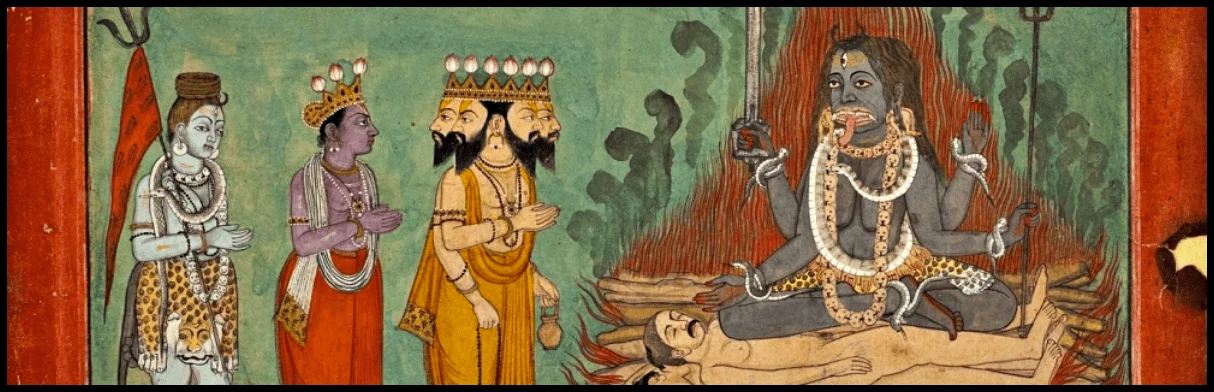
S-g-m-d-n-S Among the most revered ragas in the entire Hindustani pantheon, Malkauns (‘He who wears serpents as garlands’) combines structural simplicity with a nuanced mythological ethos. Said to have been composed by the goddess Parvati to soothe Lord Shiva’s murderous rage, in turn inspired by his wife Sati’s fiery death, its ‘all-komal‘ swara set is […]

• Raag Malkauns •

• Raag Bhupali •
S-R-G-P-D-S Hailed for its structural simplicity, Bhupali is often among the first ragas taught to Hindustani students. While its basic ‘Major Pentatonic‘ scale form is shared by countless global cultures, the North Indian incarnation (named for Madhya Pradesh’s Bhopal region) presents its own quirks – invoking tranquillity and home-bound reassurance with interlinked sliding motions between […]

• Raag Puriya •
S-r-G-M-D-N-S A prominent sunset raga, Puriya takes the same six swaras as Marwa and Sohini, reworking them to present a distinct set of melodic forces. Renditions tend to focus on mandra and madhya saptak, seeking a relatively even balance between ascending and descending phrases – with its character often considered more ‘melodic’ than Marwa (which is […]

• Raag Marwa •
S-r-G-M-D-N-S Notable for omitting its own Sa for long stretches, the hexatonic Marwa conjures moods of ‘austere, spiritual renunciation’ – summoning these sentiments with low, slow lines which patiently outline the raga’s highly irregular geometry (three adjacent plus three wide-set swaras: NSr; GMD). Its descent-dominant melodies, which avoid Pa throughout, often tease at resolutions which […]

• Raag Durga •
S-R-m-P-D-S Beguiling in its pentatonic simplicity, Durga (Sanskrit: ‘invincible, impassable, inaccessible’) is inextricably tied to visions of the Hindu Mother Goddess: a destroyer of demons and protector of the faithful, who, according to legend, “was created to slay the buffalo demon Mahisha by Brahma, Vishnu, Shiva, and the lesser gods, who were otherwise powerless to […]

• Raag Kalavati •
S-G-P-D-n-S A playful pentatonic form, neatly structured as a stack of ‘regularly narrowing’ intervals (4>3>2>1 semitones). The wide, sparse poorvang (SG) and clustered uttarang (PDnS) combine to bring reassuring momentum, with increasing melodic urgency as you rise higher (a ‘triple jump then a sprint’) – also being a rare example of a ‘jagged‘ scale, i.e. […]

• Raag Hansadhwani •
S-R-G-P-N-S Hansadhwani translates to ‘Call of Swans’, a creature with rich cultural associations in the Subcontinent: Saraswati, goddess of music and learning, is often depicted atop a swan, said to symbolise purity, discernment, and clarity of communication (n.b. While most scholars interpret the Sanskrit term ‘hamsa’ to mean ‘swan’, Rigvedic texts use the term loosely, […]

• Raag Megh (Malhar) •
S-R-m-P-n-S Among the oldest surviving members of the Malhar family, Megh (‘Cloud’) is said to have saved the life of Miyan Tansen himself. Legend holds that the great composer’s powerful rendition of the fire-bringing Deepak caused the oil lamps in Emperor Akbar’s 16th-century royal palace to ignite and burn uncontrollably – and, soon, all the […]

• Raag Gujiri Todi •
S-r-g-M-d-N-S A popular Todi variant named for its historic associations with Gujarat, India’s Westernmost state. Linked to the morning hours, it distinguishes itself from the main Todi by omitting Pa throughout. Tanarang cites a mood of “sweetness and karuna“, revolving around a deergha komal re – with komal dha also playing a prominent role, separated from […]

• Raag Shivranjani •
S-R-g-P-D-S A spellbinding raga resembling ‘Bhupali komal ga’ (or ‘Kafi no ma/ni’), Shivranjani’s melodies, described by Kalakar as “plaintive and haunting”, are said to appease the destructive rage of Lord Shiva (a similar mythology to that of Malkauns). Tanarang suggests illustrative combinations of SRgPD; PDPgR; gRgSRDS, although interpretations vary greatly within the scale’s pentatonic bounds […]

• Raag Bhupali Todi •
S-r-g-P-d-S A captivating audav raga said to symbolise spiritual purity, which essentially runs along the lines of ‘what if all Bhupali‘s chal swaras (Re, Ga, Dha) were komal rather than shuddha?’ (SRGPDS > SrgPdS). Most renditions are poorvang-dominant, drawing from the Todi-ang as well as reshaping phrases from Bhupali, Bilaskhani Todi, and other forms (given the uniqueness […]

• Raag Gorakh Kalyan •
S-R-m-P-D-n-S A spacious, folksy raga of the late evening, Gorakh Kalyan (named for the Gorakhpur region of Uttar Pradesh) has fabled associations with Saint Gorakhnath, an 11th-century yogi mystic-musician who is said to have travelled throughout the Subcontinent in search of spiritual wisdom and sonic enrichment. Despite its name, the raga’s modern form has no […]

• Raag Dhani •
S-g-m-P-n-S Despite its ‘Minor Pentatonic’ scale form enjoying global popularity as the predominant mode of blues, rock, pop, and countless other guitar-driven genres, Dhani is comparatively rare as a raga in its own right – with its swara set mostly being heard as the ‘aroha of Bhimpalasi’ rather than in isolation (…it may be the […]

• Raag Madhumad Sarang •
S-R-m-P-n-S Running along the lines of ‘Brindabani Sarang with komal ni only’, Madhumad Sarang is among the principal incarnations of its raganga (‘Madhumad’ derives from the Sanskrit ‘madhyamadi’: the Carnatic equivalent is similarly titled ‘Madhyamavati’). Ma and Pa are strong, and the PnS uttarang summons natural momentum, with crisp melodic articulations set against the scale’s palindromic […]

• Raag Nayaki Kanada •
S-R-g-m-P-n-S A popular Kanada variant usually said to have been named after Gopal Nayak, the legendary poet-composer of Alauddin Khilji’s 12th-century Delhi durbar – however, Bor highlights that Faqirullah’s 1666 Raga Darpan treatise instead connects the origins of the entire Kanada lineage to 17th-century musician Nayak Bakshu of Raja Man Singh’s royal court (best known as […]

• Raag Maru •
S-R-G-M-D-N-S Rare to the point of near-extinction in its own right, the historic Maru is now best known as an ingredient of the highly popular Maru Bihag. In the words of scholar-singer Arun Dravid: “It is not well known, even in the music world, that Maru Bihag is a mixed raga…very few people know that […]

• Raag Bairagi Todi •
S-r-g-P-n-S Created by Ravi Shankar, Bairagi Todi replaces Bairagi’s shuddha ma with a Todi-intoned ati-komal ga, retaining the concise audav structure while presenting an odd mix of narrow and wide intervals. Sometimes matched with unusual talas (e.g. Shankar’s original is in ‘sade-gyarah’: a ‘fractional‘ 11.5 matra cycle divided ‘4-4-2-1.5‘), the raga is explorable in all saptak, […]

• Raag Bairagi •
S-r-m-P-n-S A distinctive pentatonic form inducted into the ragascape by an early-career Ravi Shankar. As recounted in Oliver Craske’s superlative biography Indian Sun (p.106), “Shankar created Bairagi in 1949, [publishing] the raga and a bandish…in Sangeet Magazine”. The ‘Megh komal re‘ swara set – which may well have appeared in other guises throughout history – […]

• Raag Deshkar •
S-R-G-P-D-S Often described as ‘the other raga with Bhupali’s swaras’, Deshkar shuffles the same five tones to produce a mood suited more to the morning than evening hours – a legacy of the raga’s roots in the Bilawal raganga (vs. Bhupali’s Kalyan heritage). Taking a Bilawal-ang vadi-samvadi of Dha–Ga, the raga is uttarang-dominant, with a […]

• Raag Shuddha Malhar •
S-R-m-P-D-S Perhaps the oldest surviving Malhar raga (‘shuddha’, as well as referring to ‘pure’ or ‘unaltered’ specific swaras, can also designate a ‘primary’ or ‘original’ quality: as with the similarly-ancient Shuddha Basant), marked by “a ponderous gait and a meend-rich contour”. As per the accompanying notes to a K.G. Ginde lecture, Shuddha Malhar is distinguished […]

• Raag Reva •
S-r-G-P-d-S A rare pentatonic raga, Reva is often described as the ‘evening counterpart’ to Bibhas (or the ‘jawab to its sawal’), matching this samay designation by taking after the Poorvi–ang rather than Bibhas’ Bhairav-ang roots. Chiefly, its movements are distinguished from Bibhas via poorvang-focused sangatis including Gr; rS; SrrS, along with a greater exploration of the […]

• Raag Narayani •
S-R-m-P-D-n-S Adapted from the Carnatic ragam of the same name, Narayani takes the swaras of a ‘komal ni Durga’ (or ‘Khamaj no Ga’). Pa is a nyas, while Dha is rendered deergha (e.g. mPnD, DP), with a general melodic focus on madhya and taar saptaks. Tanarang describes the raga as “soothing”, while Parrikar traces its Northern […]

• Raag Hindol •
S-G-M-D-N-S A captivating, challenging audav raga with all swaras appearing in their highest specific positions (i.e. no komals, and Ma, if present, is tivra: also see Bhupali, Hansadhwani, & Adbhut Kalyan). The name translates as ‘swinging’: indicative of the raga’s melodic character, which is built around ‘swaying’ motions between a SGD trio of nyas, with […]

• Raag Gunkali •
S-r-m-P-d-S An enchanting morning raga, matching the swara set of ‘Durga komal re/dha’ (or ‘Shobhawari komal re’), described by Tanarang as “an epitome of bhakti and karuna…straightforward, and expandable in all three octaves”. While audav at its core, multivariate forms of the raga are in existence: some include shades of shuddha Ga in avroh (bringing hints of […]

• Raag Shankara •
S-R-G-P-D-N-S Long fabled as a favourite of Lord Shiva, Shankara (‘Auspicious‘) takes its name from a famous epithet of the deity (Rajan Parrikar: “the musical embodiment of [Shiva’s] personality, comporting with all its attributes: raudra, veera, irascible, volatile, capricious…”). Often considered a pre-midnight raga, it ascends with SGPDNS, often in vakra patterns, before adding subtle […]

• Raag Jaldhar Kedar •
S-R-m-P-D-S Jaldhar Kedar applies the movement patterns of Kedar to the swara set of Durga, also drawing on the monsoon melodies of the Malhar family. Shuddha ma is emphasised as a nyas (e.g. SRSm; mRPm; DPm), and the Malharic Re–Pa sangati is also strong, while Durga’s mRP; mRDS is replaced by mRP; mRS; SRSm. Study […]

• Raag Pahadi •
S-R-G-P-D-S Thought to derive from Kashmiri or Bengali folk tunes, Pahadi (meaning ‘mountain’ or ‘of the hills’) combines playful and subtle shades. While its Bhupali-congruent core form offers a certain sparse simplicity, the raga’s true magic is found in its extensive mishra capabilities, with the tasteful use of any swara being permitted, particularly in long […]

• Raag Malashree •
S-G-P-S Often said to comprise only three swaras (a SGP major triad), Malashree pushes the bounds of raga definition. Arguably, this challenge is its defining purpose, calling on performers to find expressive freedom within an ultra-limited framework (as per Dagarvani beenkar Bahauddin Dagar, “We do not believe in ‘small’ vs. ‘big’ ragas: Malashree for example […]

• Raag Firozkhani Todi •
S-r-g-M-d-S A fascinating audav raga formed by removing the Ni from Gujiri Todi – leaving an angular pentatonic shape which, aside from Sa, contains no shuddha swaras. The same scale form is known as ‘Audav Todi’, ‘Bangal Todi‘ and ‘Chaya Todi’ too (although the latter title is also applied to other fusions of Chaya and […]

• Raag Bibhas •
S-r-G-P-d-S The pentatonic Bibhas (or Vibhas) appears in at least three present-day forms: typically tilted towards either the Marwa, Bhairav, or Poorvi frameworks. The former takes a shuddha Dha, while the latter pair render it komal (thus drawing focus to Pa, which is often treated as a nyas). Prakriti with Reva in its komal dha […]

• Raag Jait Kalyan •
S-R-G-P-D-S A Bhupali–prakriti raga which blends Jait with the Kalyan-ang, retaining the former’s strong Pa–Sa sangati amidst descending lines from the latter such as DP(G)RS. Re may be played weakly in aroha, rendering some upward-moving sections of the raga surtar, while glides of (D)G and (P)G are frequent. Seemingly introduced to the ragascape by Jaipur-Atrauli […]

• Raag Din ki Puriya •
S-r-G-M-d-N-S Din ki Puriya (‘Daytime Puriya’) sets its six swaras to the general phrase patterns of the Puriya–ang, avoiding Pa throughout. The scale’s ‘palindromic hexagon’ places a tight hemitonic cluster (NSr) opposite a wider tone-trio (GMd), also providing an augmented ‘equilateral triangle’ (SGd). Melodic motions remain fairly free, given the lack of any prakriti ragas […]

• Raag Sarangkauns •
S-R-m-d-n-S A rare audav raga of bewitching beauty, taking the form of ‘Malkauns with shuddha Re instead of ga’. As the name implies, the adoption of Re allows for poorvang shades from Sarang (SRm, mR), set in contrast to distinctive Malkauns turnarounds in uttarang (Snd, dnS). Like both Malkauns and Madhumad Sarang, the scale shape […]

• Raag Amritvarshini •
S-G-M-P-N-S A rare audav raga corresponding to the swaras of ‘Yaman no Re/Dha’, imported from a well-established Carnatic form. The name translates as ‘one who showers the elixir of immortality’, hinting at its rich mythological history – in South India, the raga has long been associated with the monsoon (compare to the Northern Malhar ragas, […]

• Raag Palas •
S-R-g-m-P-n-S Now close to extinction in its own right, Palas (a.k.a. ‘Palasi/Palashri’) is best known for its historic confluence with Bheem – a union which produced Bhimpalasi. Subbha Rao’s Raga Nidhi Vol.3, published in 1965, states that (p.211): “These days Palas and Bhimpalasi are considered to be one and the same raga, but the aroha […]

• Raag Gaudgiri Malhar •
S-R-g-m-P-n-S An engrossing raga of uncertain origin, Gaudgiri Malhar is most prominently associated with Mewati pioneer Pandit Jasraj – although Gwalior stalwart Haribhau Ghangrekar and others were performing it even before this. Also sung by Jasraj’s brother Pratap Narayan and disciple Hemang Mehta, as well as Kirana vocalist Moumita Mitra – who describes it as a […]

• Raag Shankh Dhwani •
S-R-G-P-n-S A pleasing pentatonic form, Shankh Dhwani (‘Sound of the Conch’) takes its name from a truly ancient instrument. While we will never know precisely when our proto-human ancestors first blew into a resonant gastropod shell, artefacts turn up in the archaeological record as early as 18,000 years ago – with their ritual significance discussed […]

• Raag Zeelaf •
S-G-m-P-d-S A rare audav raga fabled to have been created by 13th-century qawwali pioneer Amir Khusrau, somewhat resembling ‘Bhairav minus re & Ni’. As per Rajan Parrikar, “this haunting pentatonic melody is composed of the following swaras: SGmPd. Jitendra Abhisheki gives a superb account with his own composition [transcribed below]: notice the strong ma and […]

• Raag Kaushik Dhwani •
S-G-m-D-N-S A modern-era descendent of the ancient Bhinna Shadja, essentially indistinguishable from its parent. Ma is a strong vadi, and a S\D glide is common in descending motions – but aside from this, artists are essentially free to roam at will within the scale, with all swaras employable as nyas across all three saptak (Tanarang: […]

• Raag Jansammohini •
S-R-G-P-D-n-S Broadly running along the lines of ‘Kalavati plus shuddha Re’ (especially in avroh), Jansammohini is a captivating Southern import. As per santooriya Tarun Bhattacharya, “This [scale] was originally called ‘Siva Kalyan’, but the raga went out of circulation. Having heard the Carnatic Jansammohini, my guruji Ravi Shankar brought it back [under] the Carnatic name. […]

• Raag Sohini •
S-r-G-M-D-N-S Sharing its six swaras with Marwa and Puriya, Sohini aims for a looser, more sprightly flavour to its more famous congruents – focusing on agile movements in madhya and taar saptak, and uttarang-based phrases built on a strong Dha–Ga sangati. Re is banned in aroha, and Sa assumes greater strength than in Marwa, while […]

• Raag Adbhut Kalyan •
S-R-G-D-N-S An uncommon Kalyan variety, named Adbhut (‘Wondrous’) for omitting two of Kalyan’s most vital swaras (Ma & Pa). Remains popular in the Dagarvani Dhrupad, but few others have risen to the centreless challenges of losing both mid-saptak swaras. Aminuddin Dagar reportedly considered the raga to be an offshoot of Khem Kalyan, while Uday Bhawalkar links […]

• Raag Sundarkauns •
S-g-m-D-n-S There are at least two ragas in modern circulation which go by the title ‘Sundarkauns’, which appear to share no connection other than their name. One version, taking the swaras SgmDnS (‘Malkauns shuddha Dha’), is described by Tanarang as having been unjustly sidelined by previous generations, who have tended to misinterpret it as a ‘Bageshri-ang Chandrakauns’ […]

• Raag Shobhawari •
S-R-m-P-d-S A rare ‘audav Asavari’ raga, matching the swaras of ‘komal Dha Durga’ (or ‘shuddha Re Gunakri‘). While relatively free of specific melodic constraints, the dha assumes natural prominence due to its disbalancing effects: it is involved in the only hemitonic pairing (Pd) and also the widest adjacent jump (dS), while serving as the only […]

• Raag Saheli Todi •
S-r-g-P-d-n-S An invention of vocalist Kumar Gandharva, lying between Bhupali Todi and Bilaskhani Todi via the addition of an avroh komal ni to the former (or the subtraction of ma from the latter). His original renditions linger patiently on the komal re (often intoned with a noticeably higher sruti than is usual for the Todi […]

• Raag Rasaranjani •
S-R-m-D-N-S A rare, oddly-shaped audav raga formed by omitting Ga and Pa from Bilawal thaat – somewhat like ‘removing the major triad from the major scale’ (it can also be seen as ‘Bhavani plus Ni’). Vocalist Sakuntala Narasimhan, introducing a drut khayal, cites Rasaranjani as an innovation of her Rampur gharana guru Hafiz Ahmed Khan, […]

• Raag Raj Kalyan •
S-R-G-M-D-N-S A ‘Kalyan no Pa’ melody devised by Gwalior vocal innovator Vasantrao Deshpande (although he may well have seen it more like a ‘Puriya shuddha Re’). Parrikar describes how “the relief-inducing nyas on Pa is missing, giving a ‘restive’ persona”, while Ocean of Ragas gives a pakad of GMD, DMGR, NRS. Generally treated as hexatonic in […]

• Raag Rageshri •
S-R-G-m-D-n-S Working along the lines of a ‘shuddha Ga Bageshri with shades of the Khamaj-ang’, the early-night Rageshri enjoys popularity among vocalists and instrumentalists alike. Like Bageshri, Re is often weak in ascent, and the ma–Dha sangati is strong – while unlike Bageshri, Pa is varjit throughout (likely as a result of shuddha Ga destroying the […]

• Raag Pancham Malkauns •
S-g-m-P-d-n-S A loose collection of melodic strands which fall under the general banner of ‘Malkauns with Pa in avroh’ (thus sharing conceptual overlap with Kaunsi Kanada and Sampurna Malkauns). Ascents typically stay true to the pentatonic structure of Malkauns, and the Pa is usually rendered in vakra avroh lines (e.g. ndmgmdP or gmdndmP). Beloved by […]

• Raag Jogiya •
S-r-m-P-d-N-S Jogiya (from Sanskrit yogi: ‘State of Union’) is a shadav raga of considerable mystique. Tanarang recounts “a characteristic mood of devotion and detachment…Jogiya has komal re and dha like Bhairav, however they are not oscillated…and shuddha ma is powerful as nyas and vadi”. Generally expandable in madhya and taar saptaks, the raga’s geometries revolve […]
