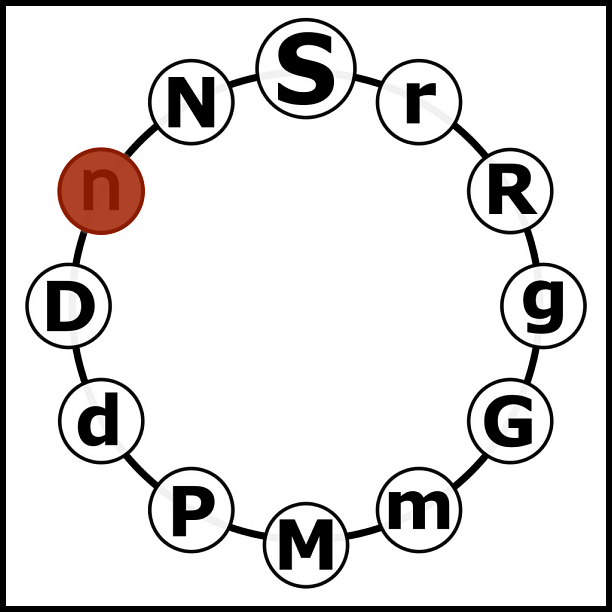

S-r-g-M-P-d-N-S Pivotal to Hindustani history, Todi overflows with musical ideas found nowhere else on the planet. Some link its ambiguous geometries with ‘existential anguish and unsettlement’, while others hear ‘the playfulness of a newborn, content and smiling’. Rajan Parrikar hails it as “the most profound, finespun idea in melodic music…from ecstasy, to frolic, to pathos, […]

• Raag Todi •

• Raag Yaman •
S-R-G-M-P-D-N-S Among the first-learned and most-performed ragas, Yaman’s influence on modern Hindustani music is impossible to overstate. Linked to the early night hours (‘when lanterns are lit’), the disbalancing effects of tivra Ma – the only non-shuddha swara on offer – allow for a kaleidoscopic emotional range, with Sa and Pa often being skipped in […]

• Raag Bhairav •
S-r-G-m-P-d-N-S Revered as the foremost raga of Lord Shiva, the morning Bhairav takes its name from Kala Bhairava (‘Bhaya-Rava’: ‘the one who roars fear’) – an apocalyptic manifestation of the deity fabled to have cut off one of Brahma’s five heads to silence his arrogance. Renditions reflect the gravity of these ancient tales, depicting Shiva’s […]

• Raag Lalit •
S-r-G-mM-d-N-S Lalit (meaning ‘Lyrical’) is an oddly-shaped sunrise raga, resembling ‘Bhairav with Pa lowered a semitone’. Among the most influential forms in Hindustani history (see the Lalit raganga), its distinctive ‘double Ma, no Pa’ structure has a malleable ambiguity, capable of conjuring flavours ranging from ‘sadness and anguish’ to ‘the serene and devotional‘ (as per […]

• Raag Shree •
S-r-G-M-P-d-N-S According to Gwalior vocalist Omkarnath Thakur, Shree’s seven swaras are associated with those sunset hours when “disembodied spirits…become active, and aid in the black magic of Tantriks”. Tied to mythologies of Lord Shiva, the raga takes its name from ‘sri’, a sacred Sanskrit syllable which, in Vedic tradition, represents the material nature of humanity’s place […]

• Raag Puriya Dhanashree •
S-r-G-M-P-d-N-S Like the scale-congruent Shree, Puriya Dhanashree’s versatile hemitonic clusters outline a major triad (SGP) with Sa and Pa ‘enclosed’ by their neighbours to present two sets of three adjacent swaras (NSr, MPd). Pa, while often omitted in aroha, exerts its gravity on descending melodies, easing the tension of the tivra Ma by providing temporary […]

• Raag Bhupali •
S-R-G-P-D-S Hailed for its structural simplicity, Bhupali is often the first raga taught to Hindustani students. While its basic ‘Major Pentatonic‘ scale form is shared by countless global cultures, the North Indian incarnation (named for Madhya Pradesh’s Bhopal region) presents its own quirks – invoking tranquillity and home-bound reassurance with interlinked sliding motions and emphatic […]

• Raag Puriya •
S-r-G-M-D-N-S A prominent sunset raga, Puriya takes the same six swaras as Marwa and Sohini, reworking them to present a distinct set of melodic forces. Renditions tend to focus on mandra and madhya saptak, seeking a relatively even balance between ascending and descending phrases – with its character often considered more ‘melodic’ than Marwa (which is […]

• Raag Marwa •
S-r-G-M-D-N-S Notable for omitting its own Sa for long stretches, the hexatonic Marwa conjures moods of ‘austere, spiritual renunciation’ – summoning these sentiments with low, slow lines which patiently outline the raga’s highly irregular geometry (three adjacent plus three wide-set swaras: NSr; GMD). Its descent-dominant melodies, which avoid Pa throughout, often tease at resolutions which […]

• Raag Bihag •
S-R-G-mM-P-D-N-S Created via the artful grafting of tivra Ma onto a Bilawal-oriented base, Bihag contains a wealth of melodic possibilities. Long linked to late evening festivities, its meend-laden tendencies are explored with symmetrical articulations and fluid resolution phrases, guided by nuanced swara hierarchies which may display significant gharana-to-gharana variance. The tivra Ma, while tending to be […]

• Raag Bilawal •
S-R-G-m-P-D-N-S Approximates the Western Major Scale, thus taking an ‘all-shuddha’ sampurna swara set – and selected by the great V.N. Bhatkhande as the titular raga of Bilawal thaat – although its popularity has declined in the century since (partly in favour of prakritis such as Tilak Kamod and Bihari). Dha and Ga assume vital roles […]

• Raag Durga •
S-R-m-P-D-S Beguiling in its pentatonic simplicity, Durga (Sanskrit: ‘invincible, impassable, inaccessible’) is inextricably tied to visions of the Hindu Mother Goddess: depicted in lore as a destroyer of demons and protector of the faithful (Maa Durga: who, according to legend, “was created to slay the buffalo demon Mahisha by Brahma, Vishnu, Shiva, and the lesser gods, […]

• Raag Hansadhwani •
S-R-G-P-N-S Hansadhwani translates to ‘Call of Swans’, a creature with rich cultural associations in the Subcontinent: Saraswati, goddess of music and learning, is often depicted atop a swan, said to symbolise purity, discernment, and clarity of communication (n.b. While most scholars interpret the Sanskrit term ‘hamsa’ to mean ‘swan’, Rigvedic texts use the term loosely, […]

• Raag Chandrakauns •
S-g-m-d-N-S Chandrakauns is a spacious raga of relatively modern origin, only becoming distinct from divergent strains of ‘shuddha Ni Malkauns’ by around the mid-20th century. This Ni-for-ni replacement removes much of Malkauns’ symmetry and intervallic balance, with the chromatic leading-tone resolution (Ni>Sa) bringing more prominence to both swaras. Given these sharper tensions, it is often played […]

• Raag Antardhwani •
S-r-g-m-d-N-S Among the youngest ragas to have found global acclaim, Antardhwani (‘Sound of the Inner Self’) was unveiled by Shivkumar Sharma in the 1990s, who discovered its unique hexatonic shape by chance while retuning his santoor from one raga to another (although their identity remains a mystery…). Adapting the geometries of Todi and Bhairavi, the […]

• Raag Basant •
S-r-G-M-P-d-N-S Basant (meaning ‘Springtime’) is a historic and highly influential form, with a lineage stretching back to at least the 8th century. The raga’s modern incarnation matches the swaras of Poorvi thaat, with shades of shuddha ma also permitted in some interpretations (e.g. SmmG; mdrS). Phraseological allies include Puriya (GMdNM; mdGmG) and Shree (e.g. NrS; […]

• Raag Gujiri Todi •
S-r-g-M-d-N-S A popular Todi variant named for its historic associations with Gujarat, India’s Westernmost state. Linked to the morning hours, it distinguishes itself from the main Todi by omitting Pa throughout. Tanarang cites a mood of “sweetness and karuna“, revolving around a deergha komal re – with komal dha also playing a particularly prominent role, separated […]

• Raag Madhuvanti •
S-R-g-M-P-D-N-S A shringara raga of relatively recent origin, Madhuvanti is geared towards evoking a ‘sweet’ flavour (‘Madhu’ means ‘Honey’). Rajan Parrikar cites “shared credits for its development…Vilayat Khan is said to have conceived it [in the] 1940s…and around the same time, Vamanrao Padhye of Kolhapur composed a similar raga and called it ‘Ambika’, after the […]

• Raag Shivranjani •
S-R-g-P-D-S A spellbinding raga resembling ‘Bhupali komal ga’ (or ‘Kafi no ma/ni’), Shivranjani’s melodies, described by Kalakar as “plaintive and haunting”, are said to appease the destructive rage of Lord Shiva (a similar mythology to that of Malkauns). Tanarang suggests illustrative combinations of SRgP; PDPgR; gRgSR DS, although interpretations vary greatly within the scale’s pentatonic […]

• Raag Maru Bihag •
S-R-G-mM-P-D-N-S Despite its A-list status (Deepak Raja’s Ragascape research estimates it as the 13th most-performed raga of the modern era), Maru Bihag is a relatively recent invention, at least in its own right – Parrikar notes that “Manikbua Thakurdas speaks of an older Raag Maru [SRGMDNS] as its progenitor…but the Maru Bihag in currency [today] […]

• Raag Patdeep •
S-R-g-m-P-D-N-S Derived from the Dhanashree family, Patdeep somewhat resembles a ‘shuddha Ni Bhimpalasi’ (akin to the Western Melodic Minor), with both ragas ascending pentatonically before revealing Re and Dha in descent. Its unique scale structure, which features a distinctive run of four adjacent whole-tone jumps (g>m>P>D>N), brings natural prominence to komal ga and shuddha Ni as the […]

• Raag Multani •
S-r-g-M-P-d-N-S Multani is an afternoon raga of angular shape and ancient heritage, which, while matching the seven swaras of Todi thaat, is a Dhanashree family raga with corresponding phrase patterns – re and dha are omitted in ascent and generally rendered durbal throughout. Bhatkhande is said to have considered it the ‘daytime’ counterpart of Basant […]

• Raag Nat (Shuddha) •
S-R-G-m-P-D-N-S Described by Parrikar as “singular for its unabashed promiscuity”, Nat is perennially popular as a jod ingredient (see Nat Bihag, Nat Bhairav, Nat Kamod, Chayanat, and Jaijaiwanti Nat). The raga has likely origins in the age before Hindustani and Carnatic music’s bifurcation (while seemingly being unrelated to the Southern ‘Nata’), although renditions of its […]

• Raag Bhupali Todi •
S-r-g-P-d-S A captivating audav raga said to symbolise spiritual purity, which essentially runs along the lines of ‘what if all Bhupali‘s chal swaras were set as komal rather than shuddha?’ (SRGPDS > SrgPdS). Most renditions are poorvang-dominant, drawing from the Todi-ang as well as reshaping phrases from Bhupali, Bilaskhani Todi, and other forms (given the uniqueness of […]

• Raag Shuddha Kalyan •
S-R-G-M-P-D-N-S A popular early night raga, Shuddha Kalyan ascends with the same 5 swaras as Bhupali (SRGPDS), and descends with the full 7 of Yaman (SNDPMGRS), leading some to title it ‘Bhoop-Kalyan’. Phrases tend to end on the poorvang-slanted Sa, Re, Ga, or Pa, and both the ‘avroh-only’ swaras (Ni & Ma) must be treated subtly throughout […]

• Raag Jogkauns •
S-gG-m-P-d-N-S Created by Jagannathbuwa Purohit ‘Gunidas’ in the 1940s (also the progenitor of Swanandi and Jaun Bhairav), Jogkauns is usually summarised as ‘Jog plus Chandrakauns’. However, the Agra vocal master’s original inception drew more from the melodies of a ‘raised Ni‘ Malkauns offshoot than from Chandrakauns itself, which was then still in its infancy (Parrikar: […]

• Raag Tilak Kamod •
S-R-G-m-P-D-N-S Mirroring the tones of the Western Major Scale, Tilak Kamod’s seven swaras offer robust melodic flexibility across a range of sentiments (“heroic courage, philosophic poise, devotional contentment, suggestive eroticism…”). Some trace the raga’s origin to Pyar Khan, a rabab-playing descendent of Tansen via his son Bilas Khan, who is said to have picked it […]

• Raag Maru •
S-R-G-M-D-N-S Rare to the point of near-extinction in its own right, the historic Maru is now best known as an ingredient of the highly popular Maru Bihag. In the words of scholar-singer Arun Dravid: “It is not well known, even in the music world, that Maru Bihag is a mixed raga…very few people know that […]

• Raag Puriya Kalyan •
S-r-G-M-P-D-N-S Essentially combining the poorvang of Puriya Dhanashree with the uttarang of Yaman (SrGM+PDNS), Puriya Kalyan matches the swaras of Marwa thaat. Pa is prominent in descent, but may be skipped in Kalyanic ascending passages such as MDNS – and Sa is often omitted in both directions, with mandra saptak Ni favoured as a melodic […]

• Raag Kedar •
S-R-mM-P-D-N-S An early night raga, Kedar is traditionally associated with heat (Tanarang: “there is much thermal energy in this melody…hence it is regarded as a ragini of Deepak“: Tansen’s legendary fire-bringing raga). Often seen as particularly subtle, complex, and hard-to-perform – partly due to its curiously wide aroha jump from Sa to Ma (depending on […]

• Raag Kirwani •
S-R-g-m-P-d-N-S Despite its congruence with the Western Harmonic Minor, Kirwani has origins in the Carnatic Keeravani (likely via Ravi Shankar‘s extensive Southern borrowings): thus lending it a natural popularity for North-South jugalbandi duets, offering artists from both cultures a rich expanse of shared melodic territory. Like many Southern imports, Kirwani is comparatively ‘open’, allowing for near-free […]

• Raag Deshkar •
S-R-G-P-D-S Typically summarised as ‘the other raga with Bhupali’s swaras’, Deshkar shuffles the same five tones to produce a mood suited more to the morning than evening hours – a legacy of the raga’s roots in the Bilawal raganga (whereas Bhupali hails from the Kalyan lineage). Taking a Bilawal-ang vadi-samvadi of Dha–Ga, the raga is […]

• Raag Shuddha Malhar •
S-R-m-P-D-S Perhaps the oldest surviving Malhar raga (‘shuddha’, as well as referring to ‘pure’ or ‘unaltered’ specific swaras, may also indicate a ‘primary’ or ‘original’ quality: as with the similarly-ancient Shuddha Basant), marked by “a ponderous gait and a meend-rich contour”. As per the accompanying notes to a K.G. Ginde lecture, Shuddha Malhar is distinguished […]

• Raag Reva •
S-r-G-P-d-S A rare pentatonic raga, Reva is often described as the ‘evening counterpart’ to Bibhas (or the ‘jawab to its sawal’), matching this samay designation by taking after the Poorvi–ang rather than Bibhas’ Bhairav-ang roots. Chiefly, its movements are distinguished from Bibhas via poorvang-focused sangatis including Gr; rS; SrrS, along with a greater exploration of the […]

• Raag Hindol •
S-G-M-D-N-S A captivating, challenging audav raga with all swaras appearing in their highest specific positions (i.e. no komals, and Ma, if present, is tivra: also see Bhupali, Hansadhwani, & Adbhut Kalyan). The name translates as ‘swinging’: indicative of the raga’s melodic character, which is built around ‘swaying’ motions between a SGD trio of nyas, with […]

• Raag Gunkali •
S-r-m-P-d-S An enchanting morning raga, matching the swara set of ‘Bhupali komal re/dha’ (or ‘Shobhawari komal re’), described by Tanarang as “an epitome of bhakti and karuna…straightforward, and expandable in all three octaves”. While audav at its core, multivariate forms of the raga are in existence: some include shades of shuddha Ga in avroh (bringing hints […]

• Raag Shankara •
S-R-G-P-D-N-S Long fabled as a favourite of Lord Shiva, Shankara (‘Auspicious‘) takes its name from a famous epithet of the deity (Rajan Parrikar: “the musical embodiment of [Shiva’s] personality, comporting with all its attributes: raudra, veera, irascible, volatile, capricious…”). Often considered a pre-midnight raga, it ascends with SGPDNS, often in vakra patterns, before adding subtle […]

• Raag Jaldhar Kedar •
S-R-m-P-D-S Jaldhar Kedar applies the movement patterns of Kedar to the swara set of Durga, also drawing on the monsoon melodies of the Malhar family. Shuddha ma is emphasised as a nyas (e.g. SRSm; mRPm; DPm), and the Malharic Re–Pa sangati is also strong, while Durga’s mRP; mRDS is replaced by mRP; mRS; SRSm. Study […]

• Raag Pahadi •
S-R-G-P-D-S Thought to derive from Kashmiri or Bengali folk tunes, Pahadi (meaning ‘mountain’ or ‘of the hills’) combines playful and subtle shades. While its Bhupali-congruent core form offers a certain sparse simplicity, the raga’s true magic is found in its extensive mishra capabilities, with the tasteful use of any swara being permitted – particularly in […]

• Raag Malashree •
S-G-P-S Often said to comprise only three swaras (a SGP major triad), Malashree pushes the bounds of raga definition. Arguably, this challenge is its defining purpose, calling on performers to find expressive freedom within an ultra-limited framework (as per Dagarvani beenkar Bahauddin Dagar, “We do not believe in ‘small’ vs. ‘big’ ragas: Malashree for example […]

• Raag Shyam Kalyan •
S-R-G-mM-P-D-N-S Shyam Kalyan (‘Evening Kalyan‘) is a prachalit Kalyan variant. Ga is used sparingly in ascent, and typically skipped in phrases which run through the scale sequentially, and shuddha ma is taken in descent only – while Re is emphasised throughout, and Pa is available as a resting note. As per Tanarang‘s summary, the raga is “a very […]

• Raag Shuddha Basant •
S-r-G-mM-P-D-N-S Typically considered the modern successor to the ‘original’ form of Basant – with Maihar musicians such as Nikhil Banerjee and Nityanand Haldipur considering it inseparable from Adi Basant (‘shuddha’, as well as referring to ‘pure’ or ‘unaltered’ swaras, may also indicate ‘primary’ or ‘original’: similar to the meaning of ‘adi’). Generally, it differs from […]

• Raag Firozkhani Todi •
S-r-g-M-d-S A fascinating audav raga formed by removing the Ni from Gujiri Todi – leaving an angular pentatonic shape which, aside from Sa, contains no shuddha swaras (n.b. the same scale is known as ‘Audav Todi’ and ‘Chaya Todi’ too: although the latter title is also separately applied to other fusions of Chaya and Todi). […]

• Raag Bibhas •
S-r-G-P-d-S The pentatonic Bibhas (or Vibhas) appears in at least three present-day forms: typically tilted towards either the Marwa, Bhairav, or Poorvi frameworks. The former takes a shuddha Dha, while the latter pair render it komal (thus drawing focus to Pa, which is often treated as a nyas). Prakriti with Reva in its komal dha […]

• Raag Jait Kalyan •
S-R-G-P-D-S A Bhupali–prakriti raga which blends Jait with the Kalyan-ang, retaining the former’s strong Pa–Sa sangati amidst descending lines from the latter such as DP(G)RS. Re may be played weakly in aroha, rendering some upward-moving sections of the raga surtar, while glides of (D)G and (P)G are frequent. Seemingly introduced to the ragascape by Jaipur-Atrauli […]

• Raag Gauri •
S-r-G-m-P-d-N-S Described by Deepak Raja as “difficult to render in its purity”, Gauri is associated with viraha shringara (‘the piety arising from the separation of lovers’). The raga had at least two distinct forms as far back as the 16th century, and continues to manifest in several variations – principally a main Bhairav-ang ‘shuddha ma‘ […]

• Raag Din ki Puriya •
S-r-G-M-d-N-S Din ki Puriya (‘Daytime Puriya’) sets its six swaras to the general phrase patterns of the Puriya–ang, avoiding Pa throughout. The scale’s ‘palindromic hexagon’ places a tight hemitonic cluster (NSr) opposite a wider tone-trio (GMd), also providing an augmented ‘equilateral triangle’ (SGd). Melodic motions remain fairly free, given the lack of any prakriti ragas […]

• Raag Kamod •
S-R-G-mM-P-D-N-S An intricate raga which draws together elements from many others (Tanarang: “this dynamic melody is rather complex…one can see clear shadows of Malhar [SmRP], Hameer [GmDP], and Kalyan [SRS, SDP], together with glimpses of Kedar [MPDP] and Chayanat [PDPS, SRS]”). Distinguishing sequences include RRP, GmPGmRS, the taar Sa is accentuated with long P/S slides, […]

• Raag Vihang •
S-r-G-mM-P-D-N-S Vihang (Sanskrit for ‘Bird’) is a complex double-Ma form, most prevalent among Jaipur-Atrauli gharana vocalists. Manjiri Asanare-Kelkar’s detailed demo casts it as a ‘phrase-based’ raga, combining a Bihag core with melodies from Purva, Jait Kalyan, and Puriya, alongside connecting phrases such as MDMG, rS – also linking it Marwa and Puriya Kalyan. Tabla scholar Aneesh Pradhan […]

• Raag Shuddha Sarang •
S-R-mM-P-D-N-S A prominent early afternoon raga of the Sarang family, often said to evoke sringara. Ga is omitted, Dha is ornamental, and shuddha ma is introduced in avroh (always before Re, and sometimes adjacent to the tivra, e.g. MmR) – with Tanarang giving a pakad of NDSNRS (n.b. older variants of the raga also employed komal […]
