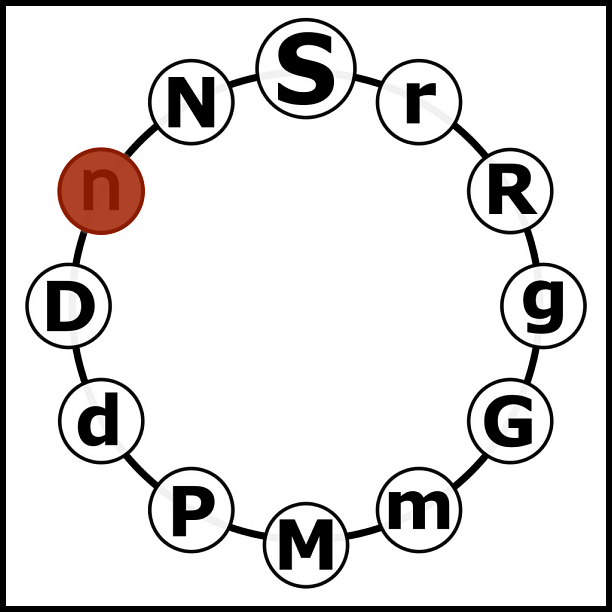

S-R-G-mM-D-N-S A tantalising invention of bansuri pioneer Pannalal Ghosh, with a scale resembling ‘Bihag no Pa’ (or even ‘Bilawal komal Pa’/’Major Scale b5‘). As with Pannababu’s other creations, debate persists as to exactly how he conceptualised the raga – his own renditions span a multitude of ideas, and, at the time of his sudden passing aged […]

• Raag Deepavali •

• Raag Kokilapriya •
S-r-g-m-P-D-N-S The Carnatic Kokilapriya scale (mela #11) is still barely known in the North (‘kokilapriya’: ‘the one who is dear to the koel bird‘). Its unique shape, resembling ‘Bhairavi–Yaman’, has several curious properties: with an ‘all-komal’ poorvang (Srgm) and ‘all-shuddha’ uttarang (PDNS), it is ‘palindromic’ (=symmetric from Sa) – but 5 of its swaras are ‘imperfect’ […]

• Raag Jaitashree •
S-r-G-M-P-d-N-S A sunset raga prominent in the Jaipur-Atrauli gharana, blending Shree with Jait’s komal re incarnation. Some, such as Ulhas Kashalkar, render the aroha ‘triswari’, limiting it to the three swaras of Malashree (SGP), set in Jait Kalyan-style phrases such as SG, GP, PSP – although the avroh is more clustered, often skipping taar Sa […]

• Raag Yaman Kalyan •
S-R-G-mM-P-D-N-S While the terms ‘Yaman’ and ‘Kalyan’ are often used interchangeably, the name ‘Yaman Kalyan’ refers to a distinct double-Ma variant of the parent raga, which sees shuddha ma inserted in descending phrases such as PMG, GmG. Vilayat Khan outlined his view of the raga’s characteristic twin-Ma interaction in the opening remarks to a sublime sitar–shehnai […]

• Raag Pancham •
S-r-G-mM-P-D-N-S An ancient raga of great historical renown, which is nevertheless rare in the modern era. Ramrang cites it as a descendent of the long-extinct Bhukosh (also an antecedent of Bhinna Shadja), with others linking it to the prakriti Bhankar and Bhatiyar (distinguished via sequences such as GMGrS; mmmGP; MDMmG). Most interpretations approximate the swaras […]

• Raag Hemant •
S-R-G-m-P-D-N-S Described by Deepak Raja as “amongst the most charming melodic entities to have gained currency in the last 50 years”, Hemant’s creation is often credited to Ravi Shankar, who began performing it from the 1940s onwards (some say it featured in his very first concert) – however it more likely originated with his guru […]

• Raag Poorvi •
S-r-G-mM-P-d-N-S Poorvi is a long-lived sunset raga from East India, which some describe as evoking a ‘serious mood of mystical contemplation’. Mixing narrow and wide intervals (all swaras have at least one immediate neighbour), its complex twists and turns belie the base scale’s neat, palindromic nature – with Sa and Pa sometimes being omitted or rendered […]

• Raag Adi Basant •
S-rR-G-m-P-D-N-S An ancient form of Basant (‘Springtime’), named for its connections to the ceremonies of that season. Many see Adi Basant as the latter’s main ancestor, highlighting its historic prevalence in Dhrupad and Haveli Sangeet – and some, including Maihar musicians, consider it inseparable from Shuddha Basant (‘shuddha’, as well as referring to ‘pure’ or […]

• Raag Bhatiyari Bhairav •
S-r-G-m-P-D-N-S A hybrid of two morning ragas: Bhairav and Bhatiyar. While movements of the latter take centre-stage, its typical PGrS descending phrase is replaced by the Bhairav-ang GmG\rS signature: Ramrang offers indicative patterns including Sm; mPGm; GmPDNP; DmPGmP; DNr; NDP; GmPmrS; PGmrS, occasionally seasoned with tivra Ma via MDS [n.b. ‘Bhairav-Bhatiyar’, though built from the same […]

• Raag Nand •
S-R-G-mM-P-D-N-S Associated with Lord Krishna, Nand (also known as ‘Anandi’ or ‘Anandi Kalyan‘) rose to prominence around the turn of the 20th century – initially gaining renown through a pair of bandishes by Mehboob Khan ‘Daraspiya’ (Dhundu Bare Saiyan) and Vilayat Hussain Khan ‘Pranpiya’ (Ajahun Na Aye). Aarshin Karande describes the raga as being “regarded […]

• Raag Amritvarshini •
S-G-M-P-N-S A rare audav raga corresponding to the swaras of ‘Yaman no Re/Dha’, imported from a well-established Carnatic form. The name translates as ‘one who showers the elixir of immortality’, hinting at its rich mythological history – in South India, the raga has long been associated with the monsoon (compare to the Northern Malhar ragas, […]

• Raag Shree Kalyan •
S-r-G-M-P-D-N-S Congruent with the seven swaras of Puriya Kalyan (and Marwa thaat), Shree Kalyan is an enchanting product of Kumar Gandharva’s prolific imagination (also see Madhusurja, Lagan Gandhar, Saheli Todi, Rati Bhairav, Bihad Bhairav, and Bhavmat Bhairav). The movements of his main rendition (Dekho Re Rut Phoolan Lagi) place Shree’s tritonal re–Pa sangati on stark […]

• Raag Mand •
S-R-G-m-P-D-N-S Arising from the festive folk tunes of Rajasthan, Mand (not to be confused with Nand) is a multifaceted raga form, popular in light-classical settings. Generally based around a Bilawal swara set, some artists also add komal ga, komal dha, and tivra Ma among other mishra touches – setting them in heavily-ornamented vakra movements (e.g. […]

• Raag Annapurna •
S-r-g-M-P-d-N-S From my 2018 Darbar interview with bansuri maestro Rupak Kulkarni: “I lately composed Raag Annapurna: dedicated to Maa Annapurna Devi, my grand-guru [teacher of my teacher]. It is a combination of morning and evening ragas, so can be played at either of these times”. In 2022 I asked Kulkarni for more info: he described […]

• Raag Latangi •
S-R-G-M-P-d-N-S A unique sampurna scale borrowed from the 63rd Carnatic mela, which takes the form of ‘Kalyan komal dha’ (or ‘Yaman’s poorvang + Bhairav’s uttarang’: SRGM+PdNS). Subbha Rao’s Raga Nidhi Vol.3, written in the early 1960s, mentions that “Latangi is not found in Hindustani music” (p.90) – and it remains unclear who first imported the […]

• Raag Lalita Gauri •
S-r-G-mM-P-dD-N-S Spanning a diverse range of ‘Lalit + Gauri‘ experiments, the name ‘Lalita Gauri’ essentially refers to the general concept of fusing these two ragas rather than a specific melodic form. The most prominent modern incarnation appears to have been created by Jaipur-Atrauli vocalist Kesarbai Kerkar (who often employed it as a concert centrepiece), although differing […]

• Raag Chayanat •
S-R-G-mM-P-D-N-S A longstanding combination of Chaya and Nat, creating (as per Tanarang) an “attractive, sweet, and emotionally swaying” mood – the latter in particular summoned via ‘simple vakra’ phrases such as DNDP; RGRS. The Pa–Re sangati is vital, and shuddha ma is stronger than tivra Ma – with the raga inviting a range of expressive […]

• Raag Paraj •
S-r-G-mM-P-d-N-S A playful sonic form which matches the swara set of Poorvi, with movements roughly akin to a ‘double-Ma Kalingada’ (also see their combination: Paraj Kalingada). Described by Parrikar as “an uttarang-pradhan raga with tonal activity clustered around taar Sa…elongation of Ni in SNdSN is a Paraj signpost, and dha is rendered durbal throughout”, with […]

• Raag Bihari •
S-R-G-m-P-D-N-S Connected to historic folk tunes of the Bihar region, Bihari is popular as a setting for thumri and other romantic song styles. Its core movements lie close to Tilak Kamod, also drawing on Shuddha Nat, and sometimes featuring mishra flourishes. Kishori Amonkar’s renditions are among my personal favourites (bandish: “Sleep will not come to […]

• Raag Lakshmi Kalyan •
S-R-G-mM-P-D-N-S An enchanting but seldom-heard raga, taking the swara set of ‘Kalyan double-Ma’ (n.b. ‘Lakshmi’ refers to the Hindu goddess of power, prosperity, and fortune). Described by slide guitarist Deepak Kshirsagar as “a combination of Shuddha Sarang and Shyam Kalyan, [although] some combine Shuddha Sarang and Kamod..or use [the swaras of] Shyam Kalyan in the […]

• Raag Dhavalshree •
S-r-G-M-P-dD-N-S A Shree-ang monsoon raga which presents in multivariate modern forms, with particular variance evident in the status of Dha. Kishori Amonkar’s Jaipur-Atrauli interpretation adds shuddha Dha to the basic framework of Jaitashree, whereas Mallikarjun Mansur’s take renders dha komal amidst Shree-ang motions such as rNdP, also showcasing a strong SGP sangati and chayas of […]

• Raag Chandraprabha •
S-R-m-d-N-S A magical audav raga matching the scale of ‘Chandrakauns with Re instead of ga’ (or ‘Kirwani no ga/Pa‘, thus allowing for poorvang shades of Sarang. Benares bansuriya Ajay Prasanna cites the raga as a creation of his father Bhola Nath Prasanna, adding that Chandraprabha “celebrates the light and glow of the moon…its serene calmness […]

• Raag Paraj Kalingada •
S-r-G-mM-P-d-N-S A seldom-performed jod raga matching the swaras of Poorvi, summarised by Aneesh Pradhan as “a combination of the [springtime] Paraj and Kalingada, [which is] popularly used in the thumri–dadra genres”. Paraj and Kalingada, already being closely-related forms, give rise to a subtle, samay-mixing blend – further seasoned by their respective proximities to Basant and Bhairav. […]

• Raag Trishnaa •
S-R-gG-P-dD-S A charming late-evening audav raga which features both forms of Ga and Dha, recently introduced by Dagarvani vocalist Ashish Dha. As per the summary he sent me, “Trishna – meaning ‘thirst’ in Hindi – creates a plaintive, slightly melancholic mood…Dha is shuddha in aroha, and komal in avroh. Komal ga is used in both […]

• Raag Maluha (Kalyan) •
S-R-G-m-P-D-N-S Maluha (‘Tearful’) is compound raga which draws on forms including Kamod and Shyam Kalyan. Tivra Ma and komal ni are mostly restricted to ornamental use (e.g. GP(MDPM)P), and the avroh may feature touches of Khem Kalyan and other proximate forms. The liner notes to a 1966 Nikhil Banerjee album describe Maluha Kalyan as “an […]

• Raag Prabhat (Bhairav) •
S-r-G-mM-P-d-N-S A morning form (Prabhat: ‘dawn’) summarised by Bose as “a combination of three or four ragas dominated by the Bhairav-ang, with a touch of Lalit-ang only in the avroh, where both Ma come together…The vadi Ma separates Prabhat Bhairav from Bhairav, while Pa keeps it away from Lalit” (also see the nearby Lalit Pancham). Characteristic […]

• Raag Zeelaf •
S-G-m-P-d-S A rare audav raga fabled to have been created by 13th-century qawwali pioneer Amir Khusrau, somewhat resembling ‘Bhairav minus re & Ni’. As per Rajan Parrikar, “this haunting pentatonic melody is composed of the following swaras: SGmPd. Jitendra Abhisheki gives a superb account with his own composition [transcribed below]: notice the strong ma and […]

• Raag Ardhanaarishvara •
S-r-g-m-P-d-N-S During my original search for the ‘32 sampurna thaat’, I couldn’t find a single raga that precisely matched the SrgmPdNS swara-set. This surprised me, given the scale’s inherently fascinating shape – with a poorvang-uttarang bifurcation of ‘Bhairavi–Bhairav’ (Srgm+PdNS), equivalent to ‘Bhairavi shuddha ni’, ‘Bhairav komal ga’, ‘Todi shuddha ma’, or ‘Kirwani komal re’. While […]

• Raag Kaushik Dhwani •
S-G-m-D-N-S A modern-era descendent of the ancient Bhinna Shadja, essentially indistinguishable from its parent. Ma is a strong vadi, and a S\D glide is common in descending motions – but aside from this, artists are essentially free to roam at will within the scale, with all swaras employable as nyas across all three saptak (Tanarang: […]

• Raag Anjani Kalyan •
S-R-g-M-P-D-N-S A creation of Gwalior vocalist and educator Ramashreya Jha ‘Ramrang’ – named in honour of Anjana, a mythic Vanara princess fabled in Hindu lore as Lord Hanuman‘s mother. As per his student Rajan Parrikar, “the basic idea involves rendering the aroha of Madhuvanti sampurna, by taking in both [shuddha] Re and Dha. The aroha […]

• Raag Bhatiyar •
S-r-G-mM-P-D-N-S A dawn raga fabled as a creation of Raja Bharthari, a mythical King of Ujjain who is said to have left behind his life of material wealth and romantic pleasure to pursue a path of ascetic devotion (“Bharthari resolves to kill a black buck, and seek diksha [initiation rites] from the yogi…As the plan […]

• Raag Madhu Multani •
S-r-g-M-P-D-N-S An aprachalit raga combining Multani’s poorvang with Madhuvanti’s uttarang (also viewable as ‘Madhuvanti komal re’ or ‘Multani shuddha Dha’), which I found during my search for ragas matching the ‘32 thaat’ (=all possible 7-swara sampurna scales). Conceived by prolific rare raga explorer Abhirang in 2020, who banishes Re and Dha in aroha alongside other […]

• Raag DoGa Kalyan •
S-gG-M-P-D-N-S A Ravi Shankar creation taking the form of ‘Kalyan with komal ga instead of Re’ (‘DoGa’: ‘Double-Gandhar’) – which, despite never having been released in classical form, may have left its mark on modern music as a possible source for The Beatles’ Blue Jay Way, composed by Shankar’s sitar student George Harrison in 1967. At […]

• Raag Hameer •
S-R-G-mM-P-D-N-S A winding raga of complex historical lineage, Hameer (‘Royal, Regal’) enjoys a steady presence on the modern concert circuit. Re is weak in aroha, and Tanarang links the shuddha Dha vadi to “the enthusiasm and courage of warriors”, giving a pakad of GMND; DDP and uttarang-focused phrases such as Gm(N)DNS; PDPPS; MPDNS. Touches of […]

• Raag Asa Bhairav •
S-rR-G-m-P-D-N-S A joining of Bhairav and the archaic Sikh form Asa (Sanskrit for ‘Hope’), matching the swaras of ‘Bilawal double-Re’ – with the shuddha taken in ascent, and the komal in descent. Parrikar notes that “the Bhairav-ang is expressed in the poorvang [e.g. Gm(G)rS], and the rest of the contour looks to Asa [e.g. S, S(m)RmP, […]

• Raag Sohini •
S-r-G-M-D-N-S Sharing its six swaras with Marwa and Puriya, Sohini aims for a looser, more sprightly flavour to its more famous congruents – focusing on agile movements in madhya and taar saptak, and uttarang-based phrases built on a strong Dha–Ga sangati. Re is banned in aroha, and Sa assumes greater strength than in Marwa, while […]

• Raag Adbhut Kalyan •
S-R-G-D-N-S An uncommon Kalyan variety, named Adbhut (‘Wondrous’) for omitting two of Kalyan’s most vital swaras (Ma & Pa). Remains popular in the Dagarvani Dhrupad, but few others have risen to the centreless challenges of losing both mid-saptak swaras. Aminuddin Dagar reportedly considered the raga to be an offshoot of Khem Kalyan, while Uday Bhawalkar links […]

• Raag Nat Bhairav •
S-R-G-m-P-d-N-S A direct combination of Nat in poorvang and Bhairav in uttarang (SRGm+PdNS), Nat Bhairav was sitar icon Ravi Shankar‘s first raga creation, released in the pre-Independence music scene of 1945 – inspired by Shankar hearing an allied theme sung in a lecture-demo by legendary musicologist B.R. Deodhar (read the full origin tale below). Flavours of the […]

• Raag Khem Kalyan •
S-R-G-mM-P-D-N-S A rare-but-charming raga of the Agra gharana, Khem Kalyan is a Kalyan variant with Hansadhwani-like touches. In his essay The Precious Kalyan, Imdadkhani sitarist-scholar Deepak Raja recounts his quest to decode and reconstruct its workings from old recordings, having failed to find a guru who knew it: “This was no ordinary raga…not even just […]

• Raag Kalingada •
S-r-G-m-P-d-N-S Kalingada shares the same seven swaras as Bhairav, but approaches them in distinct fashion – generally preferring a simpler, less ornamented character (as per Rajan Parrikar: “Kalingada has a flippant mien…far less austere than Bhairav. Ga and Pa are advanced to positions of influence, and the swara-lagav is mostly linear, without the andolit treatment […]

• Raag Gagan Vihang •
S-R-G-m-P-D-N-S As per Ocean of Ragas, Gagan Vihang (Sanskrit: ‘Birds of Heaven’) “was composed by Pandit Dinkar Kaikini…we find features of Bihag, Savani, Nand, and Mand, although the raga maintains its independent melody [via] unique phrases such as SRPGm, GmRS, NDmP” – while others also point to the influence of Shankara. The Agra khayal innovator […]

• Raag Dagori •
S-R-G-m-P-D-N-S The seldom-heard Dagori features prominent use of shuddha Ni and characteristic slides and glides between ma and Re. Seemingly invented by Jaipur-Atrauli gharana founder Alladiya Khan (also the progenitor of Maru Bihag and Jait Kalyan), and still near-exclusively performed by the khayal singers of that tradition, although detailed information is scant. While I initially […]

• Raag Rangeshwari •
S-R-g-m-P-N-S Like Parameshwari and Gangeshwari, Rangeshwari (‘Lordess of Colours’) was created in 1968 via murchana rotation of Ravi Shankar’s Kameshwari (itself dreamed up during a car journey through Bengal). Resembles a ‘no Dha’ filtering of either Patdeep or Kirwani, although its shape seems to be unique – with Shankar’s takes tending towards wide-open, poorvang-dominant movements. […]

• Raag Purba •
S-r-G-mM-P-dD-N-S A rare raga of the Jaipur-Atrauli gharana, described by Rajan Parrikar as “essentially Raag Poorvi adorned with bells and whistles” – in particular, the Ma-mixing catchphrases Sm, mGP and MMPPd, dNdP. Refer to the Rajshekhar Mansur bandish transcribed below, which showcases uttarang forays of MP, PdNdP and a prominent M\G glide. Also recorded by […]

• Raag Swanandi •
S-R-G-m-P-D-N-S Fashioned by Agra vocalist Jagannathbuwa Purohit ‘Gunidas’ (also the creator of Jogkauns and Jaun Bhairav), fusing material from Bhatiyar, Bihag, and Bhinna Shadja into an engrossing new whole. Bhatiyar forms the main base, with its phrases being reworked to match the swaras of Bilawal thaat (e.g. PGRS; SD NDP, PDPm), with Bhinna Shadja contributing […]

• Raag Simhendra Madhyamam •
S-R-g-M-P-d-N-S Borrowed from a South Indian ragam (mela #57), Simhendra Madhyamam takes the form of ‘Kirwani tivra Ma’, ‘Todi shuddha re’, or ‘Madhuvanti komal dha’. Despite the broad popularity of its Carnatic congruent (hailed by Charulatha Mani as “regal, meditative, bold, and striking”), the raga remains rare in the North – with its phraseological norms […]

• Raag Shobhawari •
S-R-m-P-d-S A rare ‘audav Asavari’ raga, matching the swaras of ‘komal Dha Durga’ (or ‘shuddha Re Gunakri‘). While relatively free of specific melodic constraints, the dha assumes natural prominence due to its disbalancing effects: it is involved in the only hemitonic pairing (Pd) and also the widest adjacent jump (dS), while serving as the only […]

• Raag Shivawanti •
S-R-g-M-P-D-S A sparsely-documented modern creation of sitar and surbahar legend Imrat Khan – kindly brought to my attention by his student Chris Stephens via the Chandrakantha forum: “In regard to the ‘idiosyncratic’ Etawah ragas, here’s a video of [Khan] playing Shivawanti, which he described as a combination of Shivranjani and Madhuvanti. I captured this in […]

• Raag Sazgiri •
S-r-G-mM-P-dD-N-S Often described as being among the most complex of Hindustani forms, Sazgiri is fabled as a creation of Amir Khusro (1253-1325): the legendary Sufi poet, singer, and mystic of the Delhi Sultanate (although direct historical evidence for his authorship of the raga is admittedly scant). Komal dha is restricted to Poorvi-ang phrases such as […]

• Raag Rasaranjani •
S-R-m-D-N-S A rare, oddly-shaped audav raga formed by omitting Ga and Pa from Bilawal thaat – somewhat like ‘removing the major triad from the major scale’ (it can also be seen as ‘Bhavani plus Ni’). Vocalist Sakuntala Narasimhan, introducing a drut khayal, cites Rasaranjani as an innovation of her Rampur gharana guru Hafiz Ahmed Khan, […]
