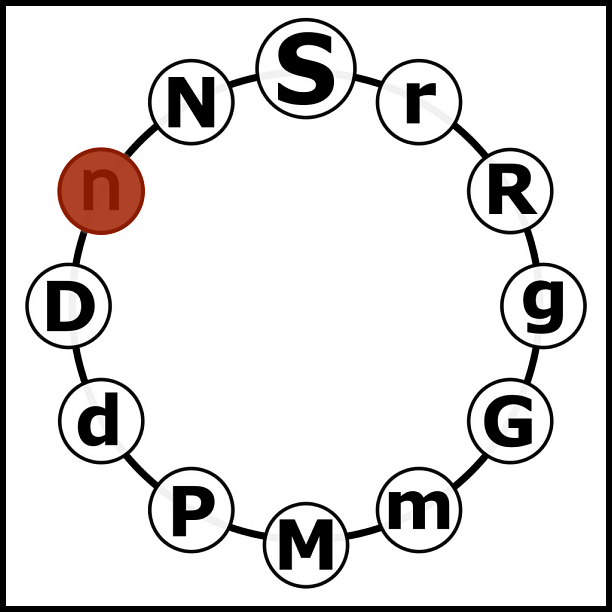

S-R-G-M-D-N-S A ‘Kalyan no Pa’ melody devised by Gwalior vocal innovator Vasantrao Deshpande (although he may well have seen it more like a ‘Puriya shuddha Re’). Parrikar describes how “the relief-inducing nyas on Pa is missing, giving a ‘restive’ persona”, while Ocean of Ragas gives a pakad of GMD, DMGR, NRS. Generally treated as hexatonic in […]

• Raag Raj Kalyan •

• Raag Meghranjani •
S-r-G-mM-N-S A truly odd scale form, Meghranjani can be interpreted as either ‘Bhairav minus Pa & dha‘ (SrGmNS) or ‘Lalit minus dha‘ (SrGmMNS) – producing a strange shape which omits two consecutive generic swaras (see other such ragas in my ‘consecutive varjits‘ category, including Adbhut Kalyan, Devranjani, & Malashree). Originally borrowed from the Carnatic Megharanjani, the […]

• Raag Lalita Sohini •
S-r-G-mM-D-N-S A blend of the early-morning Lalit and late-night Sohini, with the melodies of the latter dominating the aural impression, reportedly created by Agra vocalist Yunus Ahmed Khan in the mid-20th century. Raja notes that “while Sohini is a resident of the upper tetrachord, Lalit is a resident of the lower tetrachord. Thus, the resulting melodic entity […]

• Raag Jogiya •
S-r-m-P-d-N-S Jogiya (from Sanskrit yogi: ‘State of Union’) is a shadav raga of considerable mystique. Tanarang recounts “a characteristic mood of devotion and detachment…Jogiya has komal re and dha like Bhairav, however they are not oscillated…and shuddha ma is powerful as nyas and vadi”. Generally expandable in madhya and taar saptaks, the raga’s geometries revolve […]

• Raag Hem Bihag •
S-R-G-m-P-D-N-S Often cited as an invention of Ravi Shankar, Hem Bihag was in fact devised by his teacher Allauddin Khan – as noted by Shankar & Ali Akbar Khan when they chose it to open a tribute concert just a few weeks on from their guru’s 1972 death, at the reputed age of 110 (below: […]

• Raag Devranjani •
S-m-P-d-N-S Stretched by the emptiness of a vast Sa–ma poorvang jump, Devranjani is formed by removing the re and Ga from Bhairav. Abhirang offers up both ‘shuddha Ni’ and ‘double Ni’ variants, with the former appearing to be predominant – while Bhatkhande’s early 20th-century works discuss the unavoidable strength of the ascending phrase Sm, mP […]

• Raag Chaya Malhar •
S-R-G-m-P-D-N-S Profiled by Parrikar as “a compound melody formed by joining elements of Chaya to the Malhar raganga signature [mRm\RP]…The nyas on Pa is important, but an inapposite nyas on Re or undue brightening of ma may tilt the development towards Nat Malhar”. Listen to his Gwalior guru Ramrang’s rendition, seasoned with a particularly prominent […]

• Raag Bhavani •
S-R-m-D-S Distinguished by permitting only four swaras (and sometimes titled ‘Chatuswari’: ‘four-toned’), Bhavani’s symmetrical shape is akin to ‘Durga no Pa’ – seemingly reflected in its title, with ‘Bhavani‘ referring to a fierce, nurturing form of Maa Durga who dispenses cosmic justice by killing malevolent Asuras. Its intriguing surtar sparsity necessitates a multipolar approach to […]

• Raag Baradi •
S-r-G-M-P-D-N-S A long-lived and diffuse sonic lineage variously referred to as ‘Baradi’, ‘Barari’, ‘Varati’, and ‘Varali’, which appears in several overlapping modern forms, typically spanning the territory around Marwa thaat (Bhatkhande’s Sangeet Shastra Vol.3, published around a century ago, notes 13 distinct variants). Some artists omit tivra Ma, and others may add komal dha (‘Poorvi–ang’) – […]

• Raag Abhogi •
S-R-g-m-D-S A rare instance of an ‘audav Kanada’ raga, Abhogi’s swara-set resembles ‘Bageshri‘s aroha without ni’ – presenting a clustered poorvang and sparse uttarang (SRgm; DS). As per Tanarang, the raga’s capacity for Darbaric concluding motions (mgmRS) summons “a deep atmosphere” – with the vacant upper scale presenting performers with a curious creative challenge. Abhogi is […]

• Raag Sohini Pancham •
S-r-G-mM-P-D-N-S A variant of Sohini, named for its insertion of shuddha ma and Pa via phrases from Pancham including MGMGrS; MPGmG; MDMmG [n.b. many other raga names involving ‘Pancham’ indicate the inclusion of the swara position rather than the raga, e.g. ‘Pancham Malkauns‘]. Refer to renditions by Madhup Mudgal and Nisha Nigalye-Parasnis (singing a Pranpriya […]

• Raag Rajeshwari •
S-g-m-D-N-S Taking the swaras of ‘Chandrakauns shuddha Dha’, Rajeshwari’s five tones bring an idiosyncratic spin to the Kaunsi-ang, coloured with diffuse tensions. All poorvang swaras are set to their lowest specific position (Sgm), and all uttarang swaras are set to their highest (DNS), with the relief-bringing Re–Pa axis banished throughout. The resulting scale presents significant challenges […]

• Raag Maligoura •
S-r-G-M-P-dD-N-S A sandhiprakash raga which draws on Puriya, Gauri, Marwa, and Shree. Depending on rendition, Dha may be komal (Ali Akbar Khan), shuddha (Ramprapanna Bhattacharya), or double (Khadim Hussain Khan) – with considerable cross-gharana variance in characteristic phraseologies. Maihar sarodiya Sayak Barua states that “NDNrNP is the heart of the raga”, and, as per Manjiri […]

• Raag Gunakri •
S-r-m-P-d-S Taking the swaras of ‘Bhairav no Ga & Ni’, Gunakri – described by AUTRIM as “serious and peaceful” – brings out the character of its parent raganga via an oscillating komal re, and movements patterns including Sd, dP and SdSr, rS (although Jairazbhoy prefers to analyse it via the geometries of Basant Mukhari). Bose gives a […]

• Raag Devata Bhairav •
S-r-gG-m-P-d-N-S A double-Ga Bhairav derivative introduced by Agra gharana pioneer Azmat Hussain Khan ‘Dilrang’. As per Parrikar, the raga is distinguished from its parent with “the introduction of [an] avroh pragoya via the komal ga [mgrS]”. Some artists include subtle touches of komal ni, including Jitendra Abhisheki – who sings a madhyang-focused bandish (to me, reminiscent of […]

• Raag Bhinna Shadja •
S-G-m-D-N-S Often characterised as the ‘older form’ of today’s Kaushik Dhwani, Bhinna Shadja’s lineage stretches back well over 1000 years. It appears in numerous ancient shastras: notably including Matangamuni’s Brihaddeshi (~8th-century), Abhinavagupta 11th-century writings (“Bhinnashadaja, Kaushiki, and Bhinnapanchama are favoured in Summer”), and Sarangdeva’s 13th-century Sangita Ratnakara – which describes its scale form in remarkably […]

• Raag Bangal Bhairav •
S-r-G-m-P-d-S A distinctive Bhairav raganga offshoot with uncertain origins, summarised in oddly poetic fashion by MeetKalakar: “Being Nishad-taboo, its caste is shadav. Dhaivat and Rishabh are used softly…which are respectively the plaintiffs”. Performed by only a handful of khayal vocalists (e.g. Abhirang, Purnima Sen, and Yunus Hussain Khan) – but remains a staple of the […]

• Raag Triveni •
S-r-G-P-d-N-S Taking a hexatonic ‘Shree/Bhairav no ma’ swara set, Triveni’s main incarnation (also known as ‘Tirban/Tirvan’) comprises two congruent swara-clusters – SrG & PdN (both semitonal jumps of ‘1-3’). Melodic motions mostly take after Shree and Bhairav, particularly via a strong re–Pa sangati and G\rS descents – both evident in Shounak Abhisheki’s jhaptal bandish (Kalindi […]

• Raag Tankeshree •
S-r-G-M-P-d-N-S Tankeshree is a seldom-performed Shree–ang raga, which lies closest to the predominant form of Triveni (the same scale minus Ma). Pa is strong and tivra Ma is weak – at least based on the evidence of Omkarnath Thakur’s soaring 1940 rendition (Malan Laaye Chun Chun Kaliyan), which regularly ascends in sparse SGP fashion (also […]

• Raag Savani •
S-R-G-m-P-D-N-S An evening raga, which, despite its regular titling of ‘Savani Kalyan’, usually lies closer to Bihag than the Kalyan family – chiefly via avoiding tivra Ma, and giving greater strength to the Sa–Pa sangati. In the raga’s main incarnation, Dha and Ni are often rendered durbal, and may be skipped via PSP turnarounds (although […]

• Raag Noor Sarang •
S-R-mM-P-D-N-S A rare raga of the Sarang family, around which there exists limited melodic consensus. As per Abhirang’s account, “when we only use tivra Ma in Shuddha Sarang, it is converted to Noor Sarang…in avroh, the Dha is kept ‘free’ [e.g. ornamented D(NP)]” – also noting its proximity to Jaymini Sarang (both Ni). Dhrupad interpretations […]

• Raag Mangal Bhairav •
S-r-G-m-P-D-N-S A ‘shuddha Dha Bhairav’ offshoot, which thus allows for Durga-like uttarang movements such as mPDS. Ronu Majumdar also touches on Bhupali (e.g. SDS SDPDS: gat transcribed below), placing these passages in contrast to Bhairav’s signature GrS conclusion phrase. Subbha Rao’s Raga Nidhi Vol.3 notes that the raga’s movements remain anchored in the pentatonic swara […]

• Raag Malti Basant •
S-r-G-mM-D-N-S A rare springtime raga, summarised in Narayanrao Patwardhan’s 1964 Raga Vigyan as a fusion of Puriya, Basant, Sohini, & Hindol (see chalan phrases below) – although Deepak Raja recounts a conversation with Ulhas Kashalkar, who states that “there is no Hindol in it…the raga has shades of Puriya and Sohini as well as Basant…Mainly [sung] in […]

• Raag Madhuranjani •
S-g-m-P-N-S The name ‘Madhuranjani’ is used in reference to several distinct forms. The best-known incarnation is based on the SgmPNS swara set of ‘Dhani shuddha Ni’ (or ‘Patdeep no Re/Dha’) – as exemplified by vocalists such as Abhirang, Sawani Shende, and Jitendra Abhisheki, who also includes flourishes of shuddha Re in avroh. Some suggest that […]

• Raag Gauri Basant •
S-r-G-M-P-d-N-S Introduced by prolific raga creator Kumar Gandharva via fusing Gauri with Basant’s tivra Ma incarnation. His original renditions also prominently showcase a Bhairav-ang G\r slide – but this fragment lacks its usual support from shuddha ma above, instead being followed in the bandish by Basant-like turns such as GPd; PMPG (…this shift is timed […]

• Raag Gaud Sarang •
S-R-G-mM-P-D-N-S Aside from its afternoon designation, Gaud Sarang typically carries few hints of the Sarang family – running more like a vakra Bihag variant seasoned by a GRmGPRS pakad amongst other melodic quirks (some refer to it as ‘Din ki Bihag’: ‘Daytime Bihag’). Shuddha ma is strong, but not used as a nyas, with its enclosing […]

• Raag Lagan Gandhar •
S-R-gg̃G-P-D-S An oddball product of Kumar Gandharva’s limitless imagination, Lagan Gandhar (‘Full Ga Concentration’) is distinguished by taking a ‘triple-Ga’ – with an additional ‘quarter-tone’ sruti lying roughly halfway between the komal and shuddha shades (‘komalaa gandhar’: notated here as ‘g̃’). This strange tone-trio is often navigated in adjacent manner, with slow glides serving to […]

• Raag Saurashtra Bhairav •
S-r-G-m-P-dD-N-S A unique ‘double-Dha’ blend of the morning Bhairav with the night-time Bhinna Shadja, Saurashtra Bhairav’s movements vary across gharana boundaries. Abhirang, interpreting a pair of Ramrang compositions (Barani Na Jaye Chabi & Aba Main Kase Jaya Kahu), cites the importance of Bhinna Shadja’s mDNSNDm catchphrase – although most other movements fall in line with those of […]

• Raag Sanjh Saravali •
S-R-G-mM-P-D-N-S Taking the general form of ‘Yaman Kalyan seasoned with Bihag’, Sanjh Saravali (‘Evening Melody’) was devised by Vilayat Khan in the late 1970s. Fellow Imdadkhani sitarist Deepak Raja, aided by input from Vilayat himself, describes the raga as “incorporating fleeting impressions of several Kalyan ragas, including Nand Kalyan and Chayanat…its melodic identity rests on […]

• Raag Roopkali •
S-rR-G-mM-P-d-N-S A variation of Ramkali, which is distinguished through a general avoidance of komal ni and sporadic inclusion of shuddha Re. Renditions generally focus on the mid-scale region, with all five specific swaras from shuddha Ga to komal dha available for use (GmMPd). Khadim Hussain Khan’s twisting melodies tend to pair tivra Ma with Pa above, […]

• Raag Purva •
S-r-G-M-P-D-N-S As per Deepak Raja’s insightful analysis, “Purva [bears] resemblance to Puriya in terms of swara material, phraseology, melodic centre of gravity, and aural impression” – also adding that, while sitarist Vilayat Khan considered the raga indistinguishable from Puriya Kalyan, it is in fact marked out by “differential weightages given to different segments of the […]

• Raag Pat Bihag •
S-R-G-mM-P-D-N-S A chalan bheda of Bihag, which varies according to gharana. Tivra Ma is generally restricted to ornamental use, while Jaipur-Atrauli singers may showcase a range of additional melodic quirks. In Parrikar’s summary, “most of its mannerisms are Bihag-like, the notable departure being its ‘glowing’ shuddha ma: deergha and mukta” – also see his rundown […]

• Raag Manjari Bihag •
S-R-G-m-P-D-N-S Produced via a chalan bheda of Bihag, Manjari Bihag also lies close to Pat Bihag, typically differing from both these forms via the exclusion of tivra Ma (compare to other members of the Bihag raganga). Most prominently recorded by Aslam Khan ‘Khusrang’: his 1989 album rendition (bandish: Sohat Kanha & Sughara Banara More Ghar […]

• Raag Malavi •
S-r-G-M-P-D-S An enchanting sandhiprakash raga, which has different melodic characteristics depending on the time of day. Jaipur-Atrauli vocalist Manjiri Asanare-Kelkar’s demo lesson describes its ‘morning form’ as “a complex raga combining Hindol and shuddha Dha Bibhas…you might also find a glimpse of Deshkar” – whereas she places the ‘evening form’ closer to Shree (“There are several […]

• Raag Lalit Pancham •
S-r-G-mM-P-D-N-S A title applied to various offshoots of Lalit which add some combination of Pa and shuddha Dha to the basic SrGmMdNS swara set, often removing komal dha in the process. Many such incarnations draw from Shuddha Basant (a raga which features Pa and, depending on variant, either form of Dha: Ulhas Kashalkar notes that […]

• Raag Jait •
S-rR-G-P-D-S A charming audav raga with several disparate branches. In particular, the treatment of Re varies (some render it komal, and others shuddha, while Jaipur-Atrauli singers employ both forms) – with Dha, which must be taken vakra, also showing up in both its variants (albeit not within the same performance). Indeed, even renditions by the […]

• Raag Hansa Narayani •
S-r-G-M-P-N-S Taking the shape of ‘Puriya Dhanashree minus dha’, Hansa Narayani presents uttarang shades of Hansadhwani (PNS): another swan-related raga with Carnatic roots (‘Hansa’ suggests a swan-riding image of Saraswati, the four-armed Hindu goddess of music and learning, and ‘Narayani’ refers to an incarnation of Lakshmi, goddess of wealth and fortune: collectively covering two-thirds of […]

• Raag Viyogavarali •
S-r-g-m-d-N-S An invention of Agra vocalist S.N. Ratanjankar, Viyogavarali (or ‘Viyog Varali Todi’) was derived by omitting Pa from the Carnatic Dhenuka (mela #9) – resembling ‘Chandrakauns plus komal re’ or ‘Gujiri Todi shuddha ma’. All swaras except Ni appear in their lowest specific variants, with the use of ga restricted to Todi-ang avroh motions (e.g. […]

• Raag Kesari Kalyan •
S-R-G-P-D-N-S Kesari Kalyan is formed by removing Kalyan’s most characteristic swara – tivra Ma – leaving a curious shadav scale (prakriti with Shankara). Legendary Gwalior vocalist and educator Ramashreya Jha ‘Ramrang’ appears to have created the raga: hear his own rendition, and also listen to him discuss it in the context of “two key ideas […]

• Raag Hindolita •
S-G-mM-P-D-N-S A blend of Hindol and Lalit, seemingly introduced by Kirana master Bhimsen Joshi – who recorded it a handful of times over the years, including at the 1992 Sawai Gandharva Festival with Zakir Hussain, and for his 1997 Rarely-Heard Ragas album (also featuring Jaijaiwanti Nat and Bageshri Bahar). Given the sparsity of its recorded […]

• Raag Vijayanagari •
S-R-g-M-P-D-S A scale of Southern origin, seemingly imported North by Gwalior guru Balabhau Umdekar, which matches the swara set of ‘Madhuvanti minus Ni’ (although the Carnatic original is classed as a ‘janya‘ derivative of Hemavati). While I can’t trace any of Umdekar’s recordings, Malini Rajurkar has performed a pair of his bandish: Sajana Ghara Avo […]

• Raag Tilak Bhairav •
S-rR-G-m-P-dD-N-S An ultra-rare raga associated with Imdadkhani composer Dhruva Tara Joshi, spanning the full swara sets of Bhairav and Tilak Kamod. Although initially a sitarist, Joshi’s sole traceable take of the raga is a vocal-only rendition from a lecture-demo (seemingly the result of an injury forcing him away from the strings) – which concisely interweaves […]

• Raag Bhankar •
S-r-G-mM-P-dD-N-S Bhankar is a complex morning form which introduces Lalit-flavoured phrases to the basic framework of Bhatiyar. Manjiri Asanare-Kelkar cites two main variants sung in her Jaipur-Atrauli gharana, one of which also features touches of Bhairav – with both versions sharing common phrases including Bhatiyar’s Sm mPG, MDS and Lalit’s NdMm, GmMmG. She also elucidates how […]

• Raag Bhankari •
S-r-G-mM-P-D-N-S A complex blend of several ragas, Bhankari was created by Gwalior guru Ramashreya Jha ‘Ramrang’. His student Rajan Parrikar describes it as a “tantalizing melody blending facets of Bhatiyar, Jait, Bibhas, and Deshkar, while retaining an aesthetic coherence in the end product”. Ramrang’s renditions also overlap significantly with some interpretations of Bhankar – an […]

• Raag Dakshinatya Basant •
S-r-G-m-P-D-N-S A springtime raga described by sarodiya Joydeep Mukherjee as “very rare…adapted from Carnatic music” (hear him play it on “a very rare instrument, the Radhika Mohanveena”, created by Radhika Mohan Maitra in 1948 – accompanied by Subhasish Sabyasachi, “the first ambidextrous percussionist of India“). The name translates as ‘Southern Basant’ (to distinguish it from the […]

• Raag Shivangi •
S-G-P-D-S A charming chatuswari, confined to the swaras SGPD throughout. Vocalist Shubhada Moghe, in the accompanying notes to her 2019 rendition, describes Shivangi as “a rare morning raga taught to me by my guru-ji Pt. Manikbua Thakurdas, whose lineage goes back seven generations…it is very close to Deshkar, but omits Re completely. The vadi-samvadi are […]

• Raag Loom •
S-R-G-m-P-D-N-S A rare but charming all-shuddha raga, said by some to be an older form of the Bilawal lineage. Most commonly associated with Ali Akbar Khan, who performed several variants over the course of his long career: including the ‘pure’ Loom, as well as Loom Nat and Loom Mand (all SRGmPDNS). During one concert, Khan recounted […]

• Raag Gaud •
S-R-G-m-P-D-N-S Now lying dormant, Gaud – assumed to have been named for its origins in the archaic Gaudadesha region – is best-known via its parental role in compounds such as Gaud Malhar, Gaud Sarang, and Gaud Bahar. In spite of its modern scarcity, the raga played a vital role in Hindustani history, turning up in numerous […]

• Raag Sonakshi •
S-r-G-mM-P-dD-N-S From my 2018 Darbar interview with Maihar bansuri maestro Rupak Kulkarni: “I created Sonakshi [‘Golden-Eyed‘] so I could experience a raga which was suitable for any time of day. I believe we have different mindsets depending on the hour: in the morning our mood is spiritual and fresh, and in the evening it is […]

• Raag Japaniya •
S-R-g-P-d-S The SRgPdS swara set – equivalent to ‘Shivranjani komal dha’ or ‘Bhupali Todi shuddha Re’ – exists in several distinct Hindustani guises. Patiala vocalists title it ‘Lilavati’, however this name is also applied to a separate ‘Kalavati komal ga’ raga by others. The same scale also appears under the intriguing title of ‘Japaneeya / […]
