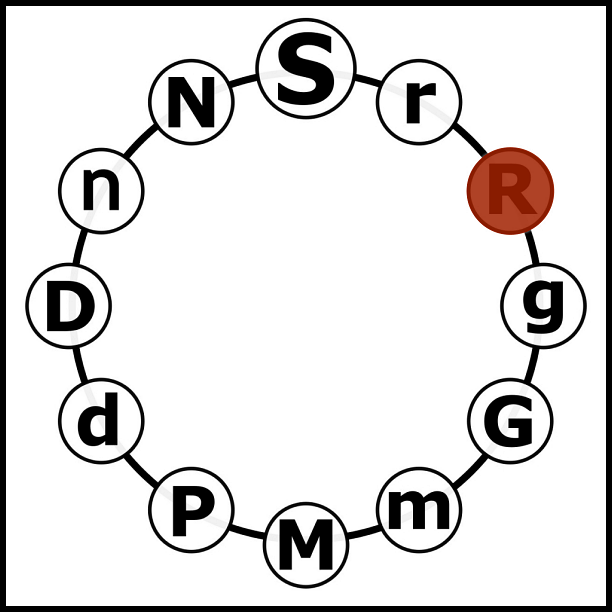

S-g-m-d-n-S Among the most revered ragas in the entire Hindustani pantheon, Malkauns (‘He who wears serpents as garlands’) combines structural simplicity with a nuanced mythological ethos. Said to have been composed by the goddess Parvati to soothe Lord Shiva’s murderous rage, in turn inspired by his wife Sati’s fiery death, its ‘all-komal‘ swara set is […]

• Raag Malkauns •

• Raag Jog •
S-gG-m-P-n-S A lively late-evening raga, Jog translates as ‘State of Union’ (derived from the Sanskrit concept of ‘yogi’). Its oddly bluesy harmony presents an enchanting almost-familiarity to uninitiated listeners, mixing Major and Minor flavours via a characteristic ‘Gmg zigzag’ phrase in descent (which, via the wonders of convergent evolution, suggests the structure of a 7#9 […]

• Raag Todi •
S-r-g-M-P-d-N-S Pivotal to Hindustani history, Todi overflows with musical ideas found nowhere else on the planet. Some link its ambiguous geometries with ‘existential anguish and unsettlement’, while others hear ‘the playfulness of a newborn, content and smiling’. Rajan Parrikar hails it as “the most profound, finespun idea in melodic music…from ecstasy, to frolic, to pathos, […]

• Raag Bhairavi •
S-r-g-m-P-d-n-S Probably the most prominent raga in the entire Hindustani canon, the dawn Bhairavi (‘awe, terror’: named after the Fifth Avatar of Mahadevi, the Mother Goddess) is a concert-closing staple. Unique in its chromatic flexibilities, the raga’s ‘Mishra Bhairavi’ form can span the full swara spectrum, allowing for a multitude of moods in the hands […]

• Raag Bhairav •
S-r-G-m-P-d-N-S Revered as the foremost raga of Lord Shiva, the morning Bhairav takes its name from Kala Bhairava (‘Bhaya-Rava’: ‘the one who roars fear’) – an apocalyptic manifestation of the deity fabled to have cut off one of Brahma’s five heads to silence his arrogance. Renditions reflect the gravity of these ancient tales, depicting Shiva’s […]

• Raag Lalit •
S-r-G-mM-d-N-S Lalit (meaning ‘Lyrical’) is an oddly-shaped sunrise raga, resembling ‘Bhairav with Pa lowered a semitone’. Among the most influential forms in Hindustani history (see the Lalit raganga), its distinctive ‘double Ma, no Pa’ structure has a malleable ambiguity, capable of conjuring flavours ranging from ‘sadness and anguish’ to ‘the serene and devotional‘ (as per […]

• Raag Shree •
S-r-G-M-P-d-N-S According to Gwalior vocalist Omkarnath Thakur, Shree’s seven swaras are associated with those sunset hours when “disembodied spirits…become active, and aid in the black magic of Tantriks”. Tied to mythologies of Lord Shiva, the raga takes its name from ‘sri’, a sacred Sanskrit syllable which, in Vedic tradition, represents the material nature of humanity’s place […]

• Raag Puriya Dhanashree •
S-r-G-M-P-d-N-S Like the scale-congruent Shree, Puriya Dhanashree’s versatile hemitonic clusters outline a major triad (SGP) with Sa and Pa ‘enclosed’ by their neighbours to present two sets of three adjacent swaras (NSr, MPd). Pa, while often omitted in aroha, exerts its gravity on descending melodies, easing the tension of the tivra Ma by providing temporary […]

• Raag Ahir Bhairav •
S-r-G-m-P-D-n-S Ahir Bhairav’s unique swara set is inextricably linked to visions of the Indian sunrise. While the raga’s poorvang matches the usual pattern of the Bhairav raganga (SrGm), its uttarang presents its own geometries, taking a shuddha Dha and komal ni (PDnS) in a manner closer to the Kafi–ang (although many artists tune their Dha sruti […]

• Raag Puriya •
S-r-G-M-D-N-S A prominent sunset raga, Puriya takes the same six swaras as Marwa and Sohini, reworking them to present a distinct set of melodic forces. Renditions tend to focus on mandra and madhya saptak, seeking a relatively even balance between ascending and descending phrases – with its character often considered more ‘melodic’ than Marwa (which is […]

• Raag Marwa •
S-r-G-M-D-N-S Notable for omitting its own Sa for long stretches, the hexatonic Marwa conjures moods of ‘austere, spiritual renunciation’ – summoning these sentiments with low, slow lines which patiently outline the raga’s highly irregular geometry (three adjacent plus three wide-set swaras: NSr; GMD). Its descent-dominant melodies, which avoid Pa throughout, often tease at resolutions which […]

• Raag Parameshwari •
S-r-g-m-D-n-S A mellifluous modern form created by Ravi Shankar in 1968, via a murchana rotation of Kameshwari (itself the product of backseat travel boredom in Bengal). While somewhat resembling a ‘komal re Bageshri’, Parameshwari’s hexagonal structure is ripe for open-ended experiments, summoning its own colours and tensions – and, despite its young history, has already garnered significant […]

• Raag Bilaskhani Todi •
S-r-g-m-P-d-n-S A hallowed form, Bilaskhani Todi is fabled to have been created by Bilas Khan: son of Tansen, the legendary composer of Emperor Akbar’s 16th-century durbar. On trying to sing Todi at his father’s funeral wake, Bilas found himself so grief-stricken that he mixed up the swaras – however, his panic was allayed on witnessing […]

• Raag Kalavati •
S-G-P-D-n-S A playful pentatonic form, neatly structured as a stack of ‘regularly narrowing’ intervals (4>3>2>1 semitones). The wide, sparse poorvang (SG) and clustered uttarang (PDnS) combine to bring a reassuring momentum, with increasing melodic urgency as you go higher (a ‘triple jump then a sprint’). Most Kalavati performances tend towards energy and rhythmic charge (Rahul […]

• Raag Basant Mukhari •
S-r-G-m-P-d-n-S Effectively blending the poorvang of Bhairav with the uttarang of Bhairavi (SrGm; PdnS), Basant Mukhari’s complex history bears the imprints of multiple musical cultures. While its modern inception is traceable to S.N. Ratanjankar’s eclectic Carnatic borrowings of the 1950s (also see Charukeshi: the same scale with shuddha re instead), many also explicitly link it to […]

• Raag Chandrakauns •
S-g-m-d-N-S Chandrakauns is a spacious raga of relatively modern origin, only becoming distinct from divergent strains of ‘shuddha Ni Malkauns’ by around the mid-20th century. This Ni-for-ni replacement removes much of Malkauns’ symmetry and intervallic balance, with the chromatic leading-tone resolution (Ni>Sa) bringing more prominence to both swaras. Given these sharper tensions, it is often played […]

• Raag Antardhwani •
S-r-g-m-d-N-S Among the youngest ragas to have found global acclaim, Antardhwani (‘Sound of the Inner Self’) was unveiled by Shivkumar Sharma in the 1990s, who discovered its unique hexatonic shape by chance while retuning his santoor from one raga to another (although their identity remains a mystery…). Adapting the geometries of Todi and Bhairavi, the […]

• Raag Basant •
S-r-G-M-P-d-N-S Basant (meaning ‘Springtime’) is a historic and highly influential form, with a lineage stretching back to at least the 8th century. The raga’s modern incarnation matches the swaras of Poorvi thaat, with shades of shuddha ma also permitted in some interpretations (e.g. SmmG; mdrS). Phraseological allies include Puriya (GMdNM; mdGmG) and Shree (e.g. NrS; […]

• Raag Gujiri Todi •
S-r-g-M-d-N-S A popular Todi variant named for its historic associations with Gujarat, India’s Westernmost state. Linked to the morning hours, it distinguishes itself from the main Todi by omitting Pa throughout. Tanarang cites a mood of “sweetness and karuna“, revolving around a deergha komal re – with komal dha also playing a particularly prominent role, separated […]

• Raag Multani •
S-r-g-M-P-d-N-S Multani is an afternoon raga of angular shape and ancient heritage, which, while matching the seven swaras of Todi thaat, is a Dhanashree family raga with corresponding phrase patterns – re and dha are omitted in ascent and generally rendered durbal throughout. Bhatkhande is said to have considered it the ‘daytime’ counterpart of Basant […]

• Raag Bhupali Todi •
S-r-g-P-d-S A captivating audav raga said to symbolise spiritual purity, which essentially runs along the lines of ‘what if all Bhupali‘s chal swaras were set as komal rather than shuddha?’ (SRGPDS > SrgPdS). Most renditions are poorvang-dominant, drawing from the Todi-ang as well as reshaping phrases from Bhupali, Bilaskhani Todi, and other forms (given the uniqueness of […]

• Raag Jogkauns •
S-gG-m-P-d-N-S Created by Jagannathbuwa Purohit ‘Gunidas’ in the 1940s (also the progenitor of Swanandi and Jaun Bhairav), Jogkauns is usually summarised as ‘Jog plus Chandrakauns’. However, the Agra vocal master’s original inception drew more from the melodies of a ‘raised Ni‘ Malkauns offshoot than from Chandrakauns itself, which was then still in its infancy (Parrikar: […]

• Raag Ahir Lalit •
S-r-G-mM-D-n-S Introduced by Ravi Shankar, drawing from the swara material of three morning ragas: Ahiri, Ahir Bhairav, and Lalit. As per Deepak Raja, “for most listeners, Ahir Lalit will be unable to escape the shadow of Ahir Bhairav over the Lalit facet of the raga…since Ahiri is heard mainly as a Bhairav variant”. Nevertheless, the […]

• Raag Dhani •
S-g-m-P-n-S Despite its ‘Minor Pentatonic’ scale form enjoying global popularity as the predominant mode of blues, rock, pop, and countless other guitar-driven genres, Dhani is comparatively rare as a raga in its own right – with its swara set mostly being heard as the ‘aroha of Bhimpalasi’ rather than in isolation (…it may be the […]

• Raag Puriya Kalyan •
S-r-G-M-P-D-N-S Essentially combining the poorvang of Puriya Dhanashree with the uttarang of Yaman (SrGM+PDNS), Puriya Kalyan matches the swaras of Marwa thaat. Pa is prominent in descent, but may be skipped in Kalyanic ascending passages such as MDNS – and Sa is often omitted in both directions, with mandra saptak Ni favoured as a melodic […]

• Raag Bairagi Todi •
S-r-g-P-n-S Created by Ravi Shankar, Bairagi Todi replaces Bairagi’s shuddha ma with a Todi-intoned ati-komal ga, retaining the concise audav structure while presenting an odd mix of narrow and wide intervals. Sometimes matched with unusual talas (e.g. Shankar’s original is in ‘sade-gyarah’: a ‘fractional‘ 11.5 matra cycle divided ‘4-4-2-1.5‘), the raga is explorable in all saptak, […]

• Raag Bairagi •
S-r-m-P-n-S Bairagi (‘detachment’, ‘separation’) is a pentatonic form inducted into the ragascape by an early-career Ravi Shankar – as recounted in Oliver Craske’s superlative biography Indian Sun, p.106: “Shankar created Bairagi in 1949, [publishing] the raga, and a bandish in it, in Sangeet Magazine”. The ‘Megh komal re‘ swara set – which may well have […]

• Raag Tilang •
S-G-m-P-nN-S A folk-derived Khamaj raga featuring distinctive double-Ni interplay, seemingly of ancient Southern origin (Bor: “Tilang probably originated in Telangana, and may have been introduced to the North by an unknown 15th-to-16th-century poet-composer“). Dha is varjit, and shuddha Re is typically omitted too (although some may occasionally include it swara in taar saptak). Parrikar suggests […]

• Raag Meladalan •
S-r-g-mM-d-n-S A truly mysterious creation I stumbled upon in Subbha Rao’s 1965 Raga Nidhi Vol.3: “’Meladalan’ and ‘Thatavidhwamasa’ are pseudo-names which Acharya Brahaspati…has given to a raga the identity of which [he] wants to keep unpublished for certain reasons. He points out, however, that it is an ancient raga which he wants to bring into life […]

• Raag Reva •
S-r-G-P-d-S A rare pentatonic raga, Reva is often described as the ‘evening counterpart’ to Bibhas (or the ‘jawab to its sawal’), matching this samay designation by taking after the Poorvi–ang rather than Bibhas’ Bhairav-ang roots. Chiefly, its movements are distinguished from Bibhas via poorvang-focused sangatis including Gr; rS; SrrS, along with a greater exploration of the […]

• Raag Hindol •
S-G-M-D-N-S A captivating, challenging audav raga with all swaras appearing in their highest specific positions (i.e. no komals, and Ma, if present, is tivra: also see Bhupali, Hansadhwani, & Adbhut Kalyan). The name translates as ‘swinging’: indicative of the raga’s melodic character, which is built around ‘swaying’ motions between a SGD trio of nyas, with […]

• Raag Gunkali •
S-r-m-P-d-S An enchanting morning raga, matching the swara set of ‘Bhupali komal re/dha’ (or ‘Shobhawari komal re’), described by Tanarang as “an epitome of bhakti and karuna…straightforward, and expandable in all three octaves”. While audav at its core, multivariate forms of the raga are in existence: some include shades of shuddha Ga in avroh (bringing hints […]

• Raag Ahiri •
S-r-g-m-P-D-n-S Traditionally held to cure stomach ailments, Ahiri allows for long, kaleidoscopic melodies – with a scale form resembling ‘Bageshri komal re’, ‘Ahir Bhairav komal ga’, or even ‘Bhairavi shuddha Dha’. Artists are relatively free to roam throughout the scale – often accentuating the ‘equilateral triangle’ of nyas (r-m-D: an augmented triad) while also drawing on motions […]

• Raag Jaiwanti Todi •
S-r-g-m-P-D-n-S An Ahiri–prakriti raga introduced by Maharaja Jaiwant Singh Waghela (1904-1980): a hereditary King of Sanand who also gained wide renown as a spiritual teacher, vocal educator, and generous patron of the nascent Mewati gharana (also hear his famous Mata Kalika composition). Its twists and turns are linked to the lineages of Todi, Ahir Bhairav, […]

• Raag Malashree •
S-G-P-S Often said to comprise only three swaras (a SGP major triad), Malashree pushes the bounds of raga definition. Arguably, this challenge is its defining purpose, calling on performers to find expressive freedom within an ultra-limited framework (as per Dagarvani beenkar Bahauddin Dagar, “We do not believe in ‘small’ vs. ‘big’ ragas: Malashree for example […]

• Raag Mohankauns •
S-gG-m-d-n-S As recounted in The Hindu, Mohankauns “was spontaneously created by Ravi Shankar in 1949. On hearing of Mohandas K. Gandhi’s death, Pandit-ji was asked by All India Radio to play a piece dedicated to the Mahatma. On the spot, he created a variation of…Malkauns”. As well as the occasional use of shuddha Re, his […]

• Raag Shuddha Basant •
S-r-G-mM-P-D-N-S Typically considered the modern successor to the ‘original’ form of Basant – with Maihar musicians such as Nikhil Banerjee and Nityanand Haldipur considering it inseparable from Adi Basant (‘shuddha’, as well as referring to ‘pure’ or ‘unaltered’ swaras, may also indicate ‘primary’ or ‘original’: similar to the meaning of ‘adi’). Generally, it differs from […]

• Raag Firozkhani Todi •
S-r-g-M-d-S A fascinating audav raga formed by removing the Ni from Gujiri Todi – leaving an angular pentatonic shape which, aside from Sa, contains no shuddha swaras (n.b. the same scale is known as ‘Audav Todi’ and ‘Chaya Todi’ too: although the latter title is also separately applied to other fusions of Chaya and Todi). […]

• Raag Bibhas •
S-r-G-P-d-S The pentatonic Bibhas (or Vibhas) appears in at least three present-day forms: typically tilted towards either the Marwa, Bhairav, or Poorvi frameworks. The former takes a shuddha Dha, while the latter pair render it komal (thus drawing focus to Pa, which is often treated as a nyas). Prakriti with Reva in its komal dha […]

• Raag Madhukauns •
S-g-M-P-n-S A curious ‘Dhani tivra Ma’ scale introduced by vocalist Amir Khan via a ‘ma-murchana’ of Chandrakauns (listen to his sargam-demo of the process below) – full of inescapable tension, with 3 of the 5 swaras being imperfect, and the disbalancing Ma–ni sangati on stark display. Sometimes considered identical to Khan’s Chandramadhu, created as part […]

• Raag Tulsikauns •
S-g-m-d-nN-S A creation of Maihar sitarist Kartik Kumar, matching the swara-set of ‘Malkauns double-Ni’ (or ‘Malkauns + Chandrakauns’). A consistently strong ma–murchana summons unmistakable flavours of the Western ‘Blues Scale’ (SgmMPnS), further accentuated by extended meend between the consecutive Ni positions (…I’ve used the exact same scale as a ‘modal sitar hack’ to play with […]

• Raag Gauri •
S-r-G-m-P-d-N-S Described by Deepak Raja as “difficult to render in its purity”, Gauri is associated with viraha shringara (‘the piety arising from the separation of lovers’). The raga had at least two distinct forms as far back as the 16th century, and continues to manifest in several variations – principally a main Bhairav-ang ‘shuddha ma‘ […]

• Raag Amirkhani Kauns •
S-G-M-P-n-S A ‘pentatonic Vachaspati’ created (as the name implies) by Indore vocal master Amir Khan, which omits Re and Dha (thus, Amirkhani Kauns is to Vachaspati as Dhani is to Kafi). All swaras except Sa are imperfect – with the unusual Ma–ni sangati exerting inevitable gravity and drawing melodies away from clear resolution. Few of […]

• Raag Ramkali •
S-r-G-mM-P-d-nN-S Resembling ‘Bhairav with touches of tivra Ma and komal ni in avroh’, Ramkali is an early morning raga, often associated with Sikh saintly traditions – with one author recounting that “the emotions in Ramkali are like those of a wise teacher disciplining their student, who is aware of the pain of learning” (although classical ragmala paintings commonly […]

• Raag Gangeshwari •
S-G-m-P-d-n-S Like Parameshwari and Rangeshwari, Gangeshwari (‘Lordess of the Ganges River’) was created by Ravi Shankar in 1968, via murchana rotation of his newly-invented Kameshwari (itself dreamed up during a car ride through Bengal). Its unevenly-spaced shadav scale (prakriti with some forms of Sundarkauns) most closely resembles a ‘no Re’ version of either Charukeshi or Basant […]

• Raag Kabiri Bhairav •
S-r-G-m-P-dD-nN-S Anuraag Dhoundeyal, writing in Swarajya magazine, considers Kabiri Bhairav to express “the angst of mystic experiences” (the ‘Kabir’ of the title refers to the famous 14th-century poet-mystic, highly influential on Sikh scriptures as well as the Hindu Bhakti movement through his radical critiques of organised religion). The raga’s poorvang matches with Bhairav (SrGm), however […]

• Raag Din ki Puriya •
S-r-G-M-d-N-S Din ki Puriya (‘Daytime Puriya’) sets its six swaras to the general phrase patterns of the Puriya–ang, avoiding Pa throughout. The scale’s ‘palindromic hexagon’ places a tight hemitonic cluster (NSr) opposite a wider tone-trio (GMd), also providing an augmented ‘equilateral triangle’ (SGd). Melodic motions remain fairly free, given the lack of any prakriti ragas […]

• Raag Vihang •
S-r-G-mM-P-D-N-S Vihang (Sanskrit for ‘Bird’) is a complex double-Ma form, most prevalent among Jaipur-Atrauli gharana vocalists. Manjiri Asanare-Kelkar’s detailed demo casts it as a ‘phrase-based’ raga, combining a Bihag core with melodies from Purva, Jait Kalyan, and Puriya, alongside connecting phrases such as MDMG, rS – also linking it Marwa and Puriya Kalyan. Tabla scholar Aneesh Pradhan […]

• Raag Kokilapriya •
S-r-g-m-P-D-N-S The Carnatic Kokilapriya scale (mela #11) is still barely known in the North (‘kokilapriya’: ‘the one who is dear to the koel bird‘). Its unique shape, resembling ‘Bhairavi–Yaman’, has several curious properties: with an ‘all-komal’ poorvang (Srgm) and ‘all-shuddha’ uttarang (PDNS), it is ‘palindromic’ (=symmetric from Sa) – but 5 of its swaras are ‘imperfect’ […]

• Raag Jaitashree •
S-r-G-M-P-d-N-S A sunset raga prominent in the Jaipur-Atrauli gharana, blending Shree with Jait’s komal re incarnation. Some, such as Ulhas Kashalkar, render the aroha ‘triswari’, limiting it to the three swaras of Malashree (SGP), set in Jait Kalyan-style phrases such as SG, GP, PSP – although the avroh is more clustered, often skipping taar Sa […]
