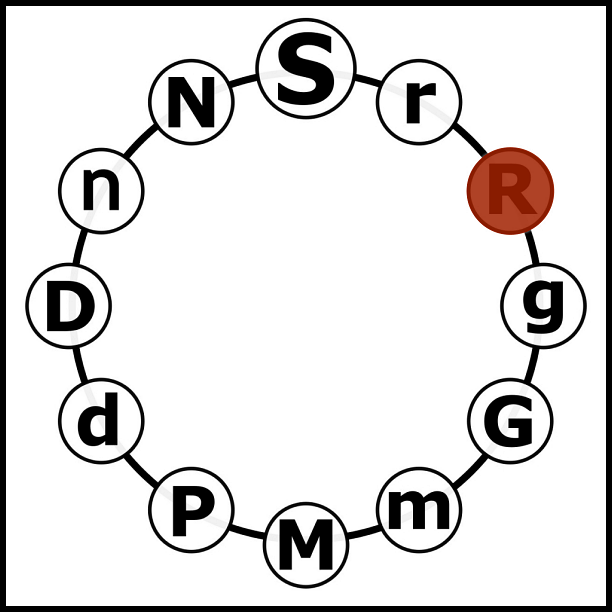

S-r-G-mM-P-D-N-S An ancient raga of great historical renown, which is nevertheless rare in the modern era. Ramrang cites it as a descendent of the long-extinct Bhukosh (also an antecedent of Bhinna Shadja), with others linking it to the prakriti Bhankar and Bhatiyar (distinguished via sequences such as GMGrS; mmmGP; MDMmG). Most interpretations approximate the swaras […]

• Raag Pancham •

• Raag Poorvi •
S-r-G-mM-P-d-N-S Poorvi is a long-lived sunset raga from East India, which some describe as evoking a ‘serious mood of mystical contemplation’. Mixing narrow and wide intervals (all swaras have at least one immediate neighbour), its complex twists and turns belie the base scale’s neat, palindromic nature – with Sa and Pa sometimes being omitted or rendered […]

• Raag Bhatiyari Bhairav •
S-r-G-m-P-D-N-S A hybrid of two morning ragas: Bhairav and Bhatiyar. While movements of the latter take centre-stage, its typical PGrS descending phrase is replaced by the Bhairav-ang GmG\rS signature: Ramrang offers indicative patterns including Sm; mPGm; GmPDNP; DmPGmP; DNr; NDP; GmPmrS; PGmrS, occasionally seasoned with tivra Ma via MDS [n.b. ‘Bhairav-Bhatiyar’, though built from the same […]

• Raag Shivmat Bhairav •
S-r-gG-m-P-d-nN-S Shivmat Bhairav can be described as a blend of Bhairav, Bhairavi, and Todi, with the former being the most dominant over the sound (‘Bhairav double Ga/Ni’). Relatively rare in modern times, the raga brings out Bhairav via GmrS phrases and oscillations on the komal re – while also incorporating komal ga and ni in […]

• Raag Amritvarshini •
S-G-M-P-N-S A rare audav raga corresponding to the swaras of ‘Yaman no Re/Dha’, imported from a well-established Carnatic form. The name translates as ‘one who showers the elixir of immortality’, hinting at its rich mythological history – in South India, the raga has long been associated with the monsoon (compare to the Northern Malhar ragas, […]

• Raag Shree Kalyan •
S-r-G-M-P-D-N-S Congruent with the seven swaras of Puriya Kalyan (and Marwa thaat), Shree Kalyan is an enchanting product of Kumar Gandharva’s prolific imagination (also see Madhusurja, Lagan Gandhar, Saheli Todi, Rati Bhairav, Bihad Bhairav, and Bhavmat Bhairav). The movements of his main rendition (Dekho Re Rut Phoolan Lagi) place Shree’s tritonal re–Pa sangati on stark […]

• Raag Annapurna •
S-r-g-M-P-d-N-S From my 2018 Darbar interview with bansuri maestro Rupak Kulkarni: “I lately composed Raag Annapurna: dedicated to Maa Annapurna Devi, my grand-guru [teacher of my teacher]. It is a combination of morning and evening ragas, so can be played at either of these times”. In 2022 I asked Kulkarni for more info: he described […]

• Raag Lalita Gauri •
S-r-G-mM-P-dD-N-S Spanning a diverse range of ‘Lalit + Gauri‘ experiments, the name ‘Lalita Gauri’ essentially refers to the general concept of fusing these two ragas rather than a specific melodic form. The most prominent modern incarnation appears to have been created by Jaipur-Atrauli vocalist Kesarbai Kerkar (who often employed it as a concert centrepiece), although differing […]

• Raag Paraj •
S-r-G-mM-P-d-N-S A playful sonic form which matches the swara set of Poorvi, with movements roughly akin to a ‘double-Ma Kalingada’ (also see their combination: Paraj Kalingada). Described by Parrikar as “an uttarang-pradhan raga with tonal activity clustered around taar Sa…elongation of Ni in SNdSN is a Paraj signpost, and dha is rendered durbal throughout”, with […]

• Raag Dhavalshree •
S-r-G-M-P-dD-N-S A Shree-ang monsoon raga which presents in multivariate modern forms, with particular variance evident in the status of Dha. Kishori Amonkar’s Jaipur-Atrauli interpretation adds shuddha Dha to the basic framework of Jaitashree, whereas Mallikarjun Mansur’s take renders dha komal amidst Shree-ang motions such as rNdP, also showcasing a strong SGP sangati and chayas of […]

• Raag Paraj Kalingada •
S-r-G-mM-P-d-N-S A seldom-performed jod raga matching the swaras of Poorvi, summarised by Aneesh Pradhan as “a combination of the [springtime] Paraj and Kalingada, [which is] popularly used in the thumri–dadra genres”. Paraj and Kalingada, already being closely-related forms, give rise to a subtle, samay-mixing blend – further seasoned by their respective proximities to Basant and Bhairav. […]

• Raag Bhavmat Bhairav •
S-r-G-mM-P-D-n-S A curious fusion of concepts from two famous morning ragas – Bhairav and Lalit – devised by the gharana-blending Kumar Gandharva around the 1970s (also see his Bihad Bhairav, Rati Bhairav, Saheli Todi, Lagan Gandhar, & Madhusurja). Sadly, few recordings seem to exist – refer to Gandharva’s classic renditions for starters (e.g. Kantha Re […]

• Raag Shrutivardhini •
S-g-mM-P-n-S A rare hexatonic raga which instantly gripped my ears as a match for the Western ‘Blues Scale’ (SgmMPnS) when I came across a mellifluous rendition by sarangi master Abdul Latif Khan – who regularly utilises distinctly bluesy double-Ma phrases such as nSgmM, PMmgS (as per his student Nicolas Magriel: “His bandish is somewhat reminiscent […]

• Raag Rati Bhairav •
S-r-G-m-P-dD-nN-S An idiosyncratic ‘double-Dha’ invention of vocalist Kumar Gandharva (also the creator of Bhavmat Bhairav, Bihad Bhairav, Saheli Todi, Lagan Gandhar, & Madhusurja), which blends Bhairav with Ahir Bhairav. As per Milap Rane, “Rati Bhairav is a jod raga, [with] Ahir Bhairav overshadowing Bhairav…This raga symbolises the union of Shiva [Bhairav] and Shakti [Ahir Bhairav]. […]

• Raag Prabhat (Bhairav) •
S-r-G-mM-P-d-N-S A morning form (Prabhat: ‘dawn’) summarised by Bose as “a combination of three or four ragas dominated by the Bhairav-ang, with a touch of Lalit-ang only in the avroh, where both Ma come together…The vadi Ma separates Prabhat Bhairav from Bhairav, while Pa keeps it away from Lalit” (also see the nearby Lalit Pancham). Characteristic […]

• Raag Tivrakauns •
S-g-M-d-n-S A novel experiment by rare raga connoisseur Abhirang, formed by changing Malkauns’ shuddha ma vadi to its tivra variant. This shift renders both Sa and Ma ‘detached’ (i.e. with no swaras either 7 semitones above or below them: a property shared by only Harikauns and Sehera), meaning that conclusive resolutions towards the raga’s two […]

• Raag Zeelaf •
S-G-m-P-d-S A rare audav raga fabled to have been created by 13th-century qawwali pioneer Amir Khusrau, somewhat resembling ‘Bhairav minus re & Ni’. As per Rajan Parrikar, “this haunting pentatonic melody is composed of the following swaras: SGmPd. Jitendra Abhisheki gives a superb account with his own composition [transcribed below]: notice the strong ma and […]

• Raag Shivanjali •
S-gG-m-P-d-nN-S Despite captivating millions of listeners, Shivanjali is only known to the world through a single performance. Conceived by bansuri master Hariprasad Chaurasia as a tribute to his close friend and collaborator Shivkumar Sharma, its lone unveiling came at a whole-night Stuttgart concert in 1995, with Shiv-ji present in the audience (‘Shiv-anjali’: ‘Reverences to Shivkumar’). […]

• Raag Ardhanaarishvara •
S-r-g-m-P-d-N-S During my original search for the ‘32 sampurna thaat’, I couldn’t find a single raga that precisely matched the SrgmPdNS swara-set. This surprised me, given the scale’s inherently fascinating shape – with a poorvang-uttarang bifurcation of ‘Bhairavi–Bhairav’ (Srgm+PdNS), equivalent to ‘Bhairavi shuddha ni’, ‘Bhairav komal ga’, ‘Todi shuddha ma’, or ‘Kirwani komal re’. While […]

• Raag Kaushik Dhwani •
S-G-m-D-N-S A modern-era descendent of the ancient Bhinna Shadja, essentially indistinguishable from its parent. Ma is a strong vadi, and a S\D glide is common in descending motions – but aside from this, artists are essentially free to roam at will within the scale, with all swaras employable as nyas across all three saptak (Tanarang: […]

• Raag Komal Ramkali •
S-r-g-M-P-d-n-S A strange sampurna scale, equivalent in shape to ‘Todi komal Ni’ or ‘Bhairavi tivra Ma’ (or ‘Todi’s poorvang + Bhairavi’s uttarang’: SrgM+PdnS) – indeed, the scale matches a historic form of Todi itself (Bor: “Todi Varali…first mentioned by Ahobala c.1665, with the scale SrgMPdnS”). Aside from Sa and Pa, Komal Ramkali has no shuddha […]

• Raag Bhatiyar •
S-r-G-mM-P-D-N-S A dawn raga fabled as a creation of Raja Bharthari, a mythical King of Ujjain who is said to have left behind his life of material wealth and romantic pleasure to pursue a path of ascetic devotion (“Bharthari resolves to kill a black buck, and seek diksha [initiation rites] from the yogi…As the plan […]

• Raag Amrut Ranjani •
S-gG-m-dD-n-S An ingenious evening raga created by the late (and vastly underappreciated) santoor maestro Ulhas Bapat, based around mirroring Jog‘s GmgS catchphrase in the uttarang as Dndm: thus hinting at a ma-murchana (i.e. ‘double-Ga is to Sa as double-Dha is to ma‘). This allows Amrut Ranjani (meaning ‘Nectar of Delight’) to sample flavours of Bageshri (DnS), Rageshri […]

• Raag Madhu Multani •
S-r-g-M-P-D-N-S An aprachalit raga combining Multani’s poorvang with Madhuvanti’s uttarang (also viewable as ‘Madhuvanti komal re’ or ‘Multani shuddha Dha’), which I found during my search for ragas matching the ‘32 thaat’ (=all possible 7-swara sampurna scales). Conceived by prolific rare raga explorer Abhirang in 2020, who banishes Re and Dha in aroha alongside other […]

• Raag Jog Tilang •
S-gG-m-P-nN-S Seldom heard today, the SgGmPnNS scale form once served as a vital historical bridge between Tilang and Jog: the latter, having evolved from the former around a century ago, originally retained Tilang’s double-Ni along with its own distinctive double-Ga. While most artists soon dropped Jog’s shuddha Ni, the older version is still occasionally performed […]

• Raag DoGa Kalyan •
S-gG-M-P-D-N-S A Ravi Shankar creation taking the form of ‘Kalyan with komal ga instead of Re’ (‘DoGa’: ‘Double-Gandhar’) – which, despite never having been released in classical form, may have left its mark on modern music as a possible source for The Beatles’ Blue Jay Way, composed by Shankar’s sitar student George Harrison in 1967. At […]

• Raag Bayati •
S-r̃-g-m-P-ᵭ-n-S A unique experiment by vocalist Dinkar Kaikini, based on adapting a Middle Eastern melodic form known as Maqam-al-Bayati – resulting in highly unusual sruti tunings for re and dha, which are set to ‘quarter-tonal’ shades roughly halfway between komal and shuddha (ga and ni also display some degree of flexibility, leaving only Sa, ma, & […]

• Raag Madhurkauns •
S-gG-m-d-n-S A fascinating creation of Kirana vocalist Prabha Atre, matching the swaras of ‘Malkauns double-Ga’ (or ‘Nandkauns no Pa’). The addition of shuddha Ga maintains the original Ga–ni symmetry axis of Malkauns, while also giving more gravity to shuddha ma via upward resolutions of G/m – a feature which forms the basis of most of her […]

• Raag Jogeshwari •
S-gG-m-D-n-S A low-high combination of Jog and Rageshri (SgGm+DnS) invented by Ravi Shankar and first released on a stellar 1980 album – although he was performing it at least 5 years before this: e.g. a 1975 rendition from an all-night concert in Varanasi. Jog’s strong shuddha Ga dominates the poorvang, while motions towards the uttarang […]

• Raag Harikauns •
S-g-M-D-n-S Among the strangest of pentatonic scales, Harikauns resembles ‘Hemavati no Re/Pa’ or ‘Madhukauns with Dha-for-Pa’ (or ‘Malkauns with the middle two swaras raised’) – forming a ‘diminished square’ of 3-semitone jumps (SgMD) plus a (symmetry-destroying) komal ni. Aside from a natural uttarang focus, the raga allows for near-complete freedom of motion – but presents inherent […]

• Raag Rasikpriya •
S-gG-M-P-nN-S A direct borrowing of the Carnatic mela #72: which, as the final position on the wheel, has all its swaras set to their highest allowable positions. In Hindustani music, the equivalent principle would produce Yaman (SRGMPDNS), but the South Indian system allows three variants for each of Re, Ga, Dha, & Ni, with the highest Re/Dha […]

• Raag Ek Prakar ki Kauns •
S-gG-m-d-nN-S An invention of Imdadkhani sitarist Rais Khan (who, with a pleasing lack of pretention, named his new raga ‘A Type of Kauns’). From Martyn Clayton’s excellent liner notes to a 1985 Navras recording: “Indeed an unusual raga…Rais Khan’s ‘Ek Prakar ki Kauns’ is based on Malkauns, but incorporates two extra notes [shuddha Ga & […]

• Raag Sohini •
S-r-G-M-D-N-S Sharing its six swaras with Marwa and Puriya, Sohini aims for a looser, more sprightly flavour to these more famous congruents – focusing on agile movements in madhya and taar saptaks, and uttarang-based phrases built on a strong Dha–Ga sangati. Re is banned in aroha, and Sa assumes greater strength than in Marwa, while […]

• Raag Prabhateshwari •
S-r-g-m-P-D-n-S A seldom-heard raga associated with bansuriya Hariprasad Chaurasia, which (to my ears) resembles a blend of the morning Ahir Bhairav and the late night Bageshri. His student Rajendra Teredesai describes it as having “all the hues…beautiful, complex, yet spiritually uplifting…full of pathos and bhakti ras, a state of perpetual divine bliss”. Prakriti with Ahiri and Jaiwanti […]

• Raag Prabhakali •
S-r-G-m-P-d-n-S An Ali Akbar Khan invention, prakriti with the better-known Basant Mukhari. Information is scant – but, as per the liner notes to the raga’s 1964 LP release, “Prabhakali permits only five notes in aroha, dropping [Ga & Ni]. For avroh, it admits all the seven notes…[re & dha] are flats as in Bhairav, and […]

• Raag Malay Marutam •
S-r-G-P-D-n-S ‘Malay Marutam’ translates as ‘Fragrant Hill-Breeze’. Maihar bansuriya Rupak Kulkarni explained to me in a 2018 interview how the raga “is from Carnatic music, which does not give so much attention to the times of day. We have decided to designate it as a morning raga, mainly due to the nature and essence of […]

• Raag Kalingada •
S-r-G-m-P-d-N-S Kalingada shares the same seven swaras as Bhairav, but approaches them in distinct fashion – generally preferring a simpler, less ornamented character (as per Rajan Parrikar: “Kalingada has a flippant mien…far less austere than Bhairav. Ga and Pa are advanced to positions of influence, and the swara-lagav is mostly linear, without the andolit treatment […]

• Raag Hemshri •
S-g-m-P-nN-S A night raga created by renowned Gwalior composer and vocalist Vishwanath Rao Ringe ‘Tanarang’, essentially equivalent to ‘Tilang komal ga’. In his own summary (seemingly the only source of melodic information): “the mood is light…a very sweet melody that manifests readily in the following combinations [e.g. SgmPm, gmPnPNNS; PNSnP; PNSgNS]”. Re is banned entirely, while […]

• Raag Deen Todi •
S-r-g-m-D-n-S A near-extinct raga of uncertain origin, Deen Todi sets an ‘Ahiri no Pa’ form to the framework of the Todi-ang. Best preserved via an astonishing rendition by Kamalesh Maitra on the tabla tarang (a semicircle of 13 sruti-tuned dayan drums: below), accompanied by a multiphonic cluster of tanpura drones (tuned to a D-n-r-S cluster). Parveen […]

• Raag Anand Bhairav •
S-r-G-m-P-D-nN-S A rarely-heard member of the Bhairav raganga, which seems to have no precise prakritis. As per Rajan Parrikar, “the komal dha in Bhairav is replaced by its shuddha counterpart, and the komal ni is parachuted into the scheme in an [avroh phrase] SDnP inspired by Bilawal (in Bhairav-ang ragas where either Re or Dha is rendered shuddha, […]

• Raag Sundarkauns •
S-g-m-D-n-S There are at least two ragas in modern circulation which go by the title ‘Sundarkauns’, which appear to share no connection other than their name. One version, taking the swaras SgmDnS (‘Malkauns shuddha Dha’), is described by Tanarang as having been unjustly sidelined by previous generations, who have tended to misinterpret it as a ‘Bageshri-ang Chandrakauns’ […]

• Raag Purba •
S-r-G-mM-P-dD-N-S A rare raga of the Jaipur-Atrauli gharana, described by Rajan Parrikar as “essentially Raag Poorvi adorned with bells and whistles” – in particular, the Ma-mixing catchphrases Sm, mGP and MMPPd, dNdP. Refer to the Rajshekhar Mansur bandish transcribed below, which showcases uttarang forays of MP, PdNdP and a prominent M\G glide. Also recorded by […]

• Raag Chandni Todi •
S-r-g-M-P-D-n-S Equivalent to ‘Todi’s poorvang + Kafi’s uttarang‘ (or ‘Ahiri tivra Ma’), the SrgM+PDnS scale has barely been explored in Hindustani music – in fact, I couldn’t trace a single recording of it until late 2025, when vocalist Ashish Dha sent me his experiment in a new raga titled Chandni Todi (‘Moonlit Todi’). He describes […]

• Raag Sazgiri •
S-r-G-mM-P-dD-N-S Often described as being among the most complex of Hindustani forms, Sazgiri is fabled as a creation of Amir Khusro (1253-1325): the legendary Sufi poet, singer, and mystic of the Delhi Sultanate (although direct historical evidence for his authorship of the raga is admittedly scant). Komal dha is restricted to Poorvi-ang phrases such as […]

• Raag Saheli Todi •
S-r-g-P-d-n-S An invention of vocalist Kumar Gandharva, lying between Bhupali Todi and Bilaskhani Todi via the addition of an avroh komal ni to the former (or the subtraction of ma from the latter). His original renditions linger patiently on the komal re (often intoned with a noticeably higher sruti than is usual for the Todi […]

• Raag Pancham Malkauns •
S-g-m-P-d-n-S A loose collection of melodic strands which fall under the general banner of ‘Malkauns with Pa in avroh’ (thus sharing conceptual overlap with Kaunsi Kanada and Sampurna Malkauns). Ascents typically stay true to the pentatonic structure of Malkauns, and the Pa is usually rendered in vakra avroh lines (e.g. ndmgmdP or gmdndmP). Beloved by […]

• Raag Monomanjari •
S-r-G-M-P-D-nN-S A scale with no apparent prakritis unveiled by sitar icon Nikhil Banerjee some time in the 1970s (in his own words: “I’m quite satisfied with one of my Sonodisc LPs, Raag Monomanjari: that’s my favourite so far…”). From Narendra Datar’s 1989 review of this record: “A jod raga…a remarkable combination of Kalavati and Marwa. […]

• Raag Meghranjani •
S-r-G-mM-N-S A truly odd scale form, Meghranjani can be interpreted as either ‘Bhairav minus Pa & dha‘ (SrGmNS) or ‘Lalit minus dha‘ (SrGmMNS) – producing a strange shape which omits two consecutive generic swaras (see other such ragas in my ‘consecutive varjits‘ category, including Adbhut Kalyan, Devranjani, & Malashree). Originally borrowed from the Carnatic Megharanjani, the […]

• Raag Madhuradhwani •
S-G-m-D-nN-S As per Parrikar, “Durga Khamaj-thaat is also known as ‘Madhuradhwani’. This is not a popular raga, its base eroded by the popularity of Rageshri…but is part of the Dagar family repertoire”. While some renditions will skip Ni in ascent, traditional Dhrupad presentations will render it shuddha in aroha and komal in avroh – along with […]

• Raag Lalita Sohini •
S-r-G-mM-D-N-S A blend of the early-morning Lalit and late-night Sohini, with the melodies of the latter dominating the aural impression, reportedly created by Agra vocalist Yunus Ahmed Khan in the mid-20th century. Raja notes that “while Sohini is a resident of the upper tetrachord, Lalit is a resident of the lower tetrachord. Thus, the resulting melodic entity […]
