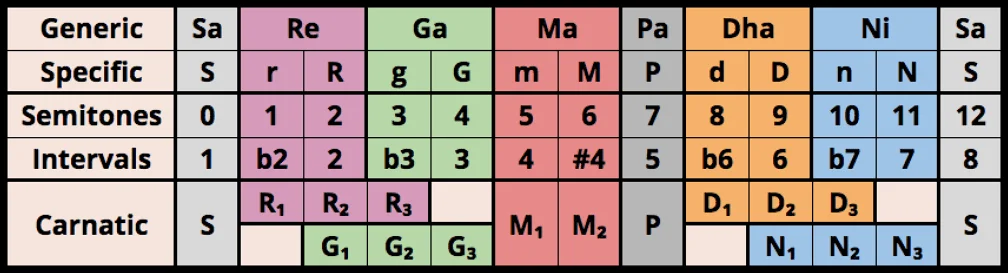
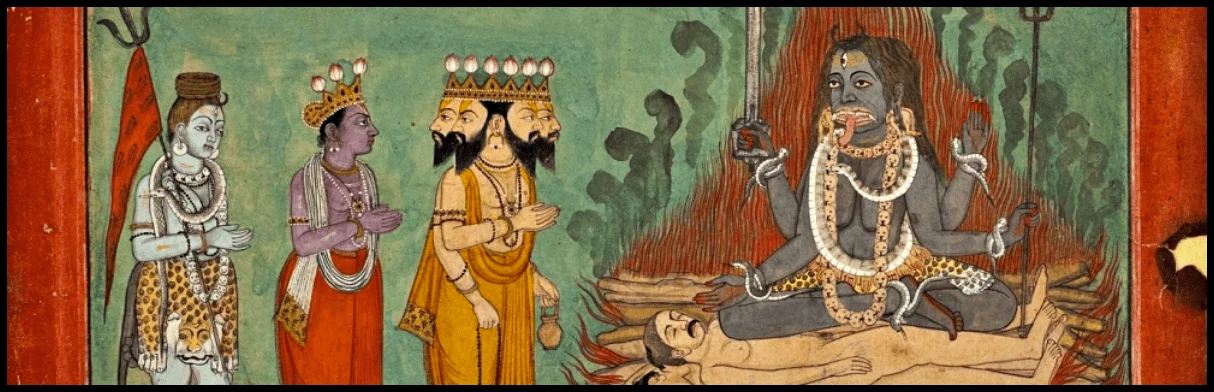
S-g-m-d-n-S Among the most revered ragas in the entire Hindustani pantheon, Malkauns (‘He who wears serpents as garlands’) combines structural simplicity with a nuanced mythological ethos. Said to have been composed by the goddess Parvati to soothe Lord Shiva’s murderous rage, in turn inspired by his wife Sati’s fiery death, its ‘all-komal‘ swara set is […]

• Raag Malkauns •

• Raag Bhupali •
S-R-G-P-D-S Hailed for its structural simplicity, Bhupali is often among the first ragas taught to Hindustani students. While its basic ‘Major Pentatonic‘ scale form is shared by countless global cultures, the North Indian incarnation (named for Madhya Pradesh’s Bhopal region) presents its own quirks – invoking tranquillity and home-bound reassurance with interlinked sliding motions between […]

• Raag Durga •
S-R-m-P-D-S Beguiling in its pentatonic simplicity, Durga (Sanskrit: ‘invincible, impassable, inaccessible’) is inextricably tied to visions of the Hindu Mother Goddess: a destroyer of demons and protector of the faithful, who, according to legend, “was created to slay the buffalo demon Mahisha by Brahma, Vishnu, Shiva, and the lesser gods, who were otherwise powerless to […]

• Raag Kalavati •
S-G-P-D-n-S A playful pentatonic form, neatly structured as a stack of ‘regularly narrowing’ intervals (4>3>2>1 semitones). The wide, sparse poorvang (SG) and clustered uttarang (PDnS) combine to bring reassuring momentum, with increasing melodic urgency as you rise higher (a ‘triple jump then a sprint’) – also being a rare example of a ‘jagged‘ scale, i.e. […]

• Raag Hansadhwani •
S-R-G-P-N-S Hansadhwani translates to ‘Call of Swans’, a creature with rich cultural associations in the Subcontinent: Saraswati, goddess of music and learning, is often depicted atop a swan, said to symbolise purity, discernment, and clarity of communication (n.b. While most scholars interpret the Sanskrit term ‘hamsa’ to mean ‘swan’, Rigvedic texts use the term loosely, […]

• Raag Chandrakauns •
S-g-m-d-N-S Chandrakauns is a spacious raga of relatively modern origin, only becoming distinct from divergent strains of ‘shuddha Ni Malkauns’ by around the mid-20th century. This Ni-for-ni replacement removes much of Malkauns’ symmetry and intervallic balance, with the chromatic leading-tone resolution (Ni>Sa) bringing more prominence to both swaras (see melodic summary). Given these sharper tensions, it […]

• Raag Megh (Malhar) •
S-R-m-P-n-S Among the oldest surviving members of the Malhar family, Megh (‘Cloud’) is said to have saved the life of Miyan Tansen himself. Legend holds that the great composer’s powerful rendition of the fire-bringing Deepak caused the oil lamps in Emperor Akbar’s 16th-century royal palace to ignite and burn uncontrollably – and, soon, all the […]

• Raag Shivranjani •
S-R-g-P-D-S A spellbinding raga resembling ‘Bhupali komal ga’ (or ‘Kafi no ma/ni’), Shivranjani’s melodies, described by Kalakar as “plaintive and haunting”, are said to appease the destructive rage of Lord Shiva (a similar mythology to that of Malkauns). Tanarang suggests illustrative combinations of SRgPD; PDPgR; gRgSRDS, although interpretations vary greatly within the scale’s pentatonic bounds […]

• Raag Bhupali Todi •
S-r-g-P-d-S A captivating audav raga said to symbolise spiritual purity, which essentially runs along the lines of ‘what if all Bhupali‘s chal swaras (Re, Ga, Dha) were komal rather than shuddha?’ (SRGPDS > SrgPdS). Most renditions are poorvang-dominant, drawing from the Todi-ang as well as reshaping phrases from Bhupali, Bilaskhani Todi, and other forms (given the uniqueness […]

• Raag Dhani •
S-g-m-P-n-S Despite its ‘Minor Pentatonic’ scale form enjoying global popularity as the predominant mode of blues, rock, pop, and countless other guitar-driven genres, Dhani is comparatively rare as a raga in its own right – with its swara set mostly being heard as the ‘aroha of Bhimpalasi’ rather than in isolation (…it may be the […]

• Raag Madhumad Sarang •
S-R-m-P-n-S Running along the lines of ‘Brindabani Sarang with komal ni only’, Madhumad Sarang is among the principal incarnations of its raganga (‘Madhumad’ derives from the Sanskrit ‘madhyamadi’: the Carnatic equivalent is similarly titled ‘Madhyamavati’). Ma and Pa are strong, and the PnS uttarang summons natural momentum, with crisp melodic articulations set against the scale’s palindromic […]

• Raag Bairagi Todi •
S-r-g-P-n-S Created by Ravi Shankar, Bairagi Todi replaces Bairagi’s shuddha ma with a Todi-intoned ati-komal ga, retaining the concise audav structure while presenting an odd mix of narrow and wide intervals. Sometimes matched with unusual talas (e.g. Shankar’s original is in ‘sade-gyarah’: a ‘fractional‘ 11.5 matra cycle divided ‘4-4-2-1.5‘), the raga is explorable in all saptak, […]

• Raag Bairagi •
S-r-m-P-n-S A distinctive pentatonic form inducted into the ragascape by an early-career Ravi Shankar. As recounted in Oliver Craske’s superlative biography Indian Sun (p.106), “Shankar created Bairagi in 1949, [publishing] the raga and a bandish…in Sangeet Magazine”. The ‘Megh komal re‘ swara set – which may well have appeared in other guises throughout history – […]

• Raag Deshkar •
S-R-G-P-D-S Often described as ‘the other raga with Bhupali’s swaras’, Deshkar shuffles the same five tones to produce a mood suited more to the morning than evening hours – a legacy of the raga’s roots in the Bilawal raganga (vs. Bhupali’s Kalyan heritage). Taking a Bilawal-ang vadi-samvadi of Dha–Ga, the raga is uttarang-dominant, with a […]

• Raag Shuddha Malhar •
S-R-m-P-D-S Perhaps the oldest surviving Malhar raga (‘shuddha’, as well as referring to ‘pure’ or ‘unaltered’ specific swaras, can also designate a ‘primary’ or ‘original’ quality: as with the similarly-ancient Shuddha Basant), marked by “a ponderous gait and a meend-rich contour”. As per the accompanying notes to a K.G. Ginde lecture, Shuddha Malhar is distinguished […]

• Raag Reva •
S-r-G-P-d-S A rare pentatonic raga, Reva is often described as the ‘evening counterpart’ to Bibhas (or the ‘jawab to its sawal’), matching this samay designation by taking after the Poorvi–ang rather than Bibhas’ Bhairav-ang roots. Chiefly, its movements are distinguished from Bibhas via poorvang-focused sangatis including Gr; rS; SrrS, along with a greater exploration of the […]

• Raag Hindol •
S-G-M-D-N-S A captivating, challenging audav raga with all swaras appearing in their highest specific positions (i.e. no komals, and Ma, if present, is tivra: also see Bhupali, Hansadhwani, & Adbhut Kalyan). The name translates as ‘swinging’: indicative of the raga’s melodic character, which is built around ‘swaying’ motions between a SGD trio of nyas, with […]

• Raag Gunkali •
S-r-m-P-d-S An enchanting morning raga, matching the swara set of ‘Bhupali komal re/dha’ (or ‘Shobhawari komal re’), described by Tanarang as “an epitome of bhakti and karuna…straightforward, and expandable in all three octaves”. While audav at its core, multivariate forms of the raga are in existence: some include shades of shuddha Ga in avroh (bringing hints […]

• Raag Jaldhar Kedar •
S-R-m-P-D-S Jaldhar Kedar applies the movement patterns of Kedar to the swara set of Durga, also drawing on the monsoon melodies of the Malhar family. Shuddha ma is emphasised as a nyas (e.g. SRSm; mRPm; DPm), and the Malharic Re–Pa sangati is also strong, while Durga’s mRP; mRDS is replaced by mRP; mRS; SRSm. Study […]

• Raag Pahadi •
S-R-G-P-D-S Thought to derive from Kashmiri or Bengali folk tunes, Pahadi (meaning ‘mountain’ or ‘of the hills’) combines playful and subtle shades. While its Bhupali-congruent core form offers a certain sparse simplicity, the raga’s true magic is found in its extensive mishra capabilities, with the tasteful use of any swara being permitted, particularly in long […]

• Raag Firozkhani Todi •
S-r-g-M-d-S A fascinating audav raga formed by removing the Ni from Gujiri Todi – leaving an angular pentatonic shape which, aside from Sa, contains no shuddha swaras. The same scale form is known as ‘Audav Todi’, ‘Bangal Todi‘ and ‘Chaya Todi’ too (although the latter title is also applied to other fusions of Chaya and […]

• Raag Bibhas •
S-r-G-P-d-S The pentatonic Bibhas (or Vibhas) appears in at least three present-day forms: typically tilted towards either the Marwa, Bhairav, or Poorvi frameworks. The former takes a shuddha Dha, while the latter pair render it komal (thus drawing focus to Pa, which is often treated as a nyas). Prakriti with Reva in its komal dha […]

• Raag Madhukauns •
S-g-M-P-n-S A curious ‘Dhani tivra Ma’ scale introduced by vocalist Amir Khan via a ‘ma-murchana’ of Chandrakauns (listen to his sargam-demo of the process below) – full of inescapable tension, with 3 of the 5 swaras being imperfect, and the disbalancing Ma–ni sangati on stark display. Sometimes considered identical to Khan’s Chandramadhu, created as part […]

• Raag Jait Kalyan •
S-R-G-P-D-S A Bhupali–prakriti raga which blends Jait with the Kalyan-ang, retaining the former’s strong Pa–Sa sangati amidst descending lines from the latter such as DP(G)RS. Re may be played weakly in aroha, rendering some upward-moving sections of the raga surtar, while glides of (D)G and (P)G are frequent. Seemingly introduced to the ragascape by Jaipur-Atrauli […]

• Raag Amirkhani Kauns •
S-G-M-P-n-S A ‘pentatonic Vachaspati’ created (as the name implies) by Indore vocal master Amir Khan, which omits Re and Dha (thus, Amirkhani Kauns is to Vachaspati as Dhani is to Kafi). All swaras except Sa are imperfect – with the unusual Ma–ni sangati exerting inevitable gravity and drawing melodies away from clear resolution. Few of […]

• Raag Sarangkauns •
S-R-m-d-n-S A rare audav raga of bewitching beauty, taking the form of ‘Malkauns with shuddha Re instead of ga’. As the name implies, the adoption of Re allows for poorvang shades from Sarang (SRm, mR), set in contrast to distinctive Malkauns turnarounds in uttarang (Snd, dnS). Like both Malkauns and Madhumad Sarang, the scale shape […]

• Raag Amritvarshini •
S-G-M-P-N-S A rare audav raga corresponding to the swaras of ‘Yaman no Re/Dha’, imported from a well-established Carnatic form. The name translates as ‘one who showers the elixir of immortality’, hinting at its rich mythological history – in South India, the raga has long been associated with the monsoon (compare to the Northern Malhar ragas, […]

• Raag Chandraprabha •
S-R-m-d-N-S A magical audav raga matching the scale of ‘Chandrakauns with Re instead of ga’ (or ‘Kirwani no ga/Pa‘, thus allowing for poorvang shades of Sarang. Benares bansuriya Ajay Prasanna cites the raga as a creation of his father Bhola Nath Prasanna, adding that Chandraprabha “celebrates the light and glow of the moon…its serene calmness […]

• Raag Shankh Dhwani •
S-R-G-P-n-S A pleasing pentatonic form, Shankh Dhwani (‘Sound of the Conch’) takes its name from a truly ancient instrument. While we will never know precisely when our proto-human ancestors first blew into a resonant gastropod shell, artefacts turn up in the archaeological record as early as 18,000 years ago – with their ritual significance discussed […]

• Raag Tivrakauns •
S-g-M-d-n-S A novel experiment by rare raga connoisseur Abhirang, formed by changing Malkauns’ shuddha ma vadi to its tivra variant. This shift renders both Sa and Ma ‘detached’ (i.e. with no swaras either 7 semitones above or below them: a property shared by only Harikauns and Sehera), meaning that conclusive resolutions towards the raga’s two […]

• Raag Zeelaf •
S-G-m-P-d-S A rare audav raga fabled to have been created by 13th-century qawwali pioneer Amir Khusrau, somewhat resembling ‘Bhairav minus re & Ni’. As per Rajan Parrikar, “this haunting pentatonic melody is composed of the following swaras: SGmPd. Jitendra Abhisheki gives a superb account with his own composition [transcribed below]: notice the strong ma and […]

• Raag Kaushik Dhwani •
S-G-m-D-N-S A modern-era descendent of the ancient Bhinna Shadja, essentially indistinguishable from its parent. Ma is a strong vadi, and a S\D glide is common in descending motions – but aside from this, artists are essentially free to roam at will within the scale, with all swaras employable as nyas across all three saptak (Tanarang: […]

• Raag Harikauns •
S-g-M-D-n-S Among the strangest of pentatonic scales, Harikauns resembles ‘Hemavati no Re/Pa’ or ‘Madhukauns with Dha-for-Pa’ (or ‘Malkauns with the middle two swaras raised’) – forming a ‘diminished square’ of 3-semitone jumps (SgMD) plus a (symmetry-destroying) komal ni. Aside from a natural uttarang focus, the raga allows for near-complete freedom of motion – but presents inherent […]

• Raag Adbhut Kalyan •
S-R-G-D-N-S An uncommon Kalyan variety, named Adbhut (‘Wondrous’) for omitting two of Kalyan’s most vital swaras (Ma & Pa). Remains popular in the Dagarvani Dhrupad, but few others have risen to the centreless challenges of losing both mid-saptak swaras. Aminuddin Dagar reportedly considered the raga to be an offshoot of Khem Kalyan, while Uday Bhawalkar links […]

• Raag Devshri •
S-R-M-P-n-S An intriguing audav raga resembling ‘Megh tivra Ma’ (or ‘Vachaspati no Ga/Dha’). Its unique swara set – which features the unusual ‘tivra Ma, komal ni‘ sangati – is principally distinguished by a disbalance in how Sa and Pa are ‘surrounded’ by the swaras above and below (nSR: ‘2-2’, MPn: ‘1-3’) – offering curious contrast with the symmetry […]

• Raag Sundarkauns •
S-g-m-D-n-S There are at least two ragas in modern circulation which go by the title ‘Sundarkauns’, which appear to share no connection other than their name. One version, taking the swaras SgmDnS (‘Malkauns shuddha Dha’), is described by Tanarang as having been unjustly sidelined by previous generations, who have tended to misinterpret it as a ‘Bageshri-ang Chandrakauns’ […]

• Raag Shobhawari •
S-R-m-P-d-S A rare ‘audav Asavari’ raga, matching the swaras of ‘komal Dha Durga’ (or ‘shuddha Re Gunakri‘). While relatively free of specific melodic constraints, the dha assumes natural prominence due to its disbalancing effects: it is involved in the only hemitonic pairing (Pd) and also the widest adjacent jump (dS), while serving as the only […]

• Raag Rasaranjani •
S-R-m-D-N-S A rare, oddly-shaped audav raga formed by omitting Ga and Pa from Bilawal thaat – somewhat like ‘removing the major triad from the major scale’ (it can also be seen as ‘Bhavani plus Ni’). Vocalist Sakuntala Narasimhan, introducing a drut khayal, cites Rasaranjani as an innovation of her Rampur gharana guru Hafiz Ahmed Khan, […]

• Raag Devranjani •
S-m-P-d-N-S Stretched by the emptiness of a vast Sa–ma poorvang jump, Devranjani is formed by removing the re and Ga from Bhairav. Abhirang offers up both ‘shuddha Ni’ and ‘double Ni’ variants, with the former appearing to be predominant – while Bhatkhande’s early 20th-century works discuss the unavoidable strength of the ascending phrase Sm, mP […]

• Raag Chandramadhu •
S-g-M-P-n-S An angular pentatonic form conjured up by vocalist Amir Khan only a short time before his untimely death in a 1974 car accident – indeed, it is unclear if he ever formally named his new creation (I’ve seen it referred to as ‘Bhushwati’ and ‘Amarpriya’, and at least two releases just list it as […]

• Raag Abhogi •
S-R-g-m-D-S A rare instance of an ‘audav Kanada’ raga, Abhogi’s swara-set resembles ‘Bageshri‘s aroha without ni’ – presenting a clustered poorvang and sparse uttarang (SRgm; DS). As per Tanarang, the raga’s capacity for Darbaric concluding motions (mgmRS) summons “a deep atmosphere” – with the vacant upper scale presenting performers with a curious creative challenge. Abhogi is […]

• Raag Sundarkali •
S-r-G-P-n-S A relatively straightforward audav raga, Sundarkali takes the swaras of ‘Ahir Bhairav no ma/dha’. Anjani Kumar Gupta’s concise bansuri rendition is the only full recording I could find (alap transcribed below), although Tanarang’s disciple Prakash Vishwanath Ringe has released a brief selection of khayal demos (and sax player Mister D Cell has used it to […]

• Raag Rajeshwari •
S-g-m-D-N-S Taking the swaras of ‘Chandrakauns shuddha Dha’, Rajeshwari’s five tones bring an idiosyncratic spin to the Kaunsi-ang, coloured with diffuse tensions. All poorvang swaras are set to their lowest specific position (Sgm), and all uttarang swaras are set to their highest (DNS), with the relief-bringing Re–Pa axis banished throughout. The resulting scale presents significant challenges […]

• Raag Gunakri •
S-r-m-P-d-S Taking the swaras of ‘Bhairav no Ga & Ni’, Gunakri – described by AUTRIM as “serious and peaceful” – brings out the character of its parent raganga via an oscillating komal re, and movements patterns including Sd, dP and SdSr, rS (although Jairazbhoy prefers to analyse it via the geometries of Basant Mukhari). Bose gives a […]

• Raag Bhinna Shadja •
S-G-m-D-N-S Often characterised as the ‘older form’ of today’s Kaushik Dhwani, Bhinna Shadja’s lineage stretches back well over 1000 years. It appears in numerous ancient shastras: notably including Matangamuni’s Brihaddeshi (~8th-century), Abhinavagupta 11th-century writings (“Bhinnashadaja, Kaushiki, and Bhinnapanchama are favoured in Summer”), and Sarangdeva’s 13th-century Sangita Ratnakara – which describes its scale form in remarkably […]

• Raag Madhuranjani •
S-g-m-P-N-S The name ‘Madhuranjani’ is used in reference to several distinct forms. The best-known incarnation is based on the SgmPNS swara set of ‘Dhani shuddha Ni’ (or ‘Patdeep no Re/Dha’) – as exemplified by vocalists such as Abhirang, Sawani Shende, and Jitendra Abhisheki, who also includes flourishes of shuddha Re in avroh. Some suggest that […]

• Raag Lilavati •
S-g-P-D-n-S Confusion persists around which melodic forms assume the name ‘Lilavati’, with several incongruous examples in sporadic modern circulation – as per Biswarup Ghosh Dastidar, “Lilavati/Leelavati can be sung in [Asavari] thaat [SRgPdS], Khamaj thaat [SgPDnS] and Bhairav thaat [SrGmPnS]”. Abhirang sets his to the tones to the second of these (as a ‘komal ga Kalavati’), […]

• Raag Japaniya •
S-R-g-P-d-S The SRgPdS swara set – equivalent to ‘Shivranjani komal dha’ or ‘Bhupali Todi shuddha Re’ – exists in several distinct Hindustani guises. Patiala vocalists title it ‘Lilavati’, however this name is also applied to a separate ‘Kalavati komal ga’ raga by others. The same scale also appears under the intriguing title of ‘Japaneeya / […]

• Raag Audav Meladalan •
S-g-mM-n-S For the 366th page in the project, I offer something a little different. Instead of documenting an already-existing raga, I humbly present a fresh scale form, intended as a challenge for intrepid artists who wish to break new melodic ground. The SgmMnS sequence – as far as I can tell, untouched in Hindustani raga […]
