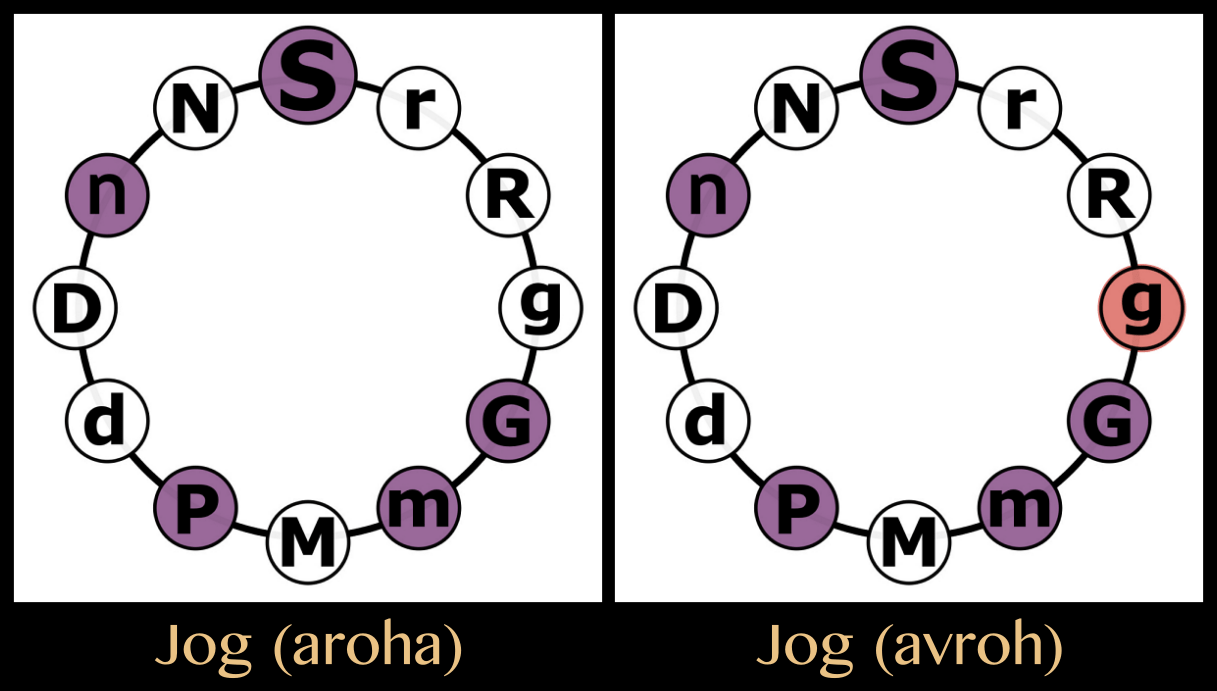

S-gG-m-D-n-S A low-high combination of Jog and Rageshri (SgGm+DnS) invented by Ravi Shankar and first released on a stellar 1980 album – although he was performing it at least 5 years before this: e.g. a 1975 rendition from an all-night concert in Varanasi. Jog’s strong shuddha Ga dominates the poorvang, while motions towards the uttarang […]

• Raag Jogeshwari •

• Raag Asa Bhairav •
S-rR-G-m-P-D-N-S A joining of Bhairav and the archaic Sikh form Asa (Sanskrit for ‘Hope’), matching the swaras of ‘Bilawal double-Re’ – with the shuddha taken in ascent, and the komal in descent. Parrikar notes that “the Bhairav-ang is expressed in the poorvang [e.g. Gm(G)rS], and the rest of the contour looks to Asa [e.g. S, S(m)RmP, […]

• Raag Ek Prakar ki Kauns •
S-gG-m-d-nN-S An invention of Imdadkhani sitarist Rais Khan (who, with a pleasing lack of pretention, named his new raga ‘A Type of Kauns’). From Martyn Clayton’s excellent liner notes to a 1985 Navras recording: “Indeed an unusual raga…Rais Khan’s ‘Ek Prakar ki Kauns’ is based on Malkauns, but incorporates two extra notes [shuddha Ga & […]

• Raag Gaurimanjari •
S-rR-G-mM-P-d-nN-S An intricate ten-toned raga created by Ali Akbar Khan via blending ideas from across the Lalit–Gauri spectrum (Gaurimanjari: ‘Bouquet of Gauris’) – notable for its winding melodic motions and dense, crowded swara-space (some renditions employ all swaras except komal ga). Its core form also possesses the ultra-rare property of rotational symmetry (i.e. the interval […]

• Raag Rang Malhar •
S-R-mM-P-D-nN-S From my 2018 Darbar interview with Rupak Kulkarni: “Rang Malhar happened by chance. It was the rainy season, and I was playing in a monsoon festival. I was the last performer, and by the time my turn came then all types of Malhar family ragas had been played already. I thought I should come […]

• Raag Jaun Bhairav •
S-rR-gG-m-P-d-nN-S A jod raga fashioned by Agra vocalist Jagannathbuwa Purohit ‘Gunidas’ (also the creator of Jogkauns and Swanandi), combining ideas from two well-known morning ragas – Jaunpuri and Bhairav. Parrikar points to to the “crowded swara-space”, with both komal and shuddha variants of Re, Ga, and Ni on display: meaning that the entire komal ni […]

• Raag Hemshri •
S-g-m-P-nN-S A night raga created by renowned Gwalior composer and vocalist Vishwanath Rao Ringe ‘Tanarang’, essentially equivalent to ‘Tilang komal ga’. In his own summary (seemingly the only source of melodic information): “the mood is light…a very sweet melody that manifests readily in the following combinations [e.g. SgmPm, gmPnPNNS; PNSnP; PNSgNS]”. Re is banned entirely, while […]

• Raag Bheem •
S-R-gG-m-P-D-n-S Near-identical to Gaoti, Bheem is sometimes said to be marked out by its allowance of komal ga in taar saptak – although this distinction now seems moot: there are plenty of Gaoti performances with this characteristic too. Debate persists: while Agra-Gwalior vocalist Prabhakar Karekar considers the ragas indistinguishable (having remarked that he “had been taught […]

• Raag Anand Bhairav •
S-r-G-m-P-D-nN-S A rarely-heard member of the Bhairav raganga, which seems to have no precise prakritis. As per Rajan Parrikar, “the komal dha in Bhairav is replaced by its shuddha counterpart, and the komal ni is parachuted into the scheme in an [avroh phrase] SDnP inspired by Bilawal (in Bhairav-ang ragas where either Re or Dha is rendered shuddha, […]

• Raag Ambika Sarang •
S-R-mM-P-D-nN-S According to Rajan Parrikar, Ambika Sarang is associated with Agra vocalist Chidanand Nagarkar, with “elements of Shuddha Sarang and Kafi blended together in a delicious cocktail” (as per his great-nephew Prasad Upasani, “The story goes that while teaching Shuddha Sarang, one student kept singing komal ni by mistake. This phrase stuck in his head, and […]

• Raag Purba •
S-r-G-mM-P-dD-N-S A rare raga of the Jaipur-Atrauli gharana, described by Rajan Parrikar as “essentially Raag Poorvi adorned with bells and whistles” – in particular, the Ma-mixing catchphrases Sm, mGP and MMPPd, dNdP. Refer to the Rajshekhar Mansur bandish transcribed below, which showcases uttarang forays of MP, PdNdP and a prominent M\G glide. Also recorded by […]

• Raag Sazgiri •
S-r-G-mM-P-dD-N-S Often described as being among the most complex of Hindustani forms, Sazgiri is fabled as a creation of Amir Khusro (1253-1325): the legendary Sufi poet, singer, and mystic of the Delhi Sultanate (although direct historical evidence for his authorship of the raga is admittedly scant). Komal dha is restricted to Poorvi-ang phrases such as […]

• Raag Monomanjari •
S-r-G-M-P-D-nN-S A scale with no apparent prakritis unveiled by sitar icon Nikhil Banerjee some time in the 1970s (in his own words: “I’m quite satisfied with one of my Sonodisc LPs, Raag Monomanjari: that’s my favourite so far…”). From Narendra Datar’s 1989 review of this record: “A jod raga…a remarkable combination of Kalavati and Marwa. […]

• Raag Madhuradhwani •
S-G-m-D-nN-S As per Parrikar, “Durga Khamaj-thaat is also known as ‘Madhuradhwani’. This is not a popular raga, its base eroded by the popularity of Rageshri…but is part of the Dagar family repertoire”. While some renditions will skip Ni in ascent, traditional Dhrupad presentations will render it shuddha in aroha and komal in avroh – along with […]

• Raag Lalita Sohini •
S-r-G-mM-D-N-S A blend of the early-morning Lalit and late-night Sohini, with the melodies of the latter dominating the aural impression, reportedly created by Agra vocalist Yunus Ahmed Khan in the mid-20th century. Raja notes that “while Sohini is a resident of the upper tetrachord, Lalit is a resident of the lower tetrachord. Thus, the resulting melodic entity […]

• Raag Devgiri Bilawal •
S-R-G-m-P-D-nN-S A fusion of Bilawal, Kalyan, and Shuddha Kalyan, which either avoids the tivra Ma throughout or relegates it to an ornamental role. Balancing an uttarang-focus with a tendency for melodic development in mandra and madhya saptak, the raga (as per Thakurdas) prioritises Ga and Dha, also using Pa as a nyas – with komal […]

• Raag Devgandhari Todi •
S-rR-gG-m-P-d-n-S A modification of Dev Gandhar, devised by Agra vocalist S.N. Ratanjankar via the addition of a Todi-ang rgrS conclusion phrase – thus filling the entire Sa-to-ma swara space. Also recorded by his student K.G. Ginde, who extends this hemitonic run (and leans further into Todi’s geometries) by including touches of shuddha Ni, also reworking some […]

• Raag Chandni Bihag •
S-G-mM-P-D-nN-S Chandni Bihag (‘Moonlit Bihag’) is a speciality of the Rampur khayal gharana which introduces the tense Ma–ni sangati to the basic framework of Bihag, further accentuated by a weak or absent Re – leaving two ‘4-row’ clusters (GmMP & DnNS), arranged symmetrically. Parrikar recounts the “enchanting tonal formulations” of his guru Ramrang’s rendition (passed down by […]

• Raag Bhairav Bahar •
S-rR-gG-m-P-D-nN-S A ten-toned multi-jod raga, Bhairav Bahar’s descent blends the melodic signatures of several disparate ragas, notably including the springtime Bahar – although, as per Darbhanga Dhrupad vocalist Premkumar Mallick, flavours of Bhairav should dominate the overall impression. Bose gives a vadi–samvadi of ma–Sa, while also mentioning the existence of an alternate ‘double-Dha’ version (thus […]

• Raag Abheri Todi •
S-rR-gG-m-P-d-n-S Summarised by musicologist and critic Rajan Parrikar as “an obscure Todi variant, in which strands of Asavari and Khamaj are tied to the Todi-ang“. His guru Ramrang’s rendition of the raga revolves around phrases such as PmPm\g; mPn\d; SRnS; rnSRG, whereas Srikant Bakre‘s take also visits the shuddha Dha (bandish transcribed in full below) – although […]

• Raag Faridi Todi •
S-r-gG-M-d-n-S A Todi variant known, as of 2025, through a single rendition: Supriyo Maitro’s spellbinding vocal tribute to his Dagarvani forebear Zia Fariduddin Dagar, live from the 2018 Faridi Samorah Festival in Bhopal with Aditya Deep on pakhawaj (“in remembrance of [Zia’s] 86th birthday, the festival was a musical tribute to the Ustad by his […]

• Raag Pancham se Pilu •
S-R-G-mM-P-D-nN-S A murchana rotation of Pilu (literally: ‘Pilu from Pa’) – i.e. if you treat this raga’s Pa as the ‘new Sa’, Pilu is produced (albeit in its somewhat less common ‘komal dha-less‘ form). Pilu’s doubled gG–nN swaras, separated by a perfect 5th, are thus spun into nN–mM (i.e. the murchana’s principal effect is to […]

• Raag Khat Todi •
S-r-g-mM-P-d-nN-S In Parrikar’s summary, Khat Todi is described as an “uncommon double-Ma prakar…mostly sung by Jaipur-Atrauli and Agra musicians. In the main body of Todi, a small phrase of Khat is introduced” (i.e. the raga is more like ‘Todi seasoned with Khat’ rather than a more equitable combo). He cites two different Khat strains used by […]

• Raag Milan Gandhar •
S-gG-P-D-n-S An enchanting yet ultra-rare raga created by pioneering Punjabi vocalist Salamat Ali Khan, running along the lines of ‘Kalavati with komal ga in avroh’ (often as PDPgS or SngS), bringing shades of Kafi. A 1965 Salamat & Nazakat performance in Kabul (bandish: Piya More Angan Aaye & Tana Dhere Na Dhim), emphatically places the […]

• Raag Tanseni Madhuvanti •
S-R-g-M-P-D-nN-S A captivating offshoot of Madhuvanti, named ‘Tanseni’ for its use of a Miyan ki Malhar-flavoured double-Ni sangati. Associated with the Rampur sarangi tradition, most prominently Hamid & Zahid Khan – as per the liner notes to Hamid’s ektal rendition: “it also resembles Multani…it is of Kafi parentage, with accents on Sa & Ma”. Thus […]

• Raag Sohini Pancham •
S-r-G-mM-P-D-N-S A variant of Sohini, named for its insertion of shuddha ma and Pa via phrases from Pancham including MGMGrS; MPGmG; MDMmG [n.b. many other raga names involving ‘Pancham’ indicate the inclusion of the swara position rather than the raga, e.g. ‘Pancham Malkauns‘]. Refer to renditions by Madhup Mudgal and Nisha Nigalye-Parasnis (singing a Pranpriya […]

• Raag Maligoura •
S-r-G-M-P-dD-N-S A sandhiprakash raga which draws on Puriya, Gauri, Marwa, and Shree. Depending on rendition, Dha may be komal (Ali Akbar Khan), shuddha (Ramprapanna Bhattacharya), or double (Khadim Hussain Khan) – with considerable cross-gharana variance in characteristic phraseologies. Maihar sarodiya Sayak Barua states that “NDNrNP is the heart of the raga”, and, as per Manjiri […]

• Raag Devata Bhairav •
S-r-gG-m-P-d-N-S A double-Ga Bhairav derivative introduced by Agra gharana pioneer Azmat Hussain Khan ‘Dilrang’. As per Parrikar, the raga is distinguished from its parent with “the introduction of [an] avroh pragoya via the komal ga [mgrS]”. Some artists include subtle touches of komal ni, including Jitendra Abhisheki – who sings a madhyang-focused bandish (to me, reminiscent of […]

• Raag Chandni Kedar •
S-R-G-mM-P-D-nN-S A loosely-organised set of Kedar variations, Chandni Kedar (‘Moonlight Kedar’) is formed via minor modifications to its parent raga. As per Parrikar, who recommends a Kesarbai Kerkar mehfil rendition (Eri Ina Naina), “some suggest strengthening the komal ni and shuddha Ga in standard Kedar…others [suggest] Kedar with an added komal ni” – while Ocean […]

• Raag Basanti Kanada •
S-r-G-mM-P-D-nN-S Perhaps the only Kanada raga to give prominence to tivra Ma (which appears in Basant-like poorvang motions such as GMDMG; MGrS), Basanti Kanada is a thinly-analysed form which summons idiosyncratic tensions via a precise mixing of seemingly incongruous elements (e.g. from the bandish below: DmG, GMdM\G, MGrS). Predominantly associated with vocalists of the Jaipur-Atrauli […]

• Raag Bahaduri Todi •
S-rR-g-m-P-d-n-S Described by Parrikar as “an exceedingly beautiful raga, known for aesthetic unity in spite of its convoluted structure…the disparate constituents are tied together by special sancharis, and the intonation is mediated by meends”. He cites two distinct versions of the raga in modern circulation (neither of which appear to be linked to the Carnatic […]

• Raag Bageshri Bahar •
S-R-g-m-P-D-nN-S A blend of the late-night Bageshri and the springtime Bahar, most prominently recorded by Bhimsen Joshi (below: from his 1997 Rarely-Heard Ragas album, also featuring Hindolita & Jaijaiwanti Nat: although the actual recording session appears to have taken place in 1980). Matches the swara set of ‘Kafi double-Ni’, and is thus prakriti with several […]

• Raag Vardhini •
S-gG-m-P-d-n-S Adapted from Carnatic music’s mela #32 (‘Ragavardhini’: strictly speaking, the Northern form should perhaps be spelled this way too), Vardhini matches the swaras of Nandkauns or ‘Jogkauns komal ni’. Seemingly introduced to the Northern ragascape via the Dagarvani Dhrupad – as per information kindly supplied by Pelva Naik, “Vardhini came into the Dagar gharana, as far […]

• Raag Noor Sarang •
S-R-mM-P-D-N-S A rare raga of the Sarang family, around which there exists limited melodic consensus. As per Abhirang’s account, “when we only use tivra Ma in Shuddha Sarang, it is converted to Noor Sarang…in avroh, the Dha is kept ‘free’ [e.g. ornamented D(NP)]” – also noting its proximity to Jaymini Sarang (both Ni). Dhrupad interpretations […]

• Raag Nagadhwani Kanada •
S-R-gG-m-P-D-nN-S A hazily-codified raga of uncertain origin, Nagadhwani Kanada is seldom performed today – although the term ‘Nagadhwani’ (‘Sound of Serpents’) seemingly appears in ancient lakshanagranthas including the 13th-century Sangita Ratnakara (‘Ocean of Music and Dance’). Joydeep Mukherjee’s Mohanveena rendition lies close to Patdeep, placing particular emphasis on shuddha Dha, while Pandit Jasraj’s Kafi-tilted bandish […]

• Raag Gaud Sarang •
S-R-G-mM-P-D-N-S Aside from its afternoon designation, Gaud Sarang typically carries few hints of the Sarang family – running more like a vakra Bihag variant seasoned by a GRmGPRS pakad amongst other melodic quirks (some refer to it as ‘Din ki Bihag’: ‘Daytime Bihag’). Shuddha ma is strong, but not used as a nyas, with its enclosing […]

• Raag Lagan Gandhar •
S-R-gg̃G-P-D-S An oddball product of Kumar Gandharva’s limitless imagination, Lagan Gandhar (‘Full Ga Concentration’) is distinguished by taking a ‘triple-Ga’ – with an additional ‘quarter-tone’ sruti lying roughly halfway between the komal and shuddha shades (‘komalaa gandhar’: notated here as ‘g̃’). This strange tone-trio is often navigated in adjacent manner, with slow glides serving to […]

• Raag Shukla Bilawal •
S-R-G-m-P-D-nN-S A traditional Bilawal prakar, marked out by phrase patterns such as SGGm, GmPm and a general focus on shuddha ma, also integrating movements from the Malhar, Khamaj, and Kedar families. Jaipur-Atrauli vocalist Manjiri Asanare-Kelkar’s detailed demo breakdown (transcribed in full below) describes it as “a complex raga, with major phrases of Gaud Malhar and Bihagda […]

• Raag Shankara Karan •
S-R-G-M-P-D-nN-S Associated with the crisp mornings of springtime, Shankara Karan is variously said to blend elements of Shankara, Shree, Hindol, and Yaman – although its swara set (‘Yaman double Ni’) is seldom-heard in the Hindustani ragascape (also hear the ultra-rare Guru Kalyan & Kala Kalyan). Recordings are rare, with the most prominent cut being a 1995 […]

• Raag Sanjh Saravali •
S-R-G-mM-P-D-N-S Taking the general form of ‘Yaman Kalyan seasoned with Bihag’, Sanjh Saravali (‘Evening Melody’) was devised by Vilayat Khan in the late 1970s. Fellow Imdadkhani sitarist Deepak Raja, aided by input from Vilayat himself, describes the raga as “incorporating fleeting impressions of several Kalyan ragas, including Nand Kalyan and Chayanat…its melodic identity rests on […]

• Raag Roopkali •
S-rR-G-mM-P-d-N-S A variation of Ramkali, which is distinguished through a general avoidance of komal ni and sporadic inclusion of shuddha Re. Renditions generally focus on the mid-scale region, with all five specific swaras from shuddha Ga to komal dha available for use (GmMPd). Khadim Hussain Khan’s twisting melodies tend to pair tivra Ma with Pa above, […]

• Raag Pat Bihag •
S-R-G-mM-P-D-N-S A chalan bheda of Bihag, which varies according to gharana. Tivra Ma is generally restricted to ornamental use, while Jaipur-Atrauli singers may showcase a range of additional melodic quirks. In Parrikar’s summary, “most of its mannerisms are Bihag-like, the notable departure being its ‘glowing’ shuddha ma: deergha and mukta” – also see his rundown […]

• Raag Pancham se Gara •
S-R-G-mM-P-D-nN-S A rotation of Gara (literally: ‘Gara from Pa’) – i.e. if you treat the raga’s Pa as the ‘new Sa’, Gara’s scale is produced (SRGmMPDNS > SRgGmPDNS: although the raga’s creation in fact came via the reverse translation). Most closely associated with murchana master Ravi Shankar, who reworks Gara’s DnSNS uttarang catchphrase into GmPMP (see […]

• Raag Neelambari •
S-R-gG-m-P-D-n-S A blend of the allied Kafi and Sindhura, brought into being by revered Gwalior vocalist Omkarnath Thakur some time prior to 1936 (n.b. it bears no discernible connections to the Carnatic raga of the same name). Parrikar points to “two special pathos-imbuing prayogas: the melodic molecule DngR, and the chromatic avroh slide from shuddha […]

• Raag Lalit Pancham •
S-r-G-mM-P-D-N-S A title applied to various offshoots of Lalit which add some combination of Pa and shuddha Dha to the basic SrGmMdNS swara set, often removing komal dha in the process. Many such incarnations draw from Shuddha Basant (a raga which features Pa and, depending on variant, either form of Dha: Ulhas Kashalkar notes that […]

• Raag Khokar •
S-G-m-P-D-nN-S A captivating raga with disparate modern strands. In its predominant Jaipur-Atrauli incarnation, Khokar is, according to some, essentially identical to Bihagda, itself a fusion of Bihag and Khamaj (Deepak Raja: “A melodic analysis of the so-called Khokar confirms its identity with Bihagda…[any] distinction remains unsupported by either logic or evidence”). On the other hand, […]

• Raag Jait •
S-rR-G-P-D-S A charming audav raga with several disparate branches. In particular, the treatment of Re varies (some render it komal, and others shuddha, while Jaipur-Atrauli singers employ both forms) – with Dha, which must be taken vakra, also showing up in both its variants (albeit not within the same performance). Indeed, even renditions by the […]

• Raag Jaijaiwanti Nat •
S-R-gG-m-P-D-nN-S A barely-explored compound of Jaijaiwanti and Shuddha Nat, which blends the basic structure of the latter raga with flourishes from the former. The only renditions I can trace are those of Bhimsen Joshi, who may be the raga’s inventor (although some sources suggest the great Jaipur-Atrauli guru Azizuddin Khan instead) – beginning in the […]

• Raag Hussaini Todi •
S-R-g-m-P-D-nN-S A rare raga which appears in at least two modern-day variants. The predominant Jaipur-Atrauli interpretation takes the swaras of ‘Kafi double-Ni’, eschewing the Todi-ang altogether: Manjiri Asanare-Kelkar’s ever-excellent melodic breakdown describes it as “Desi with a ‘Hussaini’ phrase” [a sruti-laden mPD, S(nSN)S, m, mPDnS] – adding that this phrase also turns up in the ‘other’ […]

• Raag Virat Bhairav •
S-r-G-m-P-dD-n-S A ‘double Dha Bhairav’ raga with a unique swara set, associated with Jaipur-Atrauli vocalists including Nivruttibuwa Sarnaik (who, according to gharana stablemate Gandhar Digrajkar, invented it). In addition to Bhairav’s classic G\rS swoop and general poorvang-focus, Parrikar notes “a rather busy uttarang: shuddha Dha is used sparingly, in special sancharis such as GmPDnDn and […]
