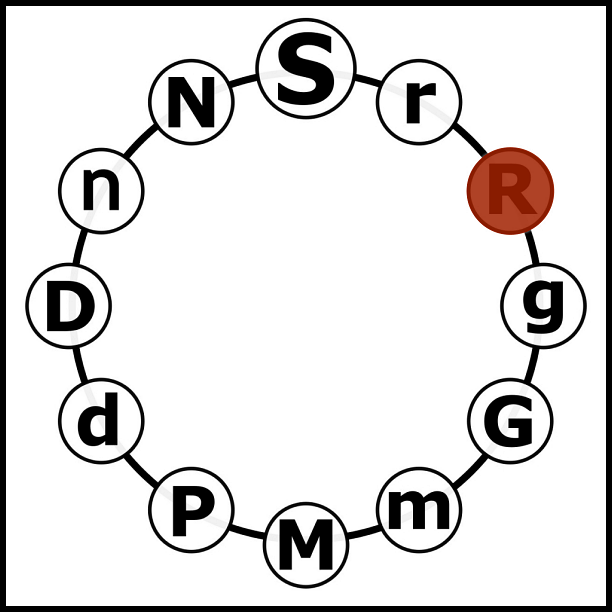

S-r-g-P-D-n-S A rare ‘Ahiri no ma’ scale, combining a Bhupali Todi-like poorvang with an Ahir Bhairavic uttarang (Srg+PDnS) As per Parrikar: “S.N. Ratanjankar conceived of this raga…ma is eliminated to yield the following contour: SrgPDnDS; SnDPgPrgrS. Brilliantly exploited by Jitendra Abhisheki in a celebrated natyageeta. Watch out for the injection of a vivadi dosha via […]

• Raag Salagavarali •

• Raag Purba •
S-r-G-mM-P-dD-N-S A rare raga of the Jaipur-Atrauli gharana, described by Rajan Parrikar as “essentially Raag Poorvi adorned with bells and whistles” – in particular, the Ma-mixing catchphrases Sm, mGP and MMPPd, dNdP. Refer to the Rajshekhar Mansur bandish transcribed below, which showcases uttarang forays of MP, PdNdP and a prominent M\G glide. Also recorded by […]

• Raag Prabhakali •
S-r-G-m-P-d-n-S An Ali Akbar Khan invention, prakriti with the better-known Basant Mukhari. Information is scant – but, as per the liner notes to the raga’s 1964 LP release, “Prabhakali permits only five notes in aroha, dropping [Ga & Ni]. For avroh, it admits all the seven notes…[re & dha] are flats as in Bhairav, and […]

• Raag Monomanjari •
S-r-G-M-P-D-nN-S A scale with no apparent prakritis unveiled by sitar icon Nikhil Banerjee some time in the 1970s (in his own words: “I’m quite satisfied with one of my Sonodisc LPs, Raag Monomanjari: that’s my favourite so far…”). From Narendra Datar’s 1989 review of this record: “A jod raga…a remarkable combination of Kalavati and Marwa. […]

• Raag Malay Marutam •
S-r-G-P-D-n-S ‘Malay Marutam’ translates as ‘Fragrant Hill-Breeze’. Maihar bansuriya Rupak Kulkarni explained to me in a 2018 interview how the raga “is from Carnatic music, which does not give so much attention to the times of day. We have decided to designate it as a morning raga, mainly due to the nature and essence of […]

• Raag Lalita Gauri •
S-r-G-mM-P-dD-N-S Spanning a diverse range of ‘Lalit + Gauri‘ experiments, the name ‘Lalita Gauri’ essentially refers to the general concept of fusing these two ragas rather than a specific melodic form. The most prominent modern incarnation was created by Jaipur-Atrauli vocalist Kesarbai Kerkar (who often employed it as a concert centrepiece), although differing forms of the […]

• Raag Kalingada •
S-r-G-m-P-d-N-S Kalingada shares the same seven swaras as Bhairav, but approaches them in distinct fashion – generally preferring a simpler, less ornamented character (as per Rajan Parrikar: “Kalingada has a flippant mien…far less austere than Bhairav. Ga and Pa are advanced to positions of influence, and the swara-lagav is mostly linear, without the andolit treatment […]

• Raag Jogeshwari Pancham •
S-gG-m-P-D-n-S Created by Gwalior educator and vocalist Vishwanath Rao Ringe ‘Tanarang’ by adding touches of avroh Pa to Ravi Shankar’s Jogeshwari (itself a blend of Jog and Rageshri). Jogeshwari’s basic phraseology is retained, while also allowing elaborate extensions into Jog’s territory (the inclusion of komal ga means that all Jog’s swaras are now present). In […]

• Raag Hemshri •
S-g-m-P-nN-S A night raga created by renowned Gwalior composer and vocalist Vishwanath Rao Ringe ‘Tanarang’, essentially equivalent to ‘Tilang komal ga’. In his own summary (seemingly the only source of melodic information): “the mood is light…a very sweet melody that manifests readily in the following combinations [e.g. SgmPm, gmPnPNNS; PNSnP; PNSgNS]”. Re is banned entirely, while […]

• Raag Deen Todi •
S-r-g-m-D-n-S A near-extinct raga of uncertain origin, Deen Todi takes an ‘Ahiri no Pa’ form. Best preserved via an astonishing rendition by Kamalesh Maitra on the tabla tarang (a semicircle of 13 sruti-tuned dayan drums: below), accompanied by a multiphonic cluster of tanpura drones (tuned D-n-r-S). Parveen Sultana has also sung it live, and seems to […]

• Raag Bhankari •
S-r-G-mM-P-D-N-S A complex blend of several ragas, Bhankari was created by Gwalior guru Ramashreya Jha ‘Ramrang’. His student Rajan Parrikar describes it as a “tantalizing melody blending facets of Bhatiyar, Jait, Bibhas, and Deshkar, while retaining an aesthetic coherence in the end product”. Ramrang’s renditions also overlap significantly with some interpretations of Bhankar – an […]

• Raag Anand Bhairav •
S-r-G-m-P-D-nN-S A rarely-heard member of the Bhairav raganga, which seems to have no precise prakritis. As per Rajan Parrikar, “the komal dha in Bhairav is replaced by its shuddha counterpart, and the komal ni is parachuted into the scheme in an [avroh phrase] SDnP inspired by Bilawal (in Bhairav-ang ragas where either Re or Dha is rendered shuddha, […]

• Raag Chandrakauns •
S-g-m-d-N-S Chandrakauns is a spacious raga of relatively modern origin, only becoming distinct from divergent strains of ‘shuddha Ni Malkauns’ by around the mid-20th century. This Ni-for-ni replacement removes much of Malkauns’ symmetry and intervallic balance, with the chromatic leading-tone resolution (Ni>Sa) bringing more prominence to both swaras. Given these sharper tensions, it is often played […]

• Raag Zeelaf •
S-G-m-P-d-S A rare audav raga fabled to have been created by 13th-century qawwali pioneer Amir Khusrau, somewhat resembling ‘Bhairav minus re & Ni’. As per Rajan Parrikar, “this haunting pentatonic melody is composed of the following swaras: SGmPd. Jitendra Abhisheki gives a superb account with his own composition [transcribed below]: notice the strong ma and […]

• Raag Sundarkauns •
S-g-m-D-n-S There are at least two ragas in modern circulation which go by the title ‘Sundarkauns’, which appear to share no connection other than their name. One version, taking the swaras SgmDnS (‘Malkauns shuddha Dha’), is described by Tanarang as having been unjustly sidelined by previous generations, who have tended to misinterpret it as a ‘Bageshri-ang Chandrakauns’ […]

• Raag Sonakshi •
S-r-G-mM-P-dD-N-S From my 2018 Darbar interview with Maihar bansuri maestro Rupak Kulkarni: “I created Sonakshi [‘Golden-Eyed‘] so I could experience a raga which was suitable for any time of day. I believe we have different mindsets depending on the hour: in the morning our mood is spiritual and fresh, and in the evening it is […]

• Raag Shivmat Bhairav •
S-r-gG-m-P-d-nN-S Shivmat Bhairav can be described as a blend of Bhairav, Bhairavi, and Todi, with the former being the most dominant over the sound (‘Bhairav double Ga/Ni’). Relatively rare in modern times, the raga brings out Bhairav via GmrS phrases and oscillations on the komal re – while also incorporating komal ga and ni in […]

• Raag Chandni Todi •
S-r-g-M-P-D-n-S Equivalent to ‘Todi’s poorvang + Kafi’s uttarang‘ (or ‘Ahiri tivra Ma’), the SrgM+PDnS scale has barely been explored in Hindustani music – in fact, I couldn’t trace a single recording of it until late 2025, when vocalist Ashish Dha sent me his experiment in a new raga titled Chandni Todi (‘Moonlit Todi’). He describes […]

• Raag Sazgiri •
S-r-G-mM-P-dD-N-S Often described as being among the most complex of Hindustani forms, Sazgiri is fabled as a creation of Amir Khusro (1253-1325): the legendary Sufi poet, singer, and mystic of the Delhi Sultanate (although direct historical evidence for his authorship of the raga is admittedly scant). Komal dha is restricted to Poorvi-ang phrases such as […]

• Raag Saheli Todi •
S-r-g-P-d-n-S An invention of vocalist Kumar Gandharva, lying between Bhupali Todi and Bilaskhani Todi via the addition of an avroh komal ni to the former (or the subtraction of ma from the latter). His original renditions linger patiently on the komal re (intoned with a noticeably higher sruti than usual), and often avoid rising more […]

• Raag Puriya Kalyan •
S-r-G-M-P-D-N-S Effectively combining the poorvang of Puriya Dhanashree with the uttarang of Yaman (SrGM+PDNS), Puriya Kalyan covers the seven swaras of Marwa thaat. Pa is prominent in descent, but may be skipped in Kalyanic ascending passages such as MDNS – and Sa is often omitted in both upward and downward motions, with mandra saptak Ni […]

• Raag Prabhat (Bhairav) •
S-r-G-mM-P-d-N-S A morning form (Prabhat: ‘dawn’) summarised by Bose as “a combination of three or four ragas dominated by the Bhairav-ang…with a touch of Lalit-ang only in the avroh , where both Ma come together…The vadi Ma separates Prabhat Bhairav from Bhairav, while Pa keeps it away from Lalit” (also see the nearby Lalit Pancham). Pakad […]

• Raag Pancham Malkauns •
S-g-m-P-d-n-S A loose collection of melodic strands which fall under the general banner of ‘Malkauns with Pa in avroh’ (thus sharing conceptual overlap with Kaunsi Kanada and Sampurna Malkauns). Ascents typically stay true to the pentatonic structure of Malkauns, and the Pa is usually rendered in vakra avroh lines (e.g. ndmgmdP or gmdndmP). Beloved by […]

• Raag Meghranjani •
S-r-G-mM-N-S A truly odd scale form, Meghranjani can be interpreted as either ‘Bhairav minus Pa & dha‘ (SrGmNS) or ‘Lalit minus dha‘ (SrGmMNS) – producing a strange shape which omits two consecutive generic swaras (as far as I can discern, Adbhut Kalyan, Devranjani, and Malashree are the only other such ragas). Originally borrowed from the Carnatic […]

• Raag Madhuradhwani •
S-G-m-D-nN-S As per Parrikar, “Durga Khamaj-thaat is also known as ‘Madhuradhwani’. This is not a popular raga, its base eroded by the popularity of Rageshri…but is part of the Dagar family repertoire”. While some renditions will skip Ni in ascent, traditional Dhrupad presentations will render it shuddha in aroha and komal in avroh – along with […]

• Raag Lalita Sohini •
S-r-G-mM-D-N-S A blend of the early-morning Lalit and late-night Sohini, with the melodies of the latter dominating the aural impression, reportedly created by Agra vocalist Yunus Ahmed Khan in the mid-20th century. Raja notes that “while Sohini is a resident of the upper tetrachord, Lalit is a resident of the lower tetrachord. Thus, the resulting melodic entity […]

• Raag Khat Todi •
S-r-g-mM-P-d-nN-S In Parrikar’s summary, Khat Todi is described as an “uncommon [double-Ma] prakar…mostly sung by Jaipur-Atrauli and Agra musicians. In the main body of Todi, a small phrase of Khat is introduced” (i.e. the raga is more like ‘Todi seasoned with Khat’ rather than a more equitable combo). He cites two different Khat strains used […]

• Raag Jogiya •
S-r-m-P-d-N-S Jogiya (from Sanskrit yogi: ‘State of Union’) is a shadav raga of considerable mystique. Tanarang recounts “a characteristic mood of devotion and detachment…Jogiya has komal re and dha like Bhairav, however they are not oscillated…and shuddha ma is powerful as nyas and vadi”. Generally expandable in madhya and taar saptaks, the raga’s geometries revolve […]

• Raag Gunakri •
S-r-m-P-d-S Taking the swaras of ‘Bhairav no Ga/Ni’, Gunakri – described by AUTRIM as “serious and peaceful” – brings out the character of its parent raga via an oscillating komal re, and movements patterns including Sd, dP and SdSr, rS (although Jairazbhoy prefers to analyse it via the geometries of Basant Mukhari). Bose gives a […]

• Raag Gopika Basant •
S-g-m-P-d-n-S A hexatonic raga of bewitching beauty, Gopika Basant matches the swaras of ‘Asavari no Re’ (or ‘Malkauns add Pa’) – while also inviting shades of Bhairavi from ga upwards. The Sa–ma sangati is strong, and, as noted by Nazir Ali Jairazbhoy, descents can mirror the Malkauns-style scheme of “parallel conjunct tetrachords by oblique use […]

• Raag Dhani •
S-g-m-P-n-S Despite its ‘Minor Pentatonic’ scale form enjoying global popularity as the predominant mode of blues, rock, pop, and countless other guitar-driven genres, Dhani is comparatively rare as a raga in its own right – with its swara set mostly being heard as the ‘aroha of Bhimpalasi’ rather than in isolation (…it may be the […]

• Raag Devranjani •
S-m-P-d-N-S Stretched by the emptiness of a vast Sa–ma poorvang jump, Devranjani is formed by removing the re and Ga from Bhairav. Abhirang offers up both ‘shuddha Ni’ and ‘double Ni’ variants, with the former appearing to be predominant – while Bhatkhande’s early 20th-century works discuss the unavoidable strength of the ascending phrase Sm, mP […]

• Raag Devata Bhairav •
S-r-gG-m-P-d-N-S A double-Ga Bhairav derivative, introduced by Agra gharana pioneer Azmat Hussain Khan ‘Dilrang’. As per Parrikar, the raga is distinguished from its parent with “the introduction of [an] avroh pragoya via the komal ga [mgrS]”. Some artists include subtle touches of komal ni, including Jitendra Abhisheki – who sings a madhyang-focused bandish (to me, reminiscent of […]

• Raag Chandramadhu •
S-g-M-P-n-S An angular pentatonic form conjured up by vocalist Amir Khan only a short time before his untimely death in a 1974 car accident – indeed, it is unclear if he ever formally named his new creation (I’ve seen it referred to as ‘Bhushwati’ and ‘Amarpriya’, and at least two releases just list it as […]

• Raag Chandni Bihag •
S-G-mM-P-D-nN-S A speciality of the Rampur khayal gharana, which introduces the tense Ma–ni sangati to the basic framework of Bihag, further accentuated by a weak or absent Re – leaving two ‘4-row’ clusters (GmMP & DnNS), arranged symmetrically. Parrikar recounts the “enchanting tonal formulations” of his guru Ramrang’s rendition (passed down by his own guru Bholanath […]

• Raag Bihad Bhairav •
S-r-gG-m-P-D-nN-S A ‘double-Ga, double-Ni’ creation of Bhairav-loving vocalist Kumar Gandharva (also see Bhavmat Bhairav and Rati Bhairav – as well as Saheli Todi, Lagan Gandhar, and Madhusurja). Bose describes how “the projection of the raga is done mainly around Sa…the aroha poorvang is similar to Jogiya [Srm: also Gunakri], and it has a small portion […]

• Raag Baradi •
S-r-G-M-P-D-N-S A long-lived and diffuse sonic lineage variously referred to as ‘Baradi’, ‘Barari’, ‘Varati’, and ‘Varali’, which appears in several overlapping modern forms, typically spanning the territory around Marwa thaat (Bhatkhande’s Sangeet Shastra Vol.3, published around a century ago, notes 13 distinct variants). Some artists omit tivra Ma, and others may add komal dha (‘Poorvi–ang’) – […]

• Raag Adarangi Todi •
S-r-g-mM-P-d-nN-S A double-ma, double-ni Todi variant linked to 18th-century composer Naimat Khan ‘Sadarang’ and his nephew Feroze Khan ‘Adarang’, who served at the court of Mughal Emperor and prolific arts patron Muhammad Shah. While the raga’s historical lineage remains half-sketched, Ali Akbar Khan took to performing it later in his career. Sometimes given the alternate title […]

• Raag Bhankar •
S-r-G-mM-P-dD-N-S Bhankar is a complex morning form which introduces Lalit-flavoured phrases to the basic framework of Bhatiyar. Manjiri Asanare-Kelkar cites two main variants sung in her Jaipur-Atrauli gharana, one of which also features touches of Bhairav – with both versions sharing common phrases including Bhatiyar’s Sm mPG, MDS and Lalit’s NdMm, GmMmG. She also elucidates how […]

• Raag Bhatiyar •
S-r-G-mM-P-D-N-S A dawn raga fabled as a creation of Raja Bharthari, a mythical King of Ujjain who is said to have left behind his life of material wealth and romantic pleasure to pursue a path of ascetic devotion (“Bharthari resolves to kill a black buck, and seek diksha [initiation rites] from the yogi…As the plan […]

• Raag Reva •
S-r-G-P-d-S A rare pentatonic raga, Reva is often described as the ‘evening counterpart’ to Bibhas (or the ‘jawab to its sawal’), matching this samay designation by taking after the Poorvi–ang rather than Bibhas’ Bhairav-ang roots. Chiefly, its movements are distinguished from Bibhas via poorvang-focused sangatis including Gr; rS; SrrS, along with a greater exploration of […]

• Raag Nandkauns •
S-gG-m-P-d-n-S A poorvang–uttarang blend of Jog and Malkauns (despite the name, there are no traces of Nand). Shuddha ma, as the natural meeting point between both ragas, assumes the most prominence (sometimes hinting at a ma-murchana of SRgmPnNS) – along with frequent use of a highly expressive n\P glide. Remains rare on the concert platform, […]

• Raag Milan Gandhar •
S-gG-P-D-n-S An enchanting yet ultra-rare raga created by pioneering Punjabi vocalist Salamat Ali Khan, running along the lines of ‘Kalavati with komal ga in avroh’ (often as PDPgS or SngS), bringing shades of Kafi. A 1965 Salamat & Nazakat performance in Kabul (bandish: Piya More Angan Aaye & Tana Dhere Na Dhim), emphatically places the […]

• Raag Din ki Puriya •
S-r-G-M-d-N-S Din ki Puriya (‘Daytime Puriya’) sets its six swaras to the general phrase patterns of the Puriya–ang, avoiding Pa throughout. The scale’s ‘palindromic hexagon’ places a tight hemitonic cluster (NSr) opposite a wider tone-trio (GMd), also providing an augmented ‘equilateral triangle’ (SGd). Melodic motions remain fairly free, given the lack of any prakriti ragas […]

• Raag Dhavalshree •
S-r-G-M-P-dD-N-S A Shree-ang monsoon raga which presents in multivariate modern forms, with particular variance evident in the status of Dha. Kishori Amonkar’s Jaipur-Atrauli interpretation adds shuddha Dha to the basic framework of Jaitashree, whereas Mallikarjun Mansur’s take renders dha komal amidst Shree-ang motions such as rNdP, also showcasing a strong SGP sangati and chayas of […]

• Raag Tilang •
S-G-m-P-nN-S A folk-derived Khamaj raga featuring distinctive double-Ni interplay, seemingly of ancient Southern origin (Bor: “Tilang probably originated in Telangana, and may have been introduced to the North by an unknown 15th-to-16th-century poet-composer“). Dha is varjit, and shuddha Re is typically omitted too (although some may occasionally include it swara in taar saptak). Parrikar suggests […]

• Raag Sundarkali •
S-r-G-P-n-S A relatively straightforward audav raga, Sundarkali takes the swaras of ‘Ahir Bhairav no ma/dha’ (n.b. the same name is also used separately as an alternate title for ‘Paraj Bhairav’). Anjani Kumar Gupta’s concise bansuri rendition is the only full recording I could find (alap transcribed below), although Tanarang’s disciple Prakash Vishwanath Ringe has released a […]

• Raag Sohini Pancham •
S-r-G-mM-P-D-N-S A variant of Sohini, named for its insertion of shuddha ma and Pa via phrases from Pancham including MGMGrS; MPGmG; MDMmG [n.b. many other raga names involving ‘Pancham’ indicate the inclusion of the swara position rather than the raga, e.g. ‘Pancham Malkauns‘]. Refer to renditions by Madhup Mudgal and Nisha Nigalye-Parasnis (singing a Pranpriya […]

• Raag Rajeshwari •
S-g-m-D-N-S Taking the swaras of ‘Kaushik Dhwani komal ga’ (or ‘Chandrakauns shuddha Dha’), Rajeshwari’s five tones bring an idiosyncratic flavour, tied with diffuse tensions. All poorvang swaras are set to their lowest specific position (Sgm), and all uttarang swaras are set to their highest (DNS), with the relief-bringing Re–Pa axis banished throughout. The resulting scale […]

• Raag Mangal Todi •
S-r-g-mM-P-d-nN-S A variant of Todi, seemingly of ancient origin, involving the addition of shuddha ma via phrases such as Smmd and MdndPmmd. Ram Marathe’s rendition, built around energetic mixing of both Ma and Ni positions, is probably the most prominent interpretation – with Shounak Abhisheki’s 2021 lockdown take building superbly on these ideas, setting bewildering […]

• Raag Mangal Gujari •
S-r-g-M-d-n-S A strange shadav scale matching the swara set of ‘Gujiri Todi komal ni’, ‘Tivrakauns add komal re’, or ‘Meladalan minus shuddha ma’. Its structure presents a unique combination of geometric quirks: Sa is ‘detached’ (=Pa and ma are both varjit), and all other swara positions are vikrit (rgdn: komal, M: tivra) – leaving the […]

• Raag Maligoura •
S-r-G-M-P-dD-N-S A sandhiprakash raga which draws on Puriya, Gauri, Marwa, and Shree. Depending on rendition, Dha may be komal (Ali Akbar Khan), shuddha (Ramprapanna Bhattacharya), or double (Khadim Hussain Khan) – with considerable cross-gharana variance in characteristic phraseologies. Maihar sarodiya Sayak Barua states that “NDNrNP is the heart of the raga”, and, as per Manjiri […]

• Raag Dakshinatya Basant •
S-r-G-m-P-D-N-S A springtime raga described by sarodiya Joydeep Mukherjee as “very rare…adapted from Carnatic music” (hear him play it on “a very rare instrument, the Radhika Mohanveena”, created by Radhika Mohan Maitra in 1948 – accompanied by Subhasish Sabyasachi, “the first ambidextrous percussionist of India“). The name translates as ‘Southern Basant’ (to distinguish it from the […]

• Raag Bhinna Shadja •
S-G-m-D-N-S Often characterised as the ‘older form’ of today’s Kaushik Dhwani, Bhinna Shadja’s lineage stretches back well over 1000 years. It appears in numerous ancient shastras: notably including Matangamuni’s Brihaddeshi (~8th-century), Abhinavagupta 11th-century writings (“Bhinnashadaja, Kaushiki, and Bhinnapanchama are favoured in Summer”), and Sarangdeva’s 13th-century Sangita Ratnakara – which describes its scale form in remarkably […]

• Raag Bhavmat Bhairav •
S-r-G-mM-P-D-n-S A curious fusion of concepts from two famous morning ragas – Bhairav and Lalit – devised by the gharana-blending Kumar Gandharva around the 1970s (also see his Bihad Bhairav, Rati Bhairav, Saheli Todi, Lagan Gandhar, & Madhusurja). Sadly, few recordings seem to exist – refer to Gandharva’s classic renditions for starters (e.g. Kantha Re […]

• Raag Bhatiyari Bhairav •
S-r-G-m-P-D-N-S A hybrid of two morning ragas: Bhairav and Bhatiyar. While movements of the latter take centre-stage, its typical PGrS descending phrase is replaced by Bhairav’s GmG\rS signature: Ramrang offers indicative patterns including Sm; mPGm; GmPDNP; DmPGmP; DNr; NDP; GmPmrS; PGmrS, occasionally seasoned with tivra Ma via MDS [n.b. ‘Bhairav-Bhatiyar’, though built from the same […]

• Raag Basanti Kanada •
S-r-G-mM-P-D-nN-S Perhaps the only Kanada raga to give prominence to tivra Ma (which appears in Basant-like poorvang motions such as GMDMG; MGrS), Basanti Kanada is a thinly-analysed form which summons idiosyncratic tensions via a precise mixing of seemingly incongruous elements (e.g. from the bandish below: DmG, GMdM\G, MGrS). Predominantly associated with vocalists of the Jaipur-Atrauli […]

• Raag Bangal Bhairav •
S-r-G-m-P-d-S A distinctive Bhairav raganga offshoot with uncertain origins, summarised in oddly poetic fashion by MeetKalakar: “Being Nishad-taboo, its caste is shadav. Dhaivat and Rishabh are used softly…which are respectively the plaintiffs” (n.b. the ultra-rare Meghranjani is the only other ‘shadav Bhairav’ raga I can definitively trace). Performed by only a handful of khayal vocalists […]

• Raag Vardhini •
S-gG-m-P-d-n-S Adapted from Carnatic music’s mela #32 (‘Ragavardhini’: strictly speaking, the Northern form should perhaps be spelled this way too), Vardhini matches the swaras of Nandkauns or ‘Jogkauns komal ni’. Seemingly introduced to the Northern ragascape via the Dagarvani Dhrupad – as per information kindly supplied by Pelva Naik, “Vardhini came into the Dagar gharana, as far […]

• Raag Triveni •
S-r-G-P-d-N-S Taking a hexatonic ‘Shree/Bhairav no ma’ swara set, Triveni’s main incarnation (also known as ‘Tirban/Tirvan’) comprises two congruent swara-clusters – SrG & PdN (both semitonal jumps of ‘1-3’). Melodic motions mostly take after Shree and Bhairav, particularly via a strong re–Pa sangati and G\rS descents – both evident in Shounak Abhisheki’s jhaptal bandish (Kalindi […]
